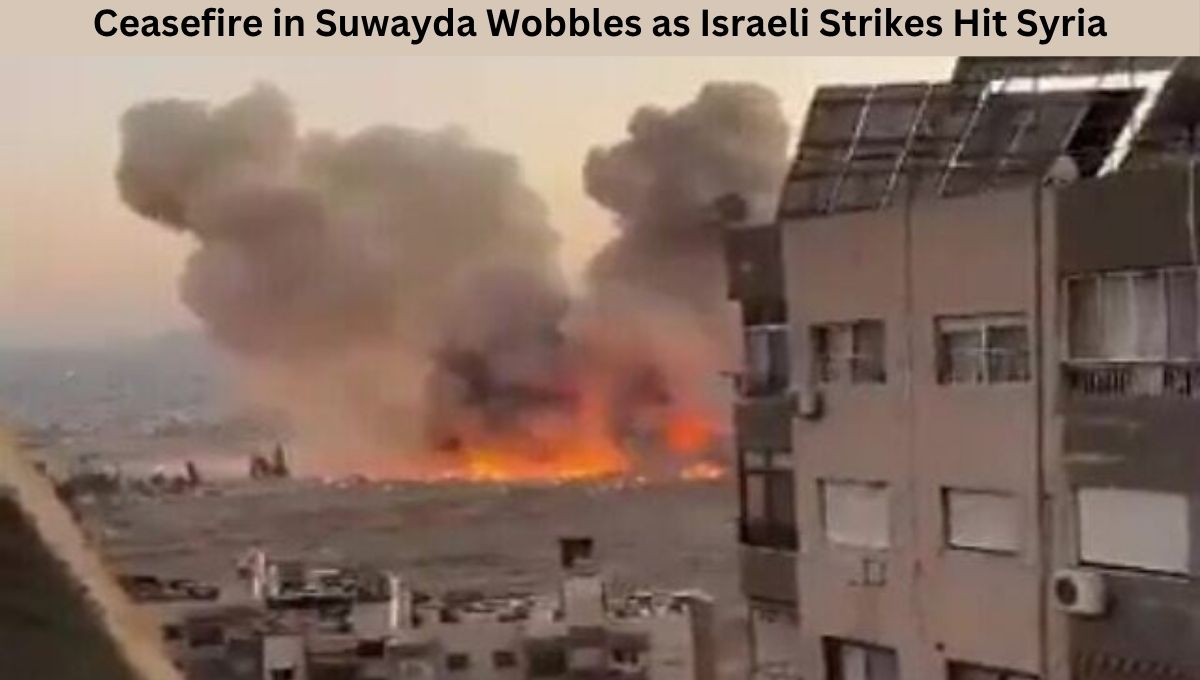
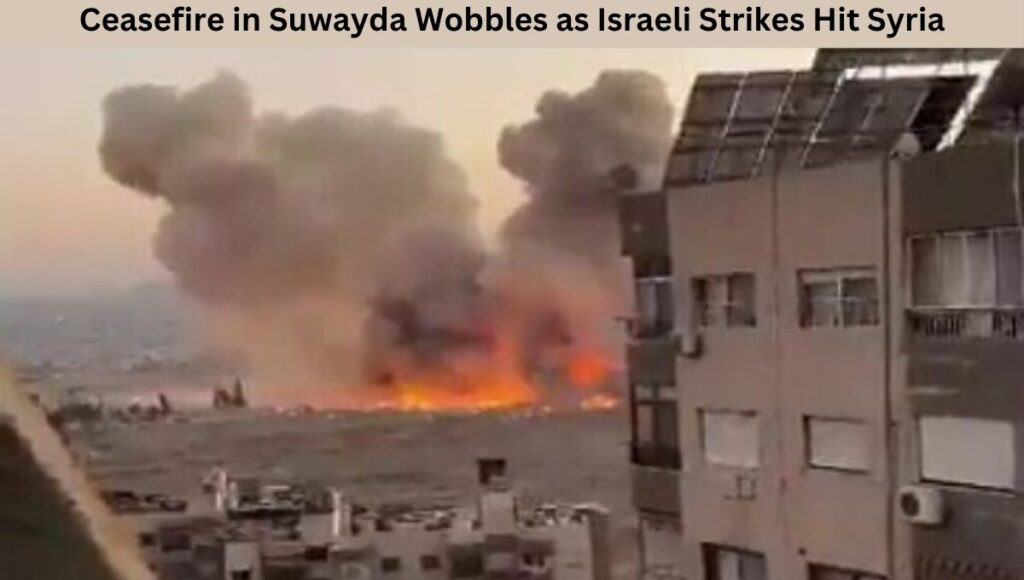
A fragile Ceasefire in Suwayda Wobbles as Israeli Strikes Hit Syria. Southern Syria has once again erupted in violence as Suwayda province becomes the epicenter of a deadly sectarian conflict between Druze militias and Bedouin fighters aligned with the Syrian government. The chaos has triggered swift and controversial Israeli airstrikes, further escalating tensions in the already war-scarred nation.
The Suwayda ceasefire, announced on July 17, appears to be holding by a thread after days of fighting that claimed more than 350 lives. Horrifying reports from human rights organizations have emerged, detailing field executions, burned civilians, and widespread displacement.
Ceasefire in Suwayda Wobbles as Israeli Strikes Hit Syria
Druze–Bedouin Clashes Spark Broader Conflict
The violence began on July 13 with the abduction of a Druze merchant by a Sunni Bedouin group. What started as a local dispute rapidly spiraled into a broader sectarian and political crisis.
The Druze, a religious minority with a deep-rooted presence in Suwayda, responded with militia retaliation, while Syrian forces intervened escalating the bloodshed.
Artillery fire shook Suwayda’s neighborhoods. Civilians sheltered indoors without electricity or water. “No internet, no food, no peace,” one resident told local reporters. “Just smoke and fear.”
Israeli Airstrikes: Humanitarian Intervention or Strategic Pressure?
On July 15 and 16, Israeli airstrikes in Syria hit Damascus and Suwayda, targeting the Ministry of Defense, areas near the Presidential Palace, and military convoys en route to Suwayda.
The Israeli government said the strikes aimed to protect the Druze community from massacre.
“We are acting to prevent the Syrian regime from harming [the Druze] and to ensure the demilitarization of the area adjacent to our border,” Israeli Prime Minister Benjamin Netanyahu said.
Thousands of Israeli troops have reportedly been redeployed from Gaza to the Golan Heights as tensions flare.
Who Are the Druze and Why Are They in the Crossfire?
The Druze are a secretive, monotheistic religious group with Islamic roots, known for their loyalty, philosophical beliefs, and strong communal ties.
In Syria, they number around 700,000, largely based in Suwayda and Damascus suburbs like Jaramana.
Historically neutral in conflicts, the Druze formed local defense militias during the Syrian civil war and kept government forces at bay.
But following the fall of Bashar al-Assad in December 2024, the new Islamist-led regime has alienated many Druze.
This has opened the door for increased Israeli outreach to the community fueling suspicions in Damascus.
Syrian Interim President Ahmed al-Sharaa Responds
Interim President Ahmed al-Sharaa, installed after Assad’s ouster and supported by the Trump administration, appeared on national television on July 16.
Promising to protect the Druze population, he announced a shift: local Druze militias would now control Suwayda’s security under a decentralized governance model.
“We are not afraid of war,” Sharaa declared, “but we will not allow the Druze to be dragged into foreign conflicts.”
Critics, however, doubt his ability to protect minority groups given the ongoing violence and deep mistrust between communities.
Ceasefire Declared But Can It Last?
The ceasefire announced on July 17 includes key provisions:
- Immediate halt to military operations in Suwayda
- Withdrawal of Syrian forces to barracks
- Local Druze militias to assume full control of regional security
- Formation of a joint monitoring committee with Druze clerics
Despite this, deep fractures in Druze leadership remain. Sheikh Hikmat al-Hijri, one of the most powerful Druze spiritual leaders, rejected the agreement, calling it a forced deal that fails to ensure true protection.
He instead demanded international monitoring and condemned both Israel and Syria for what he called a “war of extermination.”
U.S. Calls for Calm Amid Escalation
U.S. Secretary of State Marco Rubio addressed the crisis from Washington, describing the situation as a “misunderstanding” but urging de-escalation. “We’re very concerned about it,” Rubio said. “We want it to stop.”
According to the U.S. State Department, Trump’s administration has been in contact with Syrian, Israeli, and Druze representatives to broker the current ceasefire.
Special envoy Tom Barrack confirmed that the U.S. had called on Syrian troops to withdraw from Suwayda to allow local forces to stabilize the region.
Global Reactions: Outrage and Concern
The international community has responded with a mix of condemnation and diplomatic caution:
- Saudi Arabia and Iran condemned the Israeli strikes as unjustified aggression.
- Turkey and Qatar blamed both Israel and Syria for the violence.
- Egypt, Lebanon, Iraq, and Jordan criticized Israeli intervention.
- The UN Security Council held an emergency session, where Secretary-General António Guterres called for an end to all hostilities.
While many criticized Israel’s involvement, others acknowledged the complexity of the situation, especially the Druze community’s precarious position between hostile factions.
Israeli–Druze Brotherhood: Moral Duty or Geopolitical Strategy?
Israel’s actions reflect a long-standing relationship with its own Druze population, many of whom serve in the Israeli Defense Forces.
Officials cite a “deep brotherhood” and moral responsibility to protect Druze civilians beyond the border.
However, analysts argue that Israeli airstrikes in Syria also serve strategic aims mainly to prevent any hostile regime from gaining a foothold near Israeli territory.
Security expert Ammar Kahf put it bluntly:
“Israel would rather see Syria fragmented than strong.”
Speculation grew after footage emerged of armed Druze youth crossing into Syria from Israel, some carrying Israeli flags.
Israeli leaders have urged them to remain on their side of the border, but the images have stirred regional tensions further.
Voices from the Ground: Desperation and Fear
Civilians caught in the crossfire are paying the highest price. In Jaramana, Evelyn Azzam described how her husband was shot and abducted by security forces while returning home. His fate remains unknown.
Other testimonies from Druze women living in the UAE include stories of relatives burned alive in Suwayda or hiding in hospital basements as the city came under siege.
Fadi Hamdan, a carpenter from Suwayda, said, “We have no food, no electricity. People are cooking on firewood while tanks roll through the streets. It’s worse than during the civil war.”
Syria’s Political Future in Jeopardy
The Syrian interim government, led by Ahmed al-Sharaa, faces its biggest challenge yet. Since coming to power, Sharaa has struggled to gain legitimacy across Syria’s diverse sectarian landscape.
The Druze–Bedouin clashes, along with Israel’s military involvement, are testing the government’s ability to maintain order and preserve unity.
Sharaa’s balancing act promising protection for the Druze while distancing himself from Israeli influence may determine whether Syria descends into further chaos or begins a path toward reconciliation.
In his most recent speech, the president issued a stark ultimatum: “We must choose: open war with Israel at the cost of our Druze citizens or peace and reconciliation that preserves our national unity.”
What Lies Ahead?
The situation in Suwayda remains tense and unpredictable. Despite the ceasefire, ongoing skirmishes, divided Druze leadership, and Israeli air activity threaten to derail peace efforts.
If the ceasefire fails again, the region risks falling into a larger sectarian and regional war, dragging in more actors and devastating already fragile communities.
International diplomacy, especially from the United States and UN, will be critical in keeping dialogue alive.
Conclusion: A Tipping Point for Syria
The Suwayda crisis underscores Syria’s fragile post-Assad reality. The Druze community, once neutral, is now at the heart of a conflict involving militias, the Syrian government, Israeli airstrikes, and regional power plays.
Whether the ceasefire holds depends on political will, external mediation, and mutual trust something Syria’s fractured landscape currently lacks. For now, the world watches as Suwayda teeters between an uneasy peace and the brink of a new war.
Also Read: Iran Missile Strike Hits US Air Base in Qatar, Destroys Key Communications Dome
Also Read: Israel bombs Syria’s Druze-majority city of Suwayda hours after ceasefire
Related Posts:
- Israel Launches Strikes in Syria to Protect Druze…
- Israel-Syria Ceasefire Begins as Druze-Bedouin…

- Israel Launches Strikes on Syria After Rocket Fire:…

- Afghanistan–Pakistan War 2025: Inside the 48-Hour Ceasefire

- Hamas Executes 50 Rivals After Ceasefire – Inside…

- 11 Explosive Developments as Iran Warns US Over…