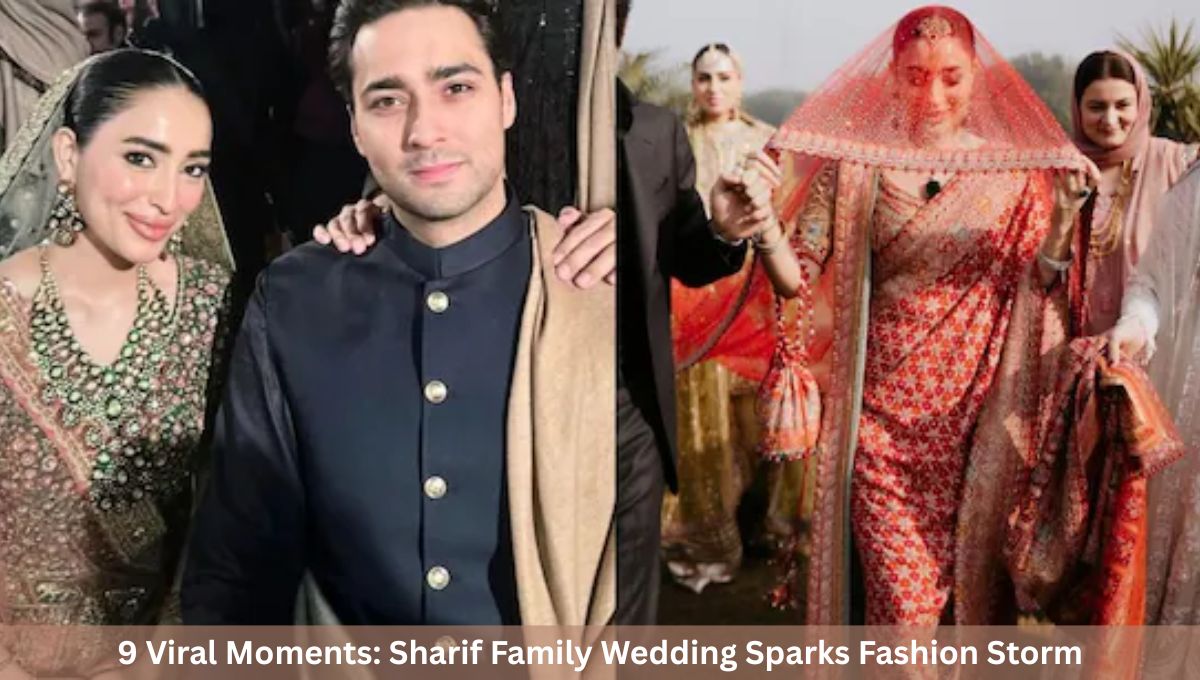
9 Viral Moments: Sharif Family Wedding Sparks Fashion Storm over Sabyasachi, Tarun Tahiliani.The wedding of Muhammad Junaid Safdar, grandson of former Pakistan Prime Minister Nawaz Sharif and son of Punjab Chief Minister Maryam Nawaz, was always destined to attract public attention.
Held in Lahore with close family members, senior politicians, and influential figures in attendance, the celebrations were a high-profile affair that quickly spilled onto social media platforms.
Yet, beyond the political pedigree of the families involved, it was the bride’s fashion choices that truly set the internet buzzing. Shanzay Ali Rohail, the granddaughter of politician Sheikh Rohail Asghar and now Nawaz Sharif’s granddaughter-in-law, opted for bridal ensembles by two of India’s most celebrated designers — Sabyasachi Mukherjee and Tarun Tahiliani.
The choice transformed what might have been a conventional elite wedding into a cross-border cultural flashpoint, drawing admiration, criticism, and intense debate across Pakistan’s digital space.
9 Viral Moments: Sharif Family Wedding Sparks Fashion Storm
Who Is Shanzay Ali Rohail?
Shanzay Ali Rohail entered the Sharif family with a profile that was already rooted in Pakistan’s political elite. She is the granddaughter of Sheikh Rohail Asghar, a long-time associate and confidant of Nawaz Sharif, meaning her ties to the Sharif dynasty predate her marriage to Junaid Safdar.
With her wedding, Shanzay became part of one of Pakistan’s most powerful political families, ensuring that her personal choices — from attire to jewellery — would be scrutinised far beyond the usual celebrity wedding lens.
The Lahore ceremonies were attended by prominent Pakistan Muslim League-Nawaz (PML-N) leaders, family members, and close associates, reinforcing the wedding’s political and social significance.
Mehendi Look: Sabyasachi’s Regal Green Lehenga
For the mehendi ceremony, Shanzay turned to Indian designer Sabyasachi Mukherjee, known for his heritage-driven silhouettes and royal aesthetics.
She wore an emerald green lehenga featuring panelled construction, jewel-toned patches, and heavy antique gold embroidery.
Craftsmanship and Styling
The ensemble was finished with a wide gold border, a richly embroidered blouse, and a sheer dupatta that added softness to the heavily detailed outfit. The look reflected Sabyasachi’s signature blend of Mughal-inspired craftsmanship and old-world opulence.
Shanzay paired the lehenga with a statement polki necklace and matching earrings, amplifying the regal feel while keeping her makeup understated. Soft tones, dewy skin, and a subtle hairstyle balanced the ornate jewellery and embroidery.
Nikah Look: Tarun Tahiliani’s Kashida Saree
For the nikah ceremony, Shanzay chose a saree by Tarun Tahiliani, another heavyweight of Indian couture. The saree bore a resemblance to one previously worn by Bollywood actor Ananya Panday, drawing further online comparisons.
A Blend of Tradition and Modernity
The kashida saree featured geometric and floral motifs, complemented by an appliqued tulle border highlighted with delicate Mughal-inspired embroidery. The blouse, adorned with jaamevar-style kashida work, added depth and texture to the ensemble.
A red dupatta draped over her head lent a traditional and ceremonial touch, aligning the look with the solemnity of the nikah. Jewellery choices shifted toward diamond and emerald pieces, introducing a contemporary glamour that contrasted with the antique feel of her mehendi look.
Fashion Meets Politics Online
While Shanzay’s bridal wardrobe was widely praised for its craftsmanship, it also ignited fierce debate on Pakistani social media. Critics questioned why a bride from one of Pakistan’s most influential political families would choose Indian designers over local talent.
Comments ranged from disappointment to outright outrage. Some users argued that Pakistani designers could have created outfits that better represented national identity, while others framed the choice as financially benefiting India at a time of strained bilateral relations.
“Giving Taxes to India”: Internet Reacts
Screenshots of comments flooded Instagram, X, and Facebook. One user wrote, “Very mid. I’m sure Pakistani designers could have made her something more Pakistani.” Another added, “Shame on giving taxes to India.”
Others questioned what they described as an obsession with Indian designers, arguing that Pakistan’s fashion industry boasts equally skilled artisans and couture houses.
At the same time, supporters pushed back against the trolling, emphasising that Shanzay is a private individual with the right to choose her wedding attire without political interpretation.
India-Pakistan Ties Add Fuel to Debate
The backlash unfolded against the backdrop of historically strained India-Pakistan relations. Since the 1947 partition, the two neighbours have shared a complex relationship marked by wars, diplomatic standoffs, and persistent security concerns.
Tensions escalated again following the Pahalgam attack in February 2025, which brought the countries to the brink of a broader military confrontation. In this context, even cultural choices — such as fashion — can take on political meaning.
For critics, Shanzay’s outfits symbolised misplaced admiration across borders. For supporters, they represented a reminder that art and craftsmanship often transcend geopolitics.
Spotlight on Junaid Safdar
Junaid Safdar, the groom, is the only son of Maryam Nawaz Sharif and Muhammad Safdar Awan. Maryam Nawaz currently serves as Punjab’s chief minister and is the first woman to hold the office in the province.
This wedding marked Junaid Safdar’s second marriage. In 2021, he married Ayesha Saif-ur-Rehman Khan in London. The couple later announced their divorce in October 2023, with Junaid confirming the split on Instagram.
Who Is Ayesha Saif Khan?
Ayesha Saif Khan is the daughter of Saifur Rehman Khan, a former chairman of Pakistan’s National Accountability Bureau.
Raised in Qatar, she pursued her education in London, earning a degree in civil engineering from University College London.
She has served as a director at Redco International, a major Qatar-based contracting firm. Her earlier marriage to Junaid Safdar also attracted significant media attention due to the family’s political stature.
Maryam Nawaz’s Wedding Looks Spark Debate
The bride was not the only one to face online scrutiny. Maryam Nawaz herself became a trending topic for her elaborate wedding outfits, with critics accusing her of dressing like a bride and overshadowing her daughter-in-law.
For the mehendi, Maryam wore a yellow and powder-orange lehenga, followed by a mint-green ensemble for the wedding ceremony. At the walima, she opted for a pink and blue-hued outfit.
While some praised her elegance and confidence, others questioned whether her styling diverted attention from the bride.
Supporters Push Back
Amid the criticism, several voices defended both Shanzay and Maryam Nawaz. Supporters argued that weddings are personal milestones and that women should not be judged for celebrating such occasions with grandeur.
They also noted that fashion exchanges between India and Pakistan have existed for decades, with designers, artisans, and trends influencing each other despite political divides.
Fashion Beyond Borders
The controversy highlights a recurring tension in South Asia: the intersection of fashion, identity, and politics.
Indian designers like Sabyasachi Mukherjee and Tarun Tahiliani enjoy immense popularity across borders, admired for craftsmanship rooted in shared cultural histories.
At the same time, Pakistan’s own designers command international respect, fuelling debates about representation and cultural pride.
A Wedding That Became a Cultural Moment
What began as a family celebration evolved into a national conversation about taste, identity, and cross-border influence. The Sharif family wedding underscored how personal choices by political families often become symbolic battlegrounds.
Whether viewed as a fashion statement, a political provocation, or simply a bride’s personal preference, Shanzay Ali Rohail’s wedding wardrobe ensured that this Lahore wedding will be remembered long after the festivities ended.
Conclusion
As images from the Sharif family wedding continue to circulate online, the debate shows no sign of fading. The episode reflects the power of fashion to spark dialogue — and division — in a region where culture and politics are deeply intertwined.
Ultimately, Shanzay’s entry into Pakistan’s most prominent political dynasty has placed her firmly in the public eye, demonstrating how even a wedding lehenga or saree can become a lens through which broader societal tensions are examined.
Also Read: 5 Shocking Revelations from Iran’s $1bn Hijab-Free Wedding
Related Posts:
- Jeff Bezos and Lauren Sanchez’s ₹430 Crore Venice…

- Here's How Much the Jeff Bezos–Lauren Sánchez…

- Pakistani Actress Humaira Asghar Found Dead Months…

- 5 Shocking Revelations from Iran’s $1bn Hijab-Free Wedding

- Afghanistan–Pakistan War 2025: Inside the 48-Hour Ceasefire

- 5 Key Shifts in Bangladesh–Pakistan Relations as…
