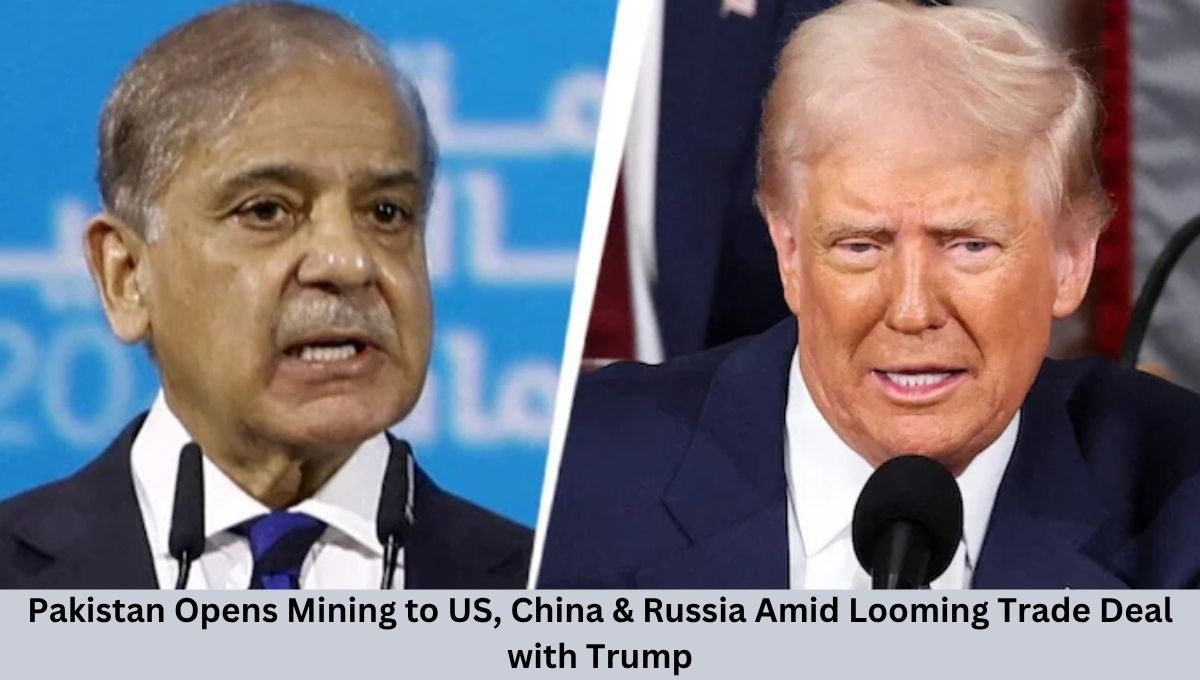
In a significant geopolitical shift, Pakistan Opens Mining to US, China & Russia Amid Looming Trade Deal with Trump. Pakistan has opened its multibillion-dollar mining sector to international bidders from the US, China, and Russia, offering equal opportunities to global companies to invest in projects like the Reko Diq copper-gold mine.
The move comes as Islamabad nears a landmark trade deal with the United States to avoid looming 29% tariffs on its exports and attract much-needed foreign investment into its mining and energy sectors. At the heart of the government’s strategy is an “open-handed policy” designed to provide a level playing field for all international investors, regardless of their country’s political alignments or past involvement.
Pakistan Opens Mining to US, China & Russia Amid Looming Trade Deal with Trump
Rekodiq and Beyond: Pakistan’s Strategic Resource Pitch
Petroleum Minister Ali Pervaiz Malik emphasized that Reko Diq, located in the resource-rich province of Balochistan, could serve as a model for future mining ventures.
The Reko Diq project, operated by Barrick Gold, is believed to be one of the largest undeveloped copper-gold deposits in the world and is now central to Pakistan’s efforts to attract foreign investment.
“We’re engaging with all global partners whether it’s the US, China, or Russia,” said Malik. “Our policy is non-discriminatory, and the doors are open.”
In addition to copper and gold, Pakistan has also highlighted its reserves of lithium, antimony, chromite, and rare earth elements, strategically vital for the production of batteries, electronics, and renewable energy technologies.
Equal Ground for Competing Powers: US, China, Russia
Despite being traditional geopolitical rivals, the US, China, and Russia have all been invited to participate in Pakistan’s mining auctions.
The government has underscored that no country will be given preferential treatment, and that it seeks to foster a competitive environment to derive maximum economic benefit from its untapped resources.
China, Pakistan’s long-standing ally, has already poured over $60 billion into mining and infrastructure under the China-Pakistan Economic Corridor (CPEC).
However, China’s growing dominance in Balochistan has triggered backlash from local separatist groups, complicating Beijing’s long-term presence in the region.
Meanwhile, Pakistani officials recently hosted a webinar with US officials and companies, laying the groundwork for potential US-Pakistan joint mining ventures.
Russian firms have also been invited, with Minister Malik confirming that invitations have been extended to Russian enterprises.
Rare Earths, Bitcoin & Diplomacy: Pakistan’s Unorthodox Strategy
In an effort to win over the Trump administration, Pakistan is strategically pitching rare earth minerals, bitcoin mining potential, and even political support for President Donald Trump’s Nobel Peace Prize bid.
“Pakistan has been smart in aligning with US interests in crypto and critical minerals,” said Michael Kugelman, a senior fellow at the Asia Pacific Foundation of Canada.
The rare earth offer is part of a broader diplomatic effort to avoid the reinstatement of 29% tariffs on Pakistani exports and position the country as a strategic investment destination for the United States.
Pakistan-US Trade Talks: Deal Framework Reached
On Friday, Pakistan and the United States reached an understanding on a broad trade framework, with a formal announcement expected after July 9.
The talks, led by Pakistan’s Commerce Secretary Jawad Paal, focused on a reciprocal tariff agreement to prevent the re-imposition of high tariffs on textile and agricultural exports, which together account for roughly $5 billion in annual trade.
The deal is expected to include:
- Commitments to purchase US-origin cotton and soybeans
- Expanded US investment in mining and energy infrastructure
- Support for American companies in projects like Reko Diq
- Potential engagement through the US Export-Import Bank
“The objective is to stabilize trade and increase investor confidence,” said a Pakistani official close to the talks.
Avoiding Tariffs and Stabilizing Exports
The threat of reimposed tariffs had loomed large over Pakistan’s economy. A 29% tariff on textile and agriculture exports originally introduced during Trump’s first term was paused earlier this year but was set to be reinstated unless a deal was reached by July 9.
Pakistani finance experts warned that the tariffs could lead to:
- A 20–25% drop in exports
- A revenue loss of up to $1.4 billion
- Significant job losses in Pakistan’s textile industry
The agreement now in place could safeguard these industries and restore Pakistan’s trade access to the US market, its largest export destination.
Energy Sector Reforms: LNG and Beyond
Alongside mining, energy sector reform is another core focus. Minister Malik criticized a controversial LNG contract with Qatar, signed by the previous administration, as a source of circular debt and gas curtailment issues.
He hinted that Pakistan might renegotiate the deal when it expires in 2026 to bring supply and demand into better balance.
“We need a unified energy ministry and stable regulatory policy,” Malik stated, calling for an integrated approach to energy and mining.
US Strategic Interests in the Region
For the US, Pakistan’s rare earths and critical minerals offer a counterweight to China’s global dominance in the sector.
A strategic foothold in Pakistan’s mineral landscape could align with Washington’s broader geopolitical goals especially as tensions grow over supply chain security and semiconductor manufacturing.
However, such a move risks provoking Beijing, which views the CPEC as central to its Belt and Road Initiative. If US companies begin investing in core CPEC zones like Balochistan, it could shift the regional power dynamics.
Regional Competition: India and Bangladesh Also in Talks
Pakistan isn’t the only South Asian nation in trade talks with the US:
- India is pursuing an interim deal focused on tariff reductions for dairy, poultry, and ethanol, but is fiercely protective of its agricultural sector.
- Bangladesh, whose trade with the US reached $10.6 billion in 2024, has completed initial talks but made no major breakthroughs. A follow-up meeting is scheduled for July 8.
While India’s trade goals differ, the competition for market access and investment flows adds urgency to Pakistan’s efforts to finalize and implement its deal quickly.
What’s at Stake for Pakistan?
The stakes for Pakistan are high:
- Attracting foreign investment in a time of economic crisis
- Avoiding trade isolation and tariff barriers
- Balancing geopolitical relationships with China, Russia, and the US
- Developing its untapped mineral resources, estimated at $8 to $50 trillion
If successful, the Pakistan-US trade pact could open the door for energy and infrastructure financing, foreign direct investment, and stronger diplomatic ties with Washington while still maintaining relationships with Beijing and Moscow.
Conclusion: A Balancing Act with Trillions on the Table
Pakistan’s mining sector is emerging as a geostrategic battleground, with the Reko Diq project and rare earth minerals at its center. As the country offers equal bidding rights to the US, China, and Russia, it walks a fine line between economic opportunity and geopolitical tension.
With the July 9 deadline approaching, Islamabad’s ability to finalize its trade deal with the US while balancing Chinese and Russian interests could determine not only its economic future, but its role in global mineral supply chains.
“We’re open for business to everyone,” said Minister Malik. “But it must be on equal terms.”
Also Read: Experts Puzzled by Trump’s “Massive Oil Deal” with Pakistan Despite Dismal Reserves
Also Read: ‘Strategic handshake’: How Pakistan is wooing Trump with critical minerals