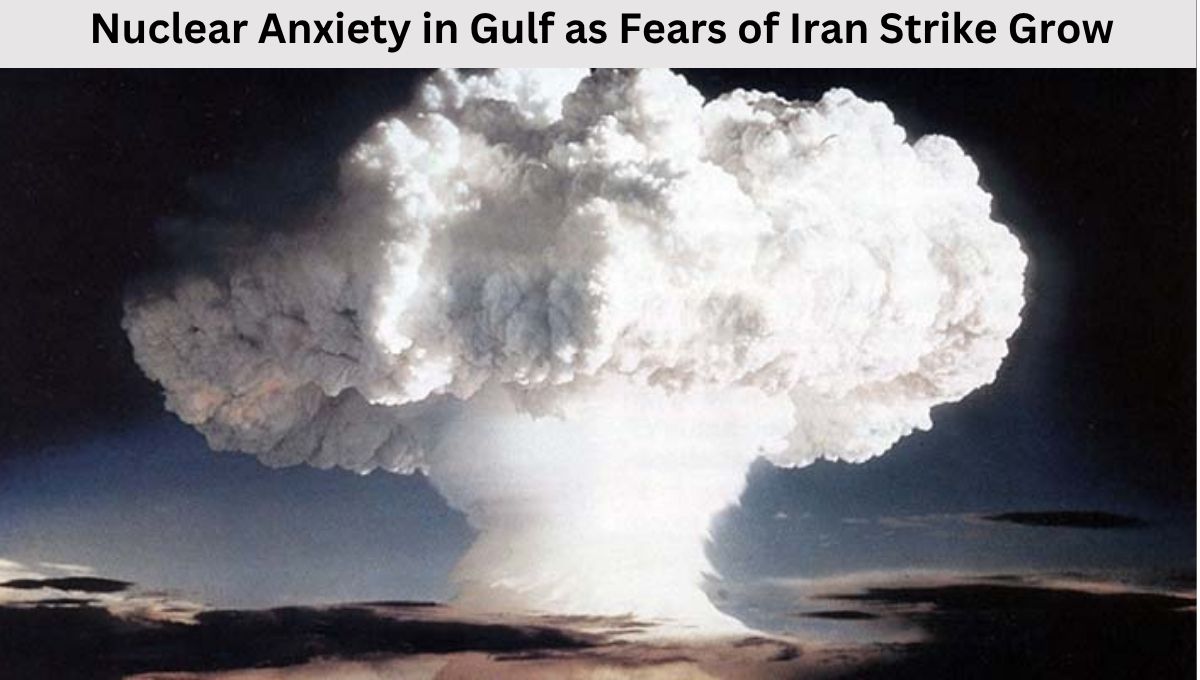
There is a rise in Nuclear Anxiety in Gulf as Fears of Iran Strike Grow. Concerns over water contamination, retaliatory attacks, and regional instability rise as tensions escalate between Iran, Israel, and the U.S. The specter of nuclear conflict looms large over the Gulf Arab states as the threat of a potential U.S. or Israeli strike on Iran’s nuclear facilities has sparked widespread anxiety.
As the war rhetoric intensifies and regional tensions mount, nations across the Persian Gulf are taking emergency precautions to deal with the possible fallout literally and figuratively. The core of their concern lies in the vulnerability of their desalination-dependent water systems, proximity to Iran’s nuclear infrastructure, and fear of reprisals by Iran targeting U.S. military assets hosted in Gulf nations.
Nuclear Anxiety in Gulf as Fears of Iran Strike Grow
Civilian Warnings and Emergency Preparations in the Gulf
Across the Gulf Cooperation Council (GCC) countries Oman, Bahrain, Qatar, the UAE, Kuwait, and Saudi Arabia citizens are being prepped for the unthinkable.
In Oman, public messaging apps are circulating civil defense guidelines urging residents to seal their homes, turn off air conditioning, and avoid outside exposure in the event of a nuclear incident.
Bahrain has already activated 33 emergency shelters, tested sirens nationwide, and is preparing for nuclear or radiological emergencies, according to its state news agency.
These moves come as Middle Eastern media outlets publish guides on how to survive radiation leaks, fueling a sense of urgency among residents.
Why Gulf States Are on Edge: Location and Fallout Risks
The main trigger for these anxieties is the Bushehr nuclear power plant, Iran’s only operational nuclear reactor, which lies closer to several Gulf capitals than to Tehran.
A strike on Bushehr whether accidental or intentional could have catastrophic implications for the Persian Gulf’s marine ecosystem and the water supply of tens of millions.
“Primarily there is fear of environmental contamination, especially in shared waters,” said Elham Fakhro, a Bahraini fellow at Harvard Kennedy School’s Middle East Initiative. This fear is not unfounded.
Around 60 million people in Gulf countries rely on desalinated seawater from the Gulf for drinking, sanitation, and industrial use. A radioactive leak or fallout could render desalination plants unusable and contaminate marine life, posing both a public health and economic crisis.
Qatar’s Dire Warning: ‘No Water in Three Days’
In a March interview with U.S. journalist Tucker Carlson, Qatari Prime Minister Mohammed Al Thani issued a stark warning. If Iran’s nuclear plant at Bushehr were attacked, he said, “The water would be entirely contaminated … no water, no fish, nothing, it has no life.”
Qatar, which conducted its own risk analysis, concluded that the nation would run out of water in just three days if desalination plants were compromised.
The prime minister noted that this concern extends beyond Qatar to the UAE and Kuwait, who also depend entirely on desalination for potable water.
As a safeguard, Qatar has since built massive underground water reservoirs to act as a buffer in case of contamination.
Israeli Strike Confusion Adds to Anxiety
A brief panic was triggered earlier this week when IDF spokesperson Brig. Gen. Effie Defrin stated that Israel had struck nuclear sites in Bushehr, Natanz, and Isfahan.
The comment was quickly walked back by another Israeli military official, who clarified it was “a mistake” and refused to confirm or deny whether Bushehr had actually been targeted.
The damage from strikes on Natanz, Isfahan, and Arak has been confirmed, with Iran accusing Israel of escalating the conflict. However, the status of Bushehr remains shrouded in uncertainty, leaving Gulf nations in a state of suspense.
Gulf Nations Activate Emergency Management and Diplomacy
In a coordinated response, the Gulf Cooperation Council has activated its Kuwait-based Emergency Management Centre, aimed at managing risks on environmental and radiological levels. The goal is to preempt any potential contamination and prepare for evacuation or mitigation if an attack does occur.
At the diplomatic level, Gulf leaders are urging restraint. UAE Foreign Minister Sheikh Abdullah bin Zayed warned against “reckless and miscalculated actions” that could spread beyond Iran and Israel. Qatar’s foreign ministry also emphasized that “uncalculated strikes” could affect shared waters and escalate into a regional humanitarian crisis.
Trump’s Calculated Silence and Potential Military Shift
Adding to the tension is the evolving stance of U.S. President Donald Trump. According to CNN, Trump is now warming to the idea of striking Iranian nuclear sites, though he remains officially non-committal.
“I may do it. I may not do it. I mean, nobody knows what I’m going to do,” Trump said on Wednesday.
Sources say that although Trump still supports a diplomatic solution, he’s growing impatient with Iran’s refusal to surrender. The possibility of preemptive military action is no longer theoretical it’s being seriously considered.
Iran’s Implicit Threats: U.S. Interests in the Gulf at Risk
While Iran has not made any explicit threats against Gulf nations, it has hinted at targeting U.S. military interests in the region if attacked. This places Bahrain, home to the U.S. Naval Forces Central Command, in the crosshairs.
Iranian leaders have repeatedly said that if they are struck by the U.S. or Israel, their response will be swift, widespread, and devastating. This has led to increased anxiety not just over environmental fallout, but also over direct missile or drone attacks on military bases and civilian infrastructure across the Gulf.
Gulf Residents Speak Out: Trust and Anxiety Coexist
Despite the grave warnings, daily life in cities like Kuwait City, Doha, Abu Dhabi, and Dubai continues with a sense of cautious calm. Some residents express trust in their governments’ ability to protect them, while others admit they are increasingly worried.
“I don’t feel worried or concerned. I have an unwavering trust in my safety here,” said an American woman living in Abu Dhabi.
“Everyone is stressed out … and it’s becoming very real,” said an Egyptian resident of Dubai. “The situation is not something to be taken lightly and war feels nearby.” These sentiments echo across the Gulf, where confidence in local governance coexists with anxiety over the unpredictability of the geopolitical situation.
Russia Weighs In: Guarantees for Bushehr Workers
Adding another layer of complexity, Russian President Vladimir Putin confirmed that Russia has over 200 personnel working at Bushehr and that an agreement was reached with Israel to guarantee their safety.
The Russian embassy in Tehran has stated that the facility is operating normally and that it sees no immediate security threat, though that reassurance has done little to quell regional anxiety.
Conclusion: A Region Holding Its Breath
With Trump weighing military options, Israel intensifying its strikes, and Iran vowing retaliation, the Gulf Arab states find themselves caught in the middle geographically, economically, and environmentally.
Whether or not Bushehr is struck, the possibility alone is enough to trigger emergency responses, water fears, and geopolitical recalculations. As the region braces for what could come next, the sentiment is clear: one miscalculation could change everything.
Also Read: Trump Teases Major Move Amid Escalating Israel-Iran Conflict: “Nobody Knows What I’m Going to Do”
Also Read: Trump’s Gulf Arab allies race to avoid all-out war in Iran
Related Posts:
- Afghanistan–Pakistan War 2025: Inside the 48-Hour Ceasefire

- 7 Powerful Measures: Trump Sanctions Russian Oil…

- Trump’s 20-Point Gaza Peace Plan Gains Urgent Global…

- In 8 Moves, EU Targets China-Linked Refineries and…

- 7 Dead in Explosive Iran Protests as Economic Anger…

- 11 Explosive Revelations From Ted Cruz’s Leaked…