
Amid international condemnation, Netanyahu Orders Gaza Hostage Talks as Israel Pushes Gaza City Capture and Hamas Defeat. Prime Minister Benjamin Netanyahu has announced a new dual-track strategy in the ongoing Israel–Hamas war: hostage negotiations alongside preparations for a massive ground offensive to seize Gaza City. The move underscores Israel’s determination to both free its remaining hostages and crush Hamas militarily, even as humanitarian concerns mount and global pressure intensifies.
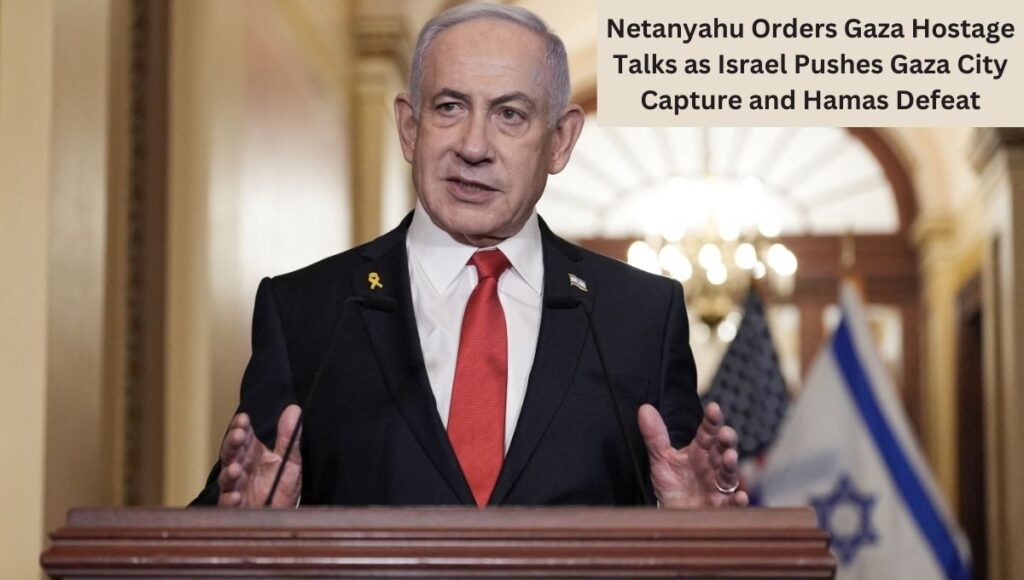
Netanyahu Orders Gaza Hostage Talks as Israel Pushes Gaza City Capture and Hamas Defeat
Netanyahu’s Announcement: Hostage Talks and “Decisive Victory”
During a visit to Israeli troops near Gaza on Thursday night, Netanyahu declared that he had approved the Israel Defense Forces (IDF) operational plans to capture Gaza City and defeat Hamas.
“We are at the stage of decisive victory,” Netanyahu told soldiers, stressing that the defeat of Hamas and the release of hostages are inseparable goals.
Netanyahu emphasized that hostage negotiations would begin immediately, but only under conditions “acceptable to Israel”.
He reiterated that the war will only end if Hamas agrees to release all hostages at once not in stages, as proposed by mediators.
Israel’s War Aims: Defeating Hamas and Securing Hostages
Israel’s war cabinet has maintained a firm stance since the beginning of the conflict:
- Full dismantling of Hamas as a military and governing force.
- Release of all hostages in one exchange, not partial releases.
- Demilitarization of Gaza and future governance by non-Hamas, non-Palestinian Authority actors.
While Hamas has shown flexibility by agreeing to a 60-day ceasefire deal mediated by Qatar and Egypt, which includes releasing 10 living hostages and 18 bodies in exchange for about 200 Palestinian prisoners, Israel has dismissed the proposal.
Netanyahu’s government insists that only total capitulation hostage release and Hamas disarmament can bring the war to an end.
IDF Prepares for Gaza City Seizure
The IDF is moving forward with its largest urban military operation since the war began nearly two years ago. Key developments include:
- Call-up of 60,000 reservists and extension of service for another 20,000.
- Preparations to evacuate over one million civilians from Gaza City to southern shelters.
- Intensified airstrikes and tank movements already encircling Gaza City.
- Warnings to hospitals, aid groups, and UN agencies to prepare for mass displacement.
Israel’s Defense Minister Israel Katz issued a stark warning, saying “all gates of hell will open on the heads of Hamas” if it refuses Israel’s terms.
He added that Gaza City could be destroyed just as Rafah and Beit Hanoun were reduced to rubble.
Humanitarian Crisis Deepens
The planned offensive has sparked alarm among humanitarian organizations, the United Nations, and Gaza’s Hamas-run health ministry.
- The UN has warned of “relentless bombardment” and “unprecedented civilian casualties.”
- The World Food Programme reports that famine is already unfolding across Gaza.
- UNRWA estimates 90% of Gaza’s residents are displaced, with shelters deteriorating rapidly.
- Gaza’s health ministry says transferring health facilities southward would amount to a “death sentence” for patients and wounded.
International aid workers describe Gaza as entering a “man-made famine”, with one in three children malnourished.
Hostages: The Core of Israel’s Dilemma
Hostages remain the central political and moral issue in Israel. Of the 251 people kidnapped by Hamas during the October 7, 2023 attacks, Israeli intelligence now believes only 20 of the 50 still held are alive.
Families of hostages have grown increasingly vocal, accusing Netanyahu of prioritizing military objectives over their loved ones’ survival.
One reservist, Avshalom Zohar Sal, who served 300 days in Gaza, called the Gaza City assault “a death sentence for the hostages.”
This growing tension inside Israel has created divisions:
- Hostage families demand negotiations even at the cost of compromise.
- Military hardliners argue that pressure must be maintained until Hamas collapses.
- Public opinion polls show most Israelis want the war to end but disagree on terms.
Military Fatigue and Manpower Concerns
Israel’s military faces severe attrition after nearly two years of nonstop operations:
- IDF Chief of Staff Lt. Gen. Eyal Zamir warned of soldier burnout and reduced motivation.
- A Hebrew University survey found 40% of soldiers are less motivated, while only 13% are more motivated.
- Reservist groups are quietly encouraging soldiers to refuse call-ups.
- Ultra-Orthodox exemptions from service remain a major political flashpoint, deepening resentment among secular Israelis.
Former IDF Chief of Staff Dan Halutz predicted that many reservists would simply not show up, stating: “I believe that some of them will stay home.”
Ceasefire Talks: Stalemate and Distrust
Mediated talks continue, but both sides accuse each other of obstruction:
- Hamas accuses Netanyahu of deliberately undermining a truce to pursue total war.
- Israel says Hamas is only offering partial hostage release, which it rejects.
- Qatar and Egypt remain engaged, but momentum has stalled.
Al Jazeera’s analyst Marwan Bishara described Israel’s dual-track strategy as “negotiation under fire”, warning that no real ceasefire will happen while Gaza City burns.
International Reactions
- The United States, Israel’s strongest backer, has continued providing support, though quiet disagreements over humanitarian conditions remain.
- The European Union and United Nations have called for restraint, warning that the Gaza City offensive could constitute collective punishment.
- Arab states including Jordan and Egypt warn that the war risks spreading across the region.
Despite global outrage, Israel’s government appears determined to continue its strategy, emboldened by what it perceives as a “green light” from Washington.
Gaza Residents: Trapped in Survival Mode
Inside Gaza, civilians face impossible choices:
- Stay in Gaza City, risking bombardment and starvation.
- Evacuate to the south, where overcrowded shelters are collapsing.
- Move to the coastline, where makeshift camps face airstrikes.
Residents describe life as a cycle of “displacement, destruction, and death.” One father of seven told Reuters:
“We are facing a bitter, bitter situation, to die at home or leave and die somewhere else. As long as this war continues, survival is uncertain.”
Analysis: Netanyahu’s Gamble
Netanyahu’s decision to approve a Gaza City takeover while starting hostage talks is a high-risk gamble:
- Military Victory vs. Humanitarian Collapse – Capturing Gaza City may weaken Hamas militarily, but at enormous humanitarian cost.
- Hostages at Risk – An expanded assault risks killing the very hostages Israel is trying to save.
- Political Pressures – Netanyahu faces mounting pressure from hostage families, reservists, and international allies.
- War Fatigue – After nearly two years, both Israelis and Palestinians are exhausted, yet no clear end is in sight.
The operation could drag on for months or even years, with no guarantee of eliminating Hamas or securing all hostages alive.
Conclusion
Israel now stands at a historic crossroads:
- Netanyahu is pursuing total military victory, but at the risk of prolonging the Middle East’s bloodiest modern war.
- The hostage crisis continues to haunt Israel, with families demanding answers as negotiations stall.
- For Palestinians, the looming destruction of Gaza City may mark the darkest chapter in decades of suffering.
As Netanyahu himself declared: “We are in the decision-making phase.” That decision may well determine not only the future of Gaza but also Israel’s own standing in the region and beyond.
Also Read: Israel Demands Full Hostage Release, Gaza Ceasefire Talks in Doubt
Also Read: Israel to send delegation to Qatar for renewed Gaza ceasefire and hostage talks
Related Posts:
- Trump’s 20-Point Gaza Peace Plan Gains Urgent Global…

- Israel–Hamas Ceasefire Under Strain: 4 More Hostage…

- 5 Key Developments as Israel Confirms Hamas Handed…

- Trump’s Breakthrough Gaza Ceasefire Deal 2025: Key Insights

- Dramatic Moments Behind Trump’s Gaza Peace Push and…

- Trump’s Historic Gaza Ceasefire Deal 2025: A…
