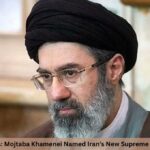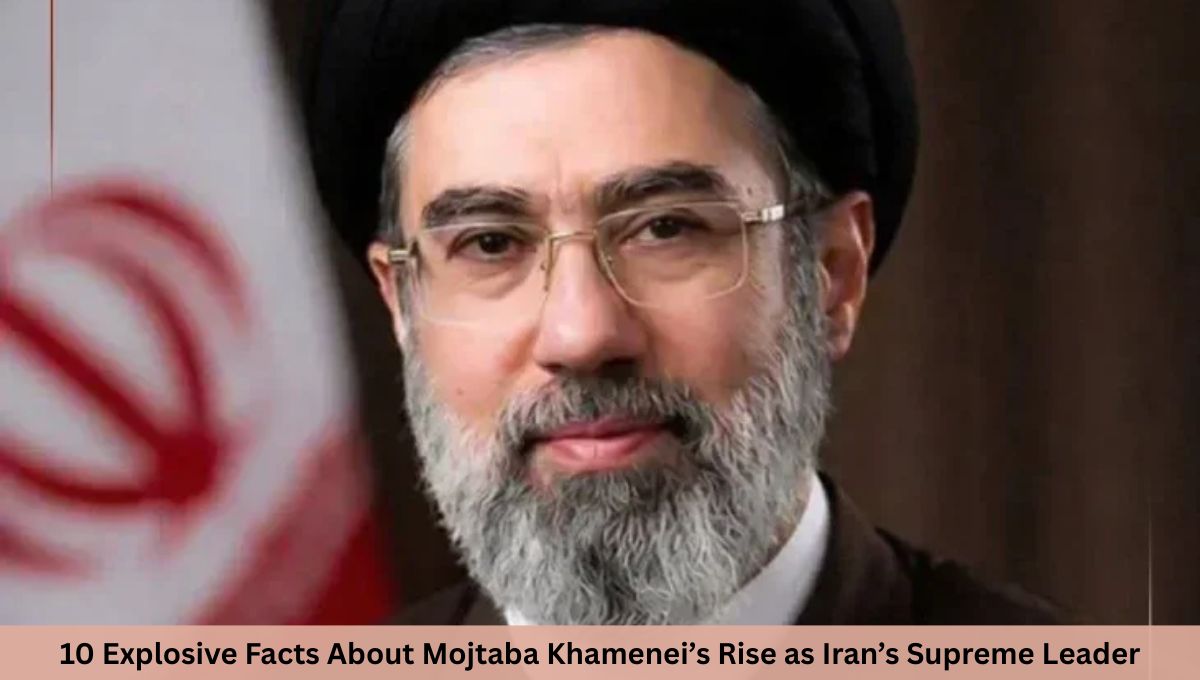
10 Explosive Facts About Mojtaba Khamenei’s Rise as Iran’s Supreme Leader after his father’s death in a US-Israeli strike. Iran has entered one of the most consequential moments in its modern political history. Following the death of Supreme Leader Ali Khamenei in a US-Israeli strike, Iran’s powerful clerical body has appointed his son Mojtaba Khamenei as the country’s new Supreme Leader.
The decision by Iran’s Assembly of Experts ensures that the Islamic Republic remains firmly under hardline control. Analysts say the move could significantly reshape the ongoing conflict between Iran, the United States, and Israel while potentially altering the geopolitical balance across the Middle East.
The announcement came as the war between Iran and a US-Israeli coalition entered its second week, with escalating missile strikes, regional instability, and surging global oil prices already rattling international markets.
With Mojtaba Khamenei now holding the most powerful position in Iran, many experts believe the world is witnessing the beginning of a dangerous new phase in the Middle East conflict.
10 Explosive Facts About Mojtaba Khamenei’s Rise as Iran’s Supreme Leader
The Death of Ali Khamenei and the Leadership Vacuum
The crisis began when Ali Khamenei, Iran’s Supreme Leader since 1989, was killed in a joint US-Israeli strike targeting key Iranian leadership infrastructure in Tehran.
The strike marked a dramatic escalation in the war that erupted after a sustained campaign by Washington and its allies to dismantle Iran’s missile capabilities and nuclear infrastructure.
Khamenei’s death created an immediate leadership vacuum in the Islamic Republic, triggering an urgent meeting of the Assembly of Experts — the powerful clerical body responsible for choosing Iran’s supreme leader.
Despite the ongoing war and security threats against the meeting, the Assembly quickly moved to appoint a successor.
Their choice:
Mojtaba Khamenei.
Who Is Mojtaba Khamenei?
Mojtaba Khamenei, 56, is a mid-ranking cleric who has long been viewed as one of the most influential figures inside Iran’s power structure.
Although he never held a formal elected position, Mojtaba wielded significant authority behind the scenes during his father’s rule.
For years, analysts described him as a “shadow power broker” within Iran’s political system.
He reportedly played a key role in:
- managing his father’s office
- coordinating with Iran’s security services
- maintaining close ties with the Islamic Revolutionary Guard Corps (IRGC)
- overseeing elements of Iran’s vast economic networks
Because of this influence, many insiders considered him a “mini-supreme leader” even before the official transition. His elevation now formalizes that power.
The Assembly of Experts’ Decision
The Assembly of Experts, an 88-member clerical body tasked with selecting Iran’s Supreme Leader, announced the appointment shortly after midnight Tehran time.
In a statement, the Assembly declared Mojtaba Khamenei as “the third leader of the sacred system of the Islamic Republic of Iran.”
The speed of the decision surprised many observers but also reflected the urgency of maintaining political stability during wartime.
Iranian officials said the Assembly acted quickly despite threats that Israel could target the gathering.
The announcement also signaled that Iran’s ruling clerical establishment had no intention of allowing the crisis to destabilize the political system.
A Direct Message to Washington and Israel
Analysts believe the decision to appoint Mojtaba Khamenei was also a strategic signal to the United States and Israel.
Before the appointment, US President Donald Trump had publicly warned that Washington should have a say in the selection of Iran’s next leader.
Trump also described Mojtaba Khamenei as “a lightweight” and suggested that any successor chosen without US approval would not last long.
Iran’s decision to move forward anyway is widely seen as a defiant response.
Regional officials say Tehran is sending a clear message:
Iran will not bow to external pressure.
For the Iranian leadership, appointing the son of the slain Supreme Leader also reinforces a narrative of resistance and continuity.
Hardliners Consolidate Power in Tehran
Mojtaba Khamenei’s rise ensures that Iran’s most conservative factions remain firmly in control.
His close relationship with the Islamic Revolutionary Guard Corps gives him strong backing from the country’s most powerful military institution.
The IRGC quickly issued a statement pledging loyalty to the new Supreme Leader and declaring its readiness to follow his commands.
Experts say this alliance between the clerical establishment and the Revolutionary Guards will likely define Iran’s political direction in the coming years.
Many analysts expect the new leadership to:
- strengthen internal security
- suppress political dissent
- expand the influence of the Revolutionary Guards
- maintain a confrontational foreign policy toward the West
A More Confrontational Iran?
Several geopolitical analysts warn that Mojtaba Khamenei’s leadership could push Iran toward an even more aggressive stance internationally.
Unlike some potential successors who might have pursued diplomacy, Mojtaba is widely viewed as a hardliner. Experts say he is unlikely to seek compromise with the United States or Israel.
Instead, his leadership could emphasize:
- resistance against Western influence
- expansion of Iran’s regional alliances
- retaliation for the killing of his father
Some regional officials believe the new Supreme Leader may feel personally compelled to seek revenge.
After all, several members of his family — including his wife — were reportedly killed in the same strike that killed his father.
Internal Challenges Facing the New Leader
Despite his powerful position, Mojtaba Khamenei inherits a deeply unstable country. Even before the war began, Iran was facing severe economic and political pressures.
These included:
- soaring inflation
- a collapsing currency
- rising poverty levels
- international sanctions
- widespread public protests
The ongoing war has only intensified these problems. Thousands of civilians have been killed, infrastructure has been damaged, and millions face economic hardship.
Maintaining internal stability could prove to be one of Mojtaba Khamenei’s biggest challenges.
A Population Already Under Pressure
Iran’s leadership was already confronting a wave of unrest in recent years.
Nationwide protests have repeatedly erupted across the country, driven by economic frustrations and opposition to strict social policies.
Many protesters have directly criticized Mojtaba Khamenei, accusing him of playing a major role in the government’s security crackdown.
His rise to power could therefore deepen tensions between the state and segments of the population. Analysts warn that increased repression could trigger new cycles of unrest.
Escalation of the Regional War
Mojtaba Khamenei’s appointment came amid an escalating regional conflict. Iran has launched missile and drone attacks across the Middle East in retaliation for US-Israeli strikes.
Targets have included locations in:
- Saudi Arabia
- the United Arab Emirates
- Qatar
- Kuwait
- Bahrain
- Jordan
Some of these attacks have damaged infrastructure and triggered regional air defense responses. The widening conflict has raised fears that the war could expand beyond Iran and Israel.
Oil Markets in Turmoil
One of the most immediate global impacts of the war has been the shock to energy markets.
The conflict has disrupted shipping routes through the Strait of Hormuz, one of the world’s most important oil transit chokepoints.
Nearly 20 percent of global oil supply normally passes through this narrow waterway. As fighting intensified, commercial shipping traffic dropped sharply and oil prices surged.
Brent crude briefly climbed above $100 per barrel, triggering concerns about inflation and economic instability worldwide.
Global Economic Ripple Effects
The surge in oil prices has already begun affecting global markets. Stock futures in Asia and the United States fell amid fears of rising energy costs and disrupted supply chains.
Higher oil prices could translate into increased transportation and manufacturing costs around the world.
Governments in Europe and Asia are closely monitoring the situation, worried that a prolonged conflict could trigger a global economic slowdown.
The Role of the Revolutionary Guards
The Islamic Revolutionary Guard Corps (IRGC) will likely play an even larger role under Mojtaba Khamenei. The Guards already dominate many aspects of Iran’s security apparatus and economy.
They control:
- powerful military units
- intelligence operations
- strategic missile forces
- large business networks
Their loyalty to the new Supreme Leader could strengthen the military’s influence over Iranian politics. Some analysts believe the IRGC may emerge as the primary pillar supporting Mojtaba’s rule.
The Risk of Assassination
Israel has already warned that any successor to Ali Khamenei could also become a target.
The Israeli military stated that it would pursue anyone involved in appointing a new Supreme Leader.
These threats highlight the extraordinary dangers surrounding Iran’s leadership transition. Security for Mojtaba Khamenei is expected to be extremely tight.
However, the possibility of further assassination attempts cannot be ruled out.
A New Phase in the Middle East Crisis
The combination of leadership change, ongoing war, and regional instability has created an extremely volatile situation.
For decades, Ali Khamenei was one of the most influential figures in the Middle East. His death — and his son’s sudden rise to power — marks a turning point.
The coming months could determine whether the region moves toward de-escalation or deeper conflict. Much will depend on how Mojtaba Khamenei chooses to wield his new authority.
Conclusion: A High-Stakes Gamble for Iran
The appointment of Mojtaba Khamenei as Iran’s Supreme Leader represents one of the most dramatic political transitions in the country’s modern history.
For Iran’s clerical establishment, choosing the son of the slain leader was a gamble intended to preserve continuity and project strength in the face of external pressure.
But the decision also carries enormous risks. Mojtaba Khamenei must now navigate a country at war, a struggling economy, and a deeply divided society.
At the same time, his leadership will shape Iran’s relations with the United States, Israel, and the wider world. Whether this new era leads to escalation or eventual diplomacy remains uncertain.
What is clear, however, is that the Middle East — and the global community — will be closely watching every move made by Iran’s new Supreme Leader.
Also Read: 7 Explosive Hours That Shook Iran: Tehran Hit as Khamenei Death Sparks Regional War
Also Read: The Hidden Power Network Behind Mojtaba Khamenei’s Rise To Supreme Leader