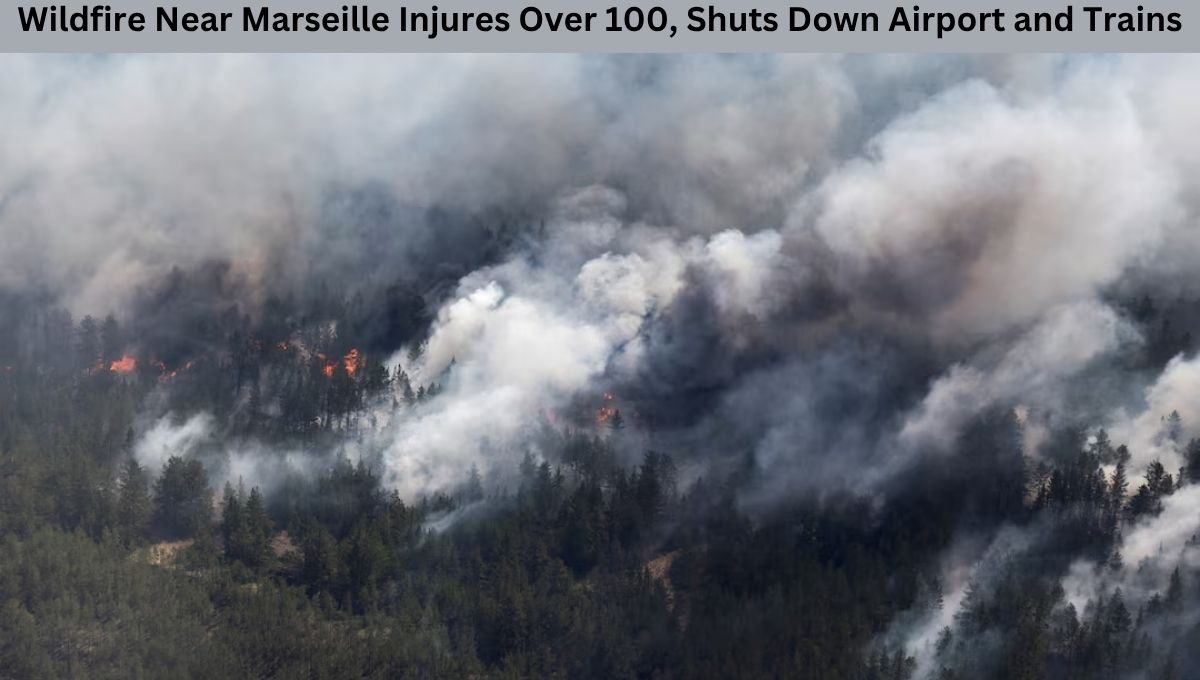
Fast-Spreading Wildfire Near Marseille Injures Over 100, Shuts Down Airport and Trains. The massive wildfire near Marseille,France’s second-largest city, has injured at least 110 people, forced hundreds of evacuations, and disrupted transportation across the region. The blaze, which started on Tuesday near Pennes-Mirabeau, north of Marseille, quickly spread due to high winds, dry vegetation, and steep terrain conditions increasingly common due to climate change.
Wildfire Near Marseille Injures Over 100, Shuts Down Airport and Trains
Emergency Response Mobilized as Fire Reaches Marseille
France’s Interior Minister Bruno Retailleau confirmed that around 800 firefighters were deployed to fight the Marseille wildfire, supported by helicopters and aircraft.
“Efforts to tackle the blaze will continue all night,” he said, noting that wind speeds of up to 70 kph (43 mph) were fanning the flames and preventing full containment.
The Marseille mayor, Benoît Payan, described the situation as a form of “guerrilla warfare,” as the city’s elite marine firefighter battalion fought the blaze with hoses in hand.
As of Tuesday evening, at least 400 residents had been evacuated and 63 homes reported damaged. Nine firefighters and 22 police officers were among those injured.
“At the moment, there are no deaths, which is remarkable given the extent of the fires,” said Minister Retailleau.
Cause of the Marseille Wildfire: Car Fire on Motorway
Initial reports suggest that the wildfire in Pennes-Mirabeau was sparked by a vehicle fire on a motorway.
The flames quickly ignited surrounding dry vegetation, turning into a fast-moving wildfire that consumed 700 hectares (1,730 acres) of land by nightfall.
“It’s very striking apocalyptic even,” said local resident Monique Baillard. The Bouches-du-Rhône region, where the fire started, has not seen any rainfall since May 19, worsening fire conditions.
Airport Closure and Train Disruption: Travel Chaos in Southern France
The Marseille Provence Airport, the fourth busiest in France, was forced to shut down from midday Tuesday. By 9:30 PM local time, it partially reopened, but not before 54 flights were canceled and 14 redirected.
“I have never experienced a situation of this magnitude,” said Julien Coffinier, the airport’s president.
Train services across the region were also heavily affected. The SNCF national rail operator canceled more than a dozen trips to and from Marseille. The company warned that train travel would remain “highly affected” into Wednesday.
Some highways and regional roads were closed to ensure emergency access, while residents were instructed not to evacuate unless officially directed, to keep routes clear for firefighters.
Residents Told to Stay Indoors, Smoke Covers City
Residents across Marseille received emergency alerts on their phones instructing them to stay indoors, seal openings with damp cloths, and avoid using roads.
“The sky is grey with ash, and the smell of fire is very strong in the center of Marseille,” said Anne, a local resident.
In the coastal neighborhood of l’Estaque, restaurant owner Simon Epenmbia described sheltering in his restaurant with family and neighbors. “We feel safer near the sea where there is less smoke,” he said.
Macron Responds from UK: “Our Thoughts Are With the Injured”
French President Emmanuel Macron, currently on a state visit to the UK, issued a statement of support via X (formerly Twitter).
“Our thoughts are with the injured and all residents,” Macron wrote, urging everyone to follow safety instructions and avoid unnecessary travel.
Fire in Narbonne Still Active, Closes Motorway
The Marseille wildfire is not the only blaze troubling southern France. A second major wildfire broke out near Narbonne on Monday, burning through 2,000 hectares of forest and prompting the closure of the A9 motorway to Spain.
Over 1,000 firefighters have been dispatched from around France to tackle the Narbonne wildfire, which continues to burn due to 60 km/h (40 mph) wind gusts.
Retiree Martine Bou, who lives near the blaze, described fleeing her home with her cats, tortoises, and dog, while her husband stayed behind to protect their property with a garden hose.
“I’ve never seen anything like it,” he told AFP. “The flames were dozens of metres high.”
Marseille Mayor Confirms 16th Arrondissement Lockdown Lifted
By early Wednesday, Mayor Benoît Payan announced that the fire was “clearly under control” and the lockdown in the 16th arrondissement had been lifted.
“I call on all Marseille residents to exercise the utmost caution in the area,” he added, emphasizing that emergency services remain active.
However, officials warned it was still too early for the evacuated residents to return to their homes.
Human Toll and Psychological Impact
In addition to the physical injuries, the emotional toll has been immense. Evacuated families watched helplessly as flames advanced toward their homes.
Children and the elderly were most affected by the intense smoke and fear of losing property.
Local hospitals were placed on high alert to manage incoming cases of smoke inhalation and heat-related issues.
Fires Across Europe: Spain and Greece Also Burning
The Marseille wildfire is part of a broader European wildfire crisis. In Catalonia, northeastern Spain, over 18,000 residents were told to stay indoors due to a wildfire in Tarragona, which has already burned nearly 3,000 hectares.
Spain is experiencing its hottest June on record, prompting wildfire alerts in multiple regions.
In Greece, 41 wildfires broke out on Monday alone. Though 34 were quickly contained, 7 remained active late into the night. Fires on the island of Crete and in Athens led to thousands being evacuated last week.
Climate Change and Wildfire Intensity
Experts say human-induced climate change is making wildfires more intense, frequent, and longer-lasting, especially in Mediterranean regions.
“We are heading toward a summer of high risk,” said Interior Minister Retailleau. The combination of record-breaking heat, extended droughts, and strong winds has created a dangerous cocktail for wildfire ignition and spread.
Damage Assessment and Future Risk
Local officials confirmed that 20 buildings had been at least partially damaged, with a dozen destroyed in and around Pennes-Mirabeau. The priority remains protecting human life and containing hotspots to prevent further spread.
Firefighters are continuing aerial surveillance to detect new outbreaks, and preventive measures including controlled burns and evacuation drills are being reviewed for other vulnerable regions.
Final Thoughts: A Summer of Fire and Urgency
As Marseille slowly begins to emerge from the smoke, the wider message is clear: Europe is facing an escalating wildfire crisis. From France to Spain to Greece, this early summer has already proven volatileand more dangerous weeks lie ahead. The Marseille wildfire, sparked by a car on a motorway, has exposed the vulnerability of even major urban centers.
With 110 people injured, over 400 evacuated, transportation halted, and homes lost, it’s a stark reminder that climate resilience is no longer optional. As firefighting teams continue to battle the blaze, and residents begin assessing damage, the nation must now look toward prevention, preparedness, and climate adaptation to protect lives and livelihoods in future summers.
Also Read: Wildfire Forces Evacuation of Thousands in Crete Amid European Heatwave
Also Read: Recurrent wildfires across the Mediterranean region are changing its landscape
Related Posts:
- Wildfire Forces Evacuation of Thousands in Crete…
- 7 Alarming Facts About Super Typhoon Fung-wong
- France in Turmoil as ‘Block Everything’ Protests…

- 7 Shocking New Revelations as Hong Kong Fire Death…

- Massive Fire Erupts at Chevron Refinery Near Los Angeles
- 7 Shocking Findings Behind Hong Kong’s Deadliest…