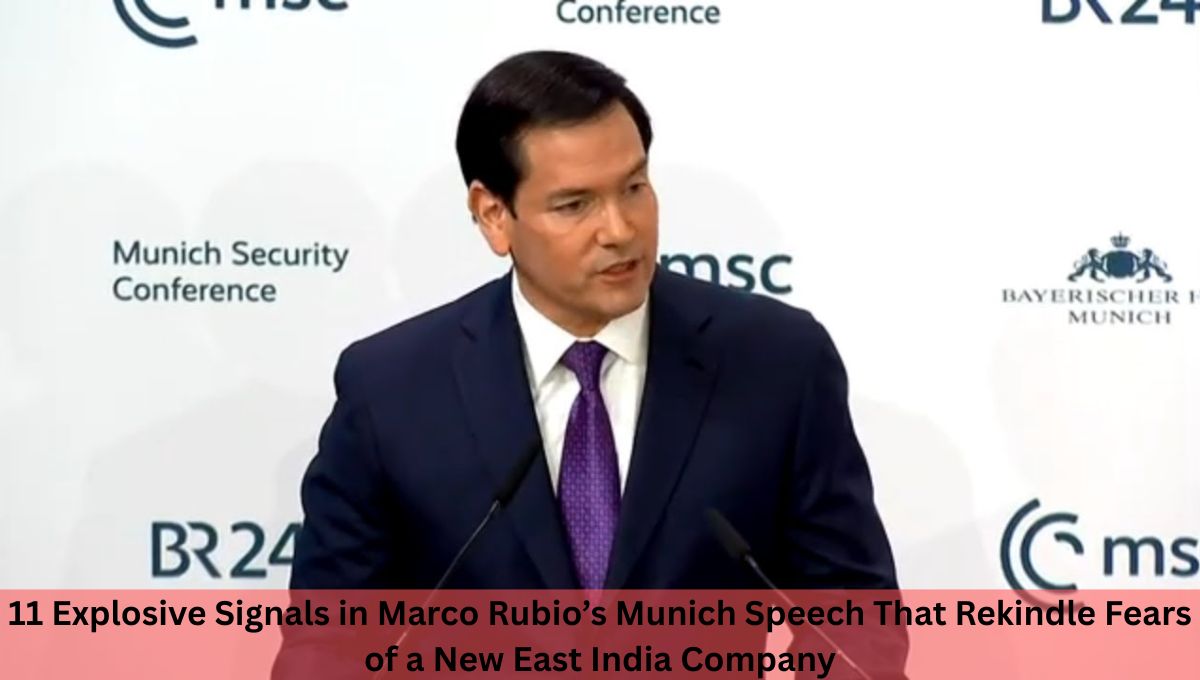
11 Explosive Signals in Marco Rubio’s Munich Speech That Rekindle Fears of a New East India Company and echo colonial-era ambitions.
When Marco Rubio took the stage at the Munich Security Conference in February, the setting was familiar:
a high-powered gathering of Western leaders, generals, diplomats, and policy elites debating the future of global security.
What followed, however, was anything but routine. Rubio’s address — framed as a civilisational rallying cry — openly called on Western nations to “compete for market share in the economies of the Global South” and to work collectively toward building a “new Western century.”
Within hours, scholars, journalists, and policymakers across Asia, Africa, and Latin America were asking an uncomfortable question:
Was the United States signalling a return to imperial logic — not through conquest, but through economic domination?
11 Explosive Signals in Marco Rubio’s Munich Speech That Rekindle Fears of a New East India Company
Why History Makes Rubio’s Words So Sensitive
For much of the 18th and 19th centuries, European empires carved up Asia and Africa under the banner of trade and civilisational uplift. Railways were built. Ports were expanded.
Institutions were imposed. But the wealth extracted rarely benefited colonised societies.
Instead, raw materials flowed outward, feeding Western industrial growth while leaving colonised regions structurally dependent, economically distorted, and socially scarred.
The human cost ran into the tens — if not hundreds — of millions.
These memories are not abstract in the Global South. They are inherited trauma.
So when Rubio framed Western engagement not as partnership or development, but as competition for market dominance, it struck a raw nerve.
What Rubio Actually Said in Munich
Rubio’s speech was expansive, unapologetic, and historically revisionist in tone.
He described the West as a single civilisational bloc:
“We are part of one civilisation — Western civilisation.”
Tracing Western power back five centuries, Rubio said that until 1945, the West had been expanding through “missionaries, pilgrims, soldiers, and explorers”, building “vast empires extending across the globe.”
He lamented that after World War II, Western power began to “contract”, blaming this decline on:
- Communist revolutions
- Anti-colonial uprisings
- What he framed as misplaced guilt and liberal universalism
Decolonisation, in Rubio’s telling, was not liberation — it was retreat.
The Global South Recast as an Economic Battleground
The most controversial part of Rubio’s address came when he outlined the future mission of this “new alliance.”
He urged Western nations to:
- Create Western-controlled supply chains for critical minerals
- Reduce dependence on rival powers
- Compete aggressively for market share in the Global South
The Global South was not described as a partner in shared prosperity. It was framed as terrain — an arena of competition.
For critics, this language echoed the earliest stages of European colonialism, which also began not with armies, but with merchants and charters.
Why the East India Company Comparison Resonates
The comparison to the East India Company did not arise by accident.
As historian William Dalrymple wrote in The Anarchy, it was not the British state that initially colonised India, but a private corporation driven by profit, protected by military force, and largely unregulated.
Trade came first. Sovereignty erosion followed.
Rubio’s emphasis on supply chains, minerals, and market capture mirrors this historical pattern — even if the methods today are financial rather than military.
Trump’s Foreign Policy Casts a Long Shadow
Rubio’s speech cannot be separated from the worldview of US President Donald Trump, under whom American foreign policy has grown increasingly transactional and unilateral.
Since returning to power, Trump has:
- Threatened territorial acquisition (including Greenland)
- Imposed sanctions on allies and rivals alike
- Used energy markets as geopolitical leverage
- Centralised decision-making within a tight personal circle
Critics argue that Rubio’s rhetoric provides intellectual cover for a strategy that treats global markets as extensions of American power.
Energy, Minerals, and Economic Coercion
Rubio’s focus on critical minerals and supply chains aligns with Washington’s growing anxiety over China’s dominance in rare earths, lithium, and strategic resources.
But for countries in Africa, Latin America, and South Asia, this raises a concern:
Will Western “competition” mean:
- Pressure to align politically in exchange for investment?
- Sanctions for independent trade choices?
- Asymmetric contracts favouring Western corporations?
India’s refusal to alter its energy policy under US pressure has already highlighted these tensions.
Experts See a Revival of Imperial Hierarchies
Indian strategic thinker Brahma Chellaney argued that Rubio’s framing was not about balance of power, but hierarchy.
He wrote that the speech sought to restore a global order that is exclusionary and reminiscent of European imperialism, cloaked in civilisational language.
French geopolitical commentator Arnaud Bertrand went further, calling it one of the most imperialist speeches ever delivered by a senior American official.
Why the Standing Ovation in Europe Matters
Perhaps the most unsettling moment came not from Rubio’s words, but from the response.
Much of the European elite audience reportedly gave him a standing ovation.
For critics, this suggested that:
- Europe is willing to subordinate itself to US leadership
- Imperial nostalgia is resurfacing under security anxieties
- Economic desperation is overriding historical accountability
The applause, many argue, symbolised complicity.
Is This Colonisation or Just Competition?
Defenders of Rubio argue that:
- Market competition is not colonisation
- No territorial control was advocated
- Globalisation always involves rivalry
That distinction is technically correct.
But history shows that colonialism often began as commerce, long before borders were redrawn.
When power asymmetry exists, competition can quickly become coercion.
Why the Global South Is Not the Same as Before
Unlike the 19th century, today’s Global South is not powerless.
- India, Brazil, and Indonesia pursue strategic autonomy
- African states diversify partners between West, China, and others
- Latin America increasingly resists unilateral pressure
These nations negotiate. They bargain. They resist.
Yet economic pressure, sanctions, and supply-chain leverage remain potent tools.
India’s Unique Position
As a country forged in anti-colonial struggle, India occupies a special moral position.
Commentators like Sanjaya Baru argue that New Delhi must call out rhetoric that revives imperial thinking, regardless of the source.
India’s response will be closely watched across the Global South.
The Ideological Undercurrent: Civilisation and Identity
Rubio’s speech leaned heavily on civilisational language — heritage, faith, borders, identity.
Critics argue this mirrors far-right narratives in both the US and Europe, reframing geopolitics as a struggle between civilisations rather than a system of sovereign equality.
Such framing historically precedes exclusion, hierarchy, and domination.
Europe’s Dilemma: Autonomy or Vassalage
European leaders now face a choice:
- Pursue strategic autonomy
- Or accept junior-partner status under US leadership
While some leaders speak of independence, actions — including muted responses to Rubio’s speech — suggest deep reluctance to confront Washington.
Why This Moment Feels Dangerous
What makes Rubio’s Munich address unsettling is not a single sentence, but the totality of its worldview:
- Empire recast as heritage
- Decolonisation reframed as decline
- Global South reduced to markets
- Power justified as civilisational destiny
This is not language of cooperation. It is language of hierarchy.
Conclusion: Empire Without Apology?
Marco Rubio’s Munich speech may be defended as rhetoric, strategy, or even provocation.
But for much of the world, it sounded like something older — and darker.
Empires rarely announce themselves as such. They speak instead of order, markets, civilisation, and destiny.
Whether the Global South accepts, resists, or reshapes this moment will determine whether the 21st century belongs to genuine multipolar cooperation — or to the return of empire economics under a new flag.
Also Read: Trump Says JD Vance ‘Most Likely’ MAGA Heir; Rubio May Join 2028 GOP Ticket
Also Read: Marco Rubio wants to build a ‘new Western century’. Will Europe join?