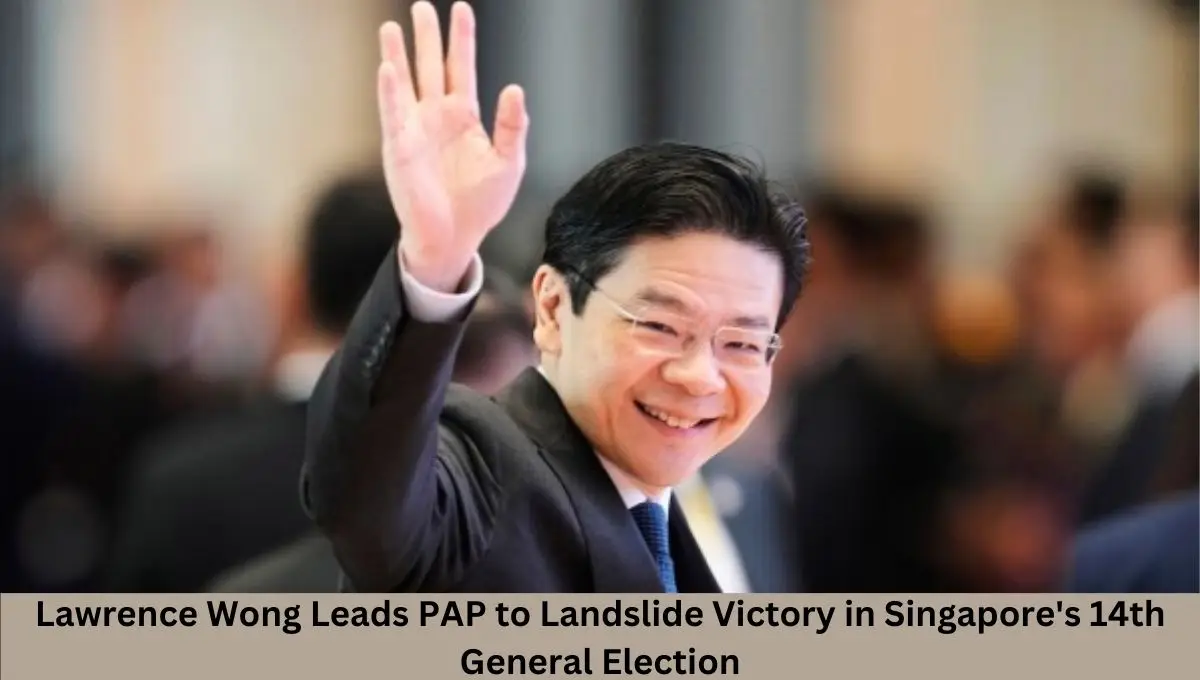
Singapore Reaffirms Trust in PAP as Lawrence Wong Leads PAP to Landslide Victory in Singapore’s 14th General Election. Singapore’s ruling People’s Action Party (PAP) secured a resounding victory in the country’s 14th General Election, winning 87 out of 97 parliamentary seats and garnering 65.57% of the valid vote share. This marks an increase from the 61.24% won in 2020, signaling a renewed mandate under Prime Minister Lawrence Wong, who faced his first electoral test as PAP’s leader.
Lawrence Wong Leads PAP to Landslide Victory in Singapore’s 14th General Election
A Milestone for Lawrence Wong’s Leadership
This historic win comes just a year after Lawrence Wong took over from Lee Hsien Loong as Singapore’s fourth Prime Minister. Wong, who also serves as Finance Minister, is the first new PAP leader to increase the party’s vote share in his debut election—a feat not achieved by his predecessors.
Speaking at a post-election press conference early Sunday morning, Wong described the result as a “clear and strong mandate to govern,” adding that it demonstrated public trust in the PAP amid global economic headwinds.
“These results place Singapore in a stronger position to confront a turbulent world,” Wong said. “They inspire us to serve you better and work to improve your lives.”
Voters Choose Stability Over Change
With global trade tensions, inflation, and economic uncertainty at the forefront of public concerns, voters appeared to opt for continuity and experience. Analysts described the result as a “flight to safety”, with citizens preferring a known and trusted leadership over the unpredictability of change.
“Singaporeans voted for political stability and economic security,” said Mustafa Izzuddin, a political analyst at the National University of Singapore.
Amid fears of a potential recession and job losses, the PAP’s campaign message focused on guiding Singapore through uncertain times. Wong warned that losing ministers to a larger opposition would weaken governance at a time when strong leadership is crucial.
Workers’ Party Holds Ground, But Makes No Gains
The Workers’ Party (WP), the main opposition, retained its 10 seats in Parliament but failed to make further inroads. Despite this, WP’s vote share improved in some constituencies, reflecting continued grassroots support.
WP leader Pritam Singh, who faced legal controversies in the lead-up to the election, acknowledged the uphill battle but urged supporters to look ahead.
“The slate is wiped clean. We start work again tomorrow,” Singh said.
The fragmented opposition, comprising 10 parties, struggled against the PAP’s deep institutional presence, broad reach, and significantly larger campaign resources.
Record Turnout and Walkover Wins
Singapore recorded a 92.47% voter turnout, despite compulsory voting laws. Notably, five PAP candidates were elected unopposed on Nomination Day (April 23), reducing the number of contested seats to 92.
This election reaffirms the PAP’s six-decade-long unbroken rule since before Singapore’s independence in 1965, making it one of the longest-ruling political parties globally.
Election Takes Place Amid Global Trade Turmoil
The victory comes as Singapore grapples with a slowdown in GDP growth, downgraded forecasts (0%-2% for 2025), and rising cost-of-living pressures. The economic backdrop includes U.S.-China trade tensions and new 10% tariffs from the United States, which may impact Singapore’s export-driven economy.
To navigate these challenges, Wong has already formed a task force led by Deputy Prime Minister Gan Kim Yong, aiming to help businesses and workers adapt. Singapore is also in talks with Washington regarding pharmaceutical trade concessions and export controls for AI chips.
International Reactions and Diplomatic Congratulation
Wong’s win drew swift congratulatory messages from global leaders. The U.S. State Department expressed its readiness to work closely with the new government, while European Commission President Ursula von der Leyen emphasized ongoing cooperation in trade, defense, and innovation.
The global response underscores Singapore’s role as a key player in Southeast Asia and a vital node in global finance and trade.
Challenges Ahead: Inflation, Housing, and Employment
While voters endorsed the PAP’s vision for stability, Wong and his team now face immediate domestic issues: rising inflation, housing shortages, and wage stagnation. The government has blamed external factors such as the Ukraine conflict and supply chain disruptions, but critics argue local policy decisions, like the GST hike, have worsened inflationary pressures.
Political observers note that while the PAP remains dominant, future elections may see stronger calls for transparency, media independence, and greater political diversity, especially from younger and first-time voters.
Looking Ahead
Despite a few scandals in recent years, the PAP’s clean governance image and Wong’s strong performance during the Covid-19 pandemic appeared to resonate with voters. Political science experts say Wong’s steady leadership during that time has solidified his credibility.
As Singapore stands at the crossroads of economic transformation and geopolitical flux, the electorate has chosen stability. With a fresh and stronger mandate, Lawrence Wong’s administration now carries the weight of expectation to steer the nation safely into the next chapter.
Also Read: COVID-19 Cases Surge in Hong Kong and Singapore: Health Officials on High Alert
Also Read: Singapore election: how ruling PAP scored massive win, denying breakthrough for opposition
Related Posts:
- 7 Alarming Facts About Super Typhoon Fung-wong
- 12 Explosive Shifts as Japan’s Iron Lady Takaichi…

- French PM François Bayrou Ousted in Confidence Vote,…

- 7 Explosive Reasons Japan’s Winter Election Could…
- 5 Historic Firsts as Rob Jetten Becomes Netherlands’…

- 7 Shocking Implications: Supreme Court Takes Up…
