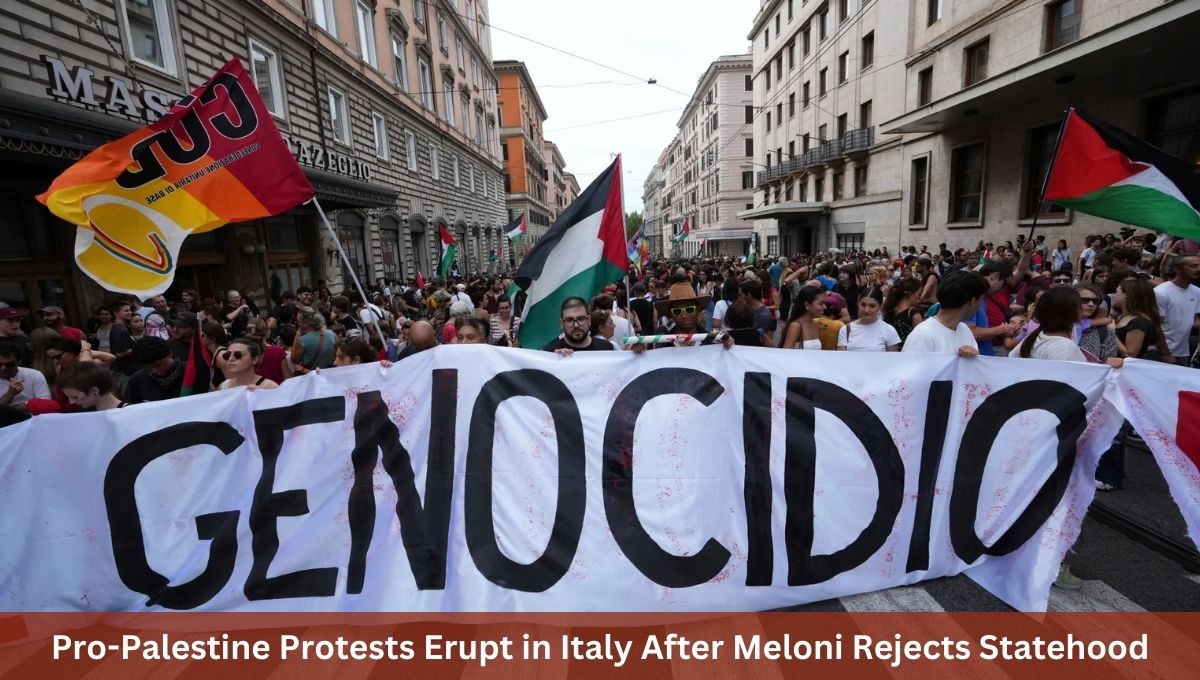
Unrest spreads nationwide: Pro-Palestine Protests Erupt in Italy After Meloni Rejects Statehood. Italy witnessed its largest wave of pro-Palestinian protests in years on Monday, as tens of thousands of demonstrators joined marches, strikes, and sit-ins across major cities to condemn the Israeli offensive in Gaza and Prime Minister Giorgia Meloni’s refusal to recognise a Palestinian state.
The protests, organised under the banner “Let’s Block Everything”, were coordinated by trade unions and grassroots groups. They swept through Rome, Milan, Naples, Bologna, Genoa, Livorno, Trieste, Venice, Florence, Bari, and Palermo, disrupting transport networks, shutting down metro lines, and blockading ports. While many rallies remained peaceful, clashes with police erupted in several cities.
In Milan, more than 60 police officers were injured after violent confrontations outside the central railway station. More than ten people were arrested in connection with the violence.
Pro-Palestine Protests Erupt in Italy After Meloni Rejects Statehood
Meloni Condemns Violence, Stands Firm on Palestine Stance
Prime Minister Calls Clashes “Shameful”
Prime Minister Giorgia Meloni responded sharply to the unrest, condemning the scenes of violence in Milan and other cities.
In a post on X (formerly Twitter), she described the protesters as “pseudo-pacifists” and “self-proclaimed Antifa members” who had “nothing to do with solidarity” for Palestinians.
“Outrageous images coming from Milan: self-proclaimed ‘pro-Pal’ individuals, self-proclaimed ‘Antifa’ members, self-proclaimed ‘pacifists’ who wreak havoc on the train station and provoke clashes with law enforcement,” Meloni wrote.
“Violence and destruction that have nothing to do with solidarity and that will not change a single thing in the lives of people in Gaza, but will have concrete consequences for Italian citizens, who will end up suffering and paying for the damages caused by these thugs.”
Meloni expressed support for law enforcement, saying officers were “forced to endure bullying and gratuitous violence.” She urged both the organisers of the strike and opposition parties to condemn the unrest “clearly and unequivocally.”
Meloni’s Position on Palestinian Statehood
While Italy voted in favour of Palestinian statehood in a symbolic UN vote earlier this month, Meloni’s government has so far rejected formal recognition, calling such a step “counter-productive.”
Her government argues that recognising a Palestinian state that does not yet exist on the ground could undermine peace efforts. Critics say Meloni’s stance leaves Italy out of step with much of Europe.
Her refusal comes as countries including France, the UK, Canada, Australia, Portugal, Spain, and Norway have recently moved to recognise Palestine formally, deepening pressure on Rome to follow suit.
Milan at the Center of Clashes
Violence at the Central Station
The most intense clashes broke out in Milan, where thousands of demonstrators converged on the city’s central train station. Protesters waving Palestinian flags smashed windows with poles, threw chairs at police, and hurled stones and smoke bombs.
Police in riot gear responded with tear gas, and the area around the station was locked down.
Local officials said more than 60 police officers were injured, some requiring hospitalisation, while at least 10 demonstrators were arrested.
Milan’s Mayor Giuseppe Sala called the vandalism “unjustifiable” and said it undermined the cause of Gaza.
Disruption to Public Transport
A key metro line in Milan was shut down for several hours, while services at the central station were temporarily suspended. Authorities said trains faced significant delays due to security concerns.
Also Read: Clashes break out as Italians strike demanding action over Gaza
Rome: Tens of Thousands March
In Rome, an estimated 20,000 protesters gathered outside Termini Station, waving Palestinian flags and chanting “Free Palestine” before marching onto a major ring road, blocking traffic for hours.
Large banners reading “Against Genocide. Let’s Block Everything” were carried by student groups and trade unions.
The protest was largely peaceful, though police clashed briefly with small groups who attempted to move into the station building.
Nationwide Strike: “Let’s Block Everything”
Dockworkers Shut Down Ports
The nationwide day of action saw dockworkers block major Italian ports, arguing that Italy should not be used as a logistical hub for arms destined for Israel.
In Venice, police deployed water cannons to disperse protesters who tried to shut down port operations.
Similar demonstrations took place at the ports of Genoa, Livorno, and Trieste, where dockworkers attempted to halt shipments linked to Israel.
Ricky, a protester from the Autonomous Port Workers’ Collective in Genoa, told reporters:
“The Palestinian people continue to give us yet another lesson in dignity and resistance. We learn from them and try to do our part.”
Highway and University Blockades
In Bologna, protesters blocked a major highway before being dispersed by water cannon. In Naples, crowds forced their way into the main railway station and briefly occupied the tracks, disrupting train services.
University students joined the strike in Turin and Bologna, blocking lecture halls and staging sit-ins.
International Context: Europe Divided on Palestine
France Leads Recognition Push
The Italian protests came on the same day that French President Emmanuel Macron formally recognised Palestine as a state at the United Nations General Assembly in New York.
Macron called the decision a “necessity”, adding that it would be the beginning of a “political process and a peace and security plan for everybody.”
The move followed recent recognition announcements by the UK, Canada, Australia, and Portugal, and added momentum to a growing European push for Palestinian statehood.
Israel Denounces Recognition Efforts
Israel condemned Macron’s move, with Prime Minister Benjamin Netanyahu describing it as a “reward for Hamas.” Israel’s UN ambassador dismissed the recognition as a “circus.”
Netanyahu reiterated that “there will be no Palestinian state to the west of the River Jordan.”
President Isaac Herzog added that recognising Palestine would only “embolden the forces of darkness.”
Other European Positions
- Spain and Norway formally recognised Palestine last year.
- Germany, one of Israel’s closest allies in Europe, has grown more critical of Israel’s military campaign in Gaza but insists recognition must come “at the end of the process.”
- Italy, under Meloni, has stood firm against immediate recognition, despite pressure from opposition parties.
Also Read: Recognition of Palestine by Western Powers: Symbolism or a Diplomatic Shift?
Gaza War Fuels Protests
Mounting Palestinian Death Toll
The demonstrations came as the war in Gaza approaches its second anniversary. According to Palestinian health authorities, more than 65,000 Palestinians have been killed since the conflict began in 2023, following Hamas’s October 7 attack on Israel.
International condemnation of Israel’s offensive has intensified, with European Commission President Ursula von der Leyen calling for an end to “the horrific events taking place in Gaza on a daily basis.”
Public Anger in Italy
Many protesters carried signs reading “Stop the Genocide”, “Italy out of the war”, and “Solidarity with Gaza.”
Strikers included teachers, students, port workers, and transport employees, with union leaders describing the action as a call to “paralyse the country until the government listens.”
Opposition Criticism of Meloni
Meloni has come under fire from left-wing political opponents who accuse her of refusing to clarify Italy’s stance on Israel in parliament.
Elly Schlein, leader of the opposition Democratic Party, mocked Meloni for giving a light-hearted TV interview about family meals on the same day other world leaders were making historic announcements on Palestine.
Schlein said Meloni’s government was “turning its back on a humanitarian catastrophe.”
The Broader Cost of Recognition
The protests also coincided with Palestinian Authority President Mahmoud Abbas’s demand that Britain pay reparations for its administration of the territory during the British Mandate (1917–1948).
Abbas put the figure at £2 trillion, a move seen by some analysts as a warning of the potential costs of recognition decisions.
Observers say this illustrates the high stakes for European governments navigating the contentious issue of Palestinian statehood.
Conclusion: Italy at a Crossroads
The dramatic scenes across Italy underscored the deepening domestic and international divisions over the Gaza war and the question of Palestinian statehood.
For protesters, Meloni’s refusal to join France, Spain, and other countries in recognising Palestine is seen as complicity with Israel’s military campaign. For Meloni, immediate recognition risks undermining Italy’s diplomatic leverage and security interests.
With dozens of police injured, widespread transport disruption, and political anger on the rise, Monday’s protests may mark a turning point in Italy’s debate over Gaza. As the conflict in Gaza grinds into its second year, and more European nations take formal steps to recognise a Palestinian state, pressure on Italy’s government to shift its position is set to intensify.
Related Posts:
- Here's How Much the Jeff Bezos–Lauren Sánchez…

- Jeff Bezos and Lauren Sanchez’s ₹430 Crore Venice…

- Awkward and Hilarious Moments at Gaza Peace Summit 2025

- 7 Dead in Explosive Iran Protests as Economic Anger…

- France in Turmoil as ‘Block Everything’ Protests…

- Trump’s 20-Point Gaza Peace Plan Gains Urgent Global…
