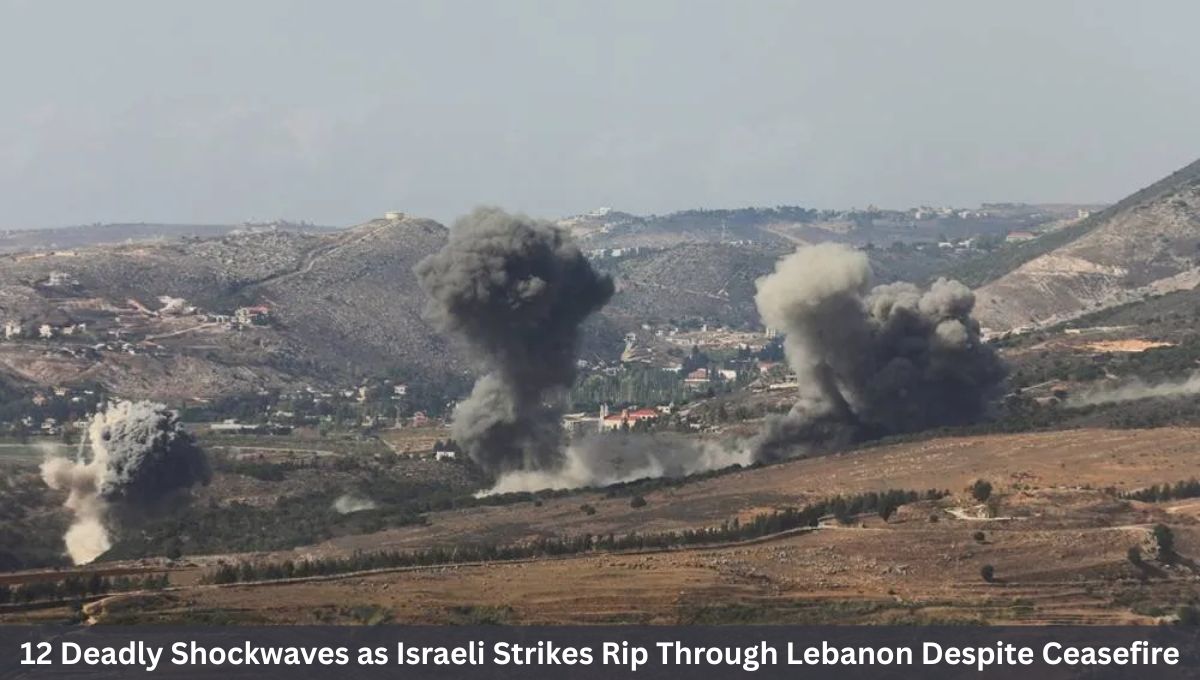
12 Deadly Shockwaves as Israeli Strikes Rip Through Lebanon Despite Ceasefire, killing at least 12 and wounding dozens. At least 12 people have been killed and dozens injured in a wave of Israeli air strikes and drone attacks across eastern and southern Lebanon, marking one of the deadliest breaches yet of the November 2024 ceasefire between Israel and the Lebanese armed group Hezbollah.
The attacks struck multiple locations in a single day, including the Bekaa Valley in eastern Lebanon and the Ain al-Hilweh Palestinian refugee camp near the southern city of Sidon. Lebanese authorities, humanitarian agencies, and the United Nations warned that the escalation risks dragging the country back toward a wider conflict, barely months after a devastating war was halted.
Israel said the strikes targeted command centres belonging to Hezbollah and Hamas, accusing both groups of violating ceasefire understandings.
Lebanese officials and Palestinian factions, however, reported significant civilian casualties, damage to residential buildings, and attacks on areas long regarded as sensitive humanitarian zones.
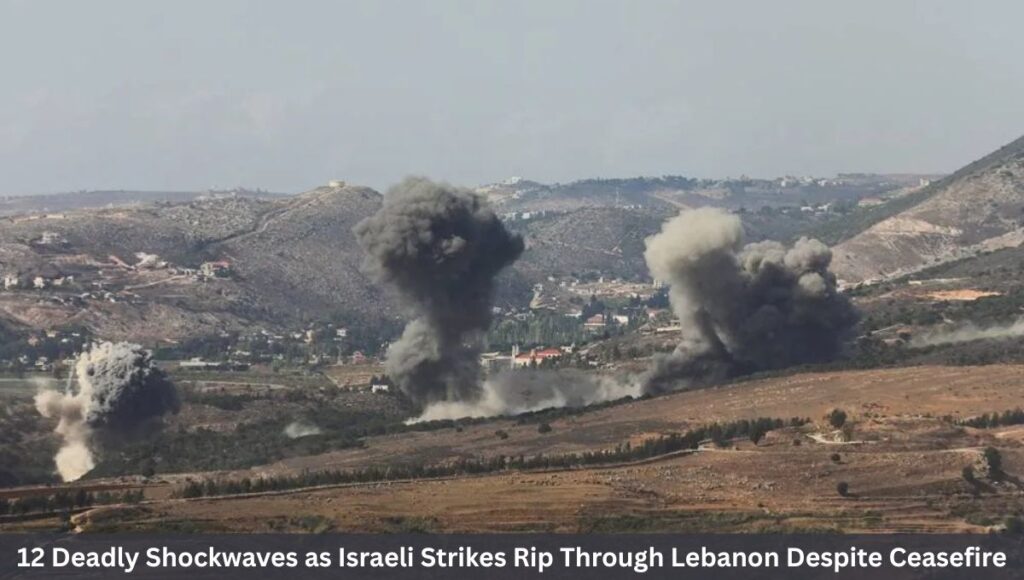
12 Deadly Shockwaves as Israeli Strikes Rip Through Lebanon Despite Ceasefire
Deadliest Strikes in the Bekaa Valley
Lebanon’s official National News Agency (NNA) reported that Israeli air strikes on the Bekaa Valley, a vast agricultural and population centre in eastern Lebanon, killed at least six people initially and wounded more than 25 others.
Later updates raised the toll to more than 10 dead and at least 30 wounded, following a strike on a residential building in the town of Riyaq, located within the Bekaa governorate.
Rescue teams continued searching the rubble for survivors well into the evening, as smoke billowed from the collapsed structure.
Victims were transported to hospitals across the region, prompting emergency appeals for blood donations amid fears that the death toll could still rise.
Israel Says Hezbollah Command Centres Were Targeted
The Israeli military said the Bekaa strikes hit “Hezbollah command centres” in the Baalbek area, accusing the group of embedding military infrastructure within civilian neighbourhoods in violation of the ceasefire agreement.
According to Israeli statements, the command centres were used to plan attacks against Israel and posed an “ongoing threat” to its security.
A Hezbollah source cited by AFP confirmed that a senior military figure was among those killed, though the group did not immediately disclose details.
Reports of Hezbollah Commanders Killed
Saudi-based outlet al-Hadath reported that three Hezbollah commanders were killed in the Baalbek strike:
- Ali Zeid al-Moussawi
- Muhammad Ibrahim al-Moussawi
- Hussein Yaghi
The report said the strike targeted a meeting of commanders, with early speculation that a commander from Iran’s Islamic Revolutionary Guard Corps (IRGC) may also have been present.
These claims could not be independently verified, and the Israeli army declined to comment on specific targets.
Reuters reported that at least one senior Hezbollah official was among the dead, while placing the casualty figure at 10 killed and up to 50 wounded.
Local television footage showed firefighters and civil defence crews combing through debris as residents looked on in shock.
Strike on Ain al-Hilweh Refugee Camp Kills Two
Earlier the same day, an Israeli drone strike hit the Ain al-Hilweh camp, Lebanon’s largest Palestinian refugee camp, killing at least two people and injuring several others.
The camp lies on the outskirts of Sidon, a densely populated coastal city in southern Lebanon.
NNA reported that an Israeli drone struck the Hittin neighbourhood inside the camp, causing significant damage to a multi-storey building.
Ambulances rushed the wounded to hospitals in Sidon, which issued urgent calls for blood donations due to the severity of injuries.
The Palestinian Red Crescent confirmed that two people were killed and three injured.
Israel Claims Hamas Command Centre Was Hit
The Israeli army said it had targeted a Hamas command centre operating inside the refugee camp, describing the site as a base from which “terrorists operated” in violation of the ceasefire.
“The IDF is operating against the entrenchment of Hamas in Lebanon and will continue to act decisively against Hamas terrorists wherever they operate,” the military said.
Hamas strongly rejected the claim, calling the strike a “flimsy pretext” and insisting the building belonged to a joint Palestinian security force tasked with maintaining order inside the camp.
According to NNA, the building had more recently been rented by an individual to operate a community kitchen distributing food aid, further fuelling outrage over civilian harm.
A History of Deadly Raids on the Camp
The Ain al-Hilweh camp has been repeatedly struck despite its sensitive humanitarian status.
In November last year, an Israeli raid on the camp killed 13 people, including 11 children, according to the United Nations human rights office.
Israel said it targeted a Hamas training compound, a claim Hamas denied, insisting it does not operate military facilities in refugee camps in Lebanon.
Palestinian factions have long warned that strikes on the camp risk destabilising an already volatile area plagued by poverty, overcrowding, and weak state control.
Israeli Drone and Gunfire Attacks Across Southern Lebanon
Beyond major air strikes, Israeli forces also carried out multiple drone and machine-gun attacks across southern Lebanon on Friday, according to NNA.
Reported incidents included:
- Machine-gun fire hitting the outskirts of Yaroun in the Bint Jbeil district
- An Israeli drone dropping a stun grenade on the town of Houla
- Gunfire from Israeli positions at Jabal Blat, one of five points Israel continues to occupy inside Lebanese territory
- Drone strikes near Markaba, with two rockets fired at dawn
The agency also reported a large demolition operation near the town of Addaisseh, though details remain limited.
Eastern Lebanon Under Constant Surveillance
In eastern Lebanon, Israeli drones were reported flying at low altitude over Baalbek and surrounding villages, maintaining pressure even after the main strikes concluded.
Residents described a night of fear as aircraft continued to circle overhead, raising concerns of further attacks.
Ceasefire Under Severe Strain
The November 2024 ceasefire was brokered to halt more than a year of hostilities between Israel and Hezbollah that escalated into full-scale war in September 2024.
Since the truce:
- Israel has launched more than 10,000 air and ground attacks, according to the UN
- At least 108 civilians have been verified killed since the ceasefire, including 21 women and 16 children
- Hezbollah has claimed one strike against Israel since the agreement took effect
Lebanon filed a formal complaint with the United Nations Security Council last month, urging it to pressure Israel to end violations and fully withdraw from Lebanese territory.
Five Areas Still Occupied by Israel
Israel continues to occupy five strategic areas inside Lebanese territory seized during the last war, blocking:
- Reconstruction of destroyed border villages
- The return of tens of thousands of displaced residents
- Agricultural and economic recovery in affected regions
Lebanese officials say the continued occupation directly violates the ceasefire’s core provisions.
Broader Regional Tensions Loom
The latest escalation comes amid growing fears of a wider regional conflict, as the United States has warned it could strike Iran, a key backer of Hezbollah and Hamas, if nuclear talks fail.
During last year’s Israel-Iran confrontation, Hezbollah largely avoided direct engagement. However, Lebanese analysts warn that renewed Israeli-Iranian hostilities could once again pull Lebanon into the crossfire.
Human Cost of the War So Far
Lebanon’s Ministry of Public Health says:
- More than 4,000 people were killed
- Around 17,000 injured
during Israel’s military campaign that began in October 2023 and escalated into full-scale war before ending with the 2024 ceasefire.
Entire towns along the southern border remain in ruins, while thousands of families are still displaced.
Conclusion: A Truce in Name Only?
Friday’s deadly strikes underscore how fragile—and perhaps hollow—the ceasefire has become.
While Israel insists it is acting against militant entrenchment, the rising civilian toll, repeated attacks on refugee camps, and ongoing territorial occupation are fuelling anger in Lebanon and drawing increasing scrutiny from international bodies.
With dozens wounded, entire buildings flattened, and tensions spreading beyond the border, fears are mounting that Lebanon is once again sliding toward a conflict it can ill afford—economically, politically, or humanely.
For now, the ceasefire remains on paper. On the ground, however, the sound of drones and air strikes tells a far darker story.
Also Read: 7 Explosive Signals as Israeli Strikes in Lebanon Threaten Ceasefire
Also Read: Senior Hezbollah leader among 10 killed in Israeli strikes on Lebanon
Related Posts:
- 7 Explosive Signals as Israeli Strikes in Lebanon…
- Camp Mystic TikTok Turns Tragic: Texas Flash Flood…

- Trump’s 20-Point Gaza Peace Plan Gains Urgent Global…

- Afghanistan–Pakistan War 2025: Inside the 48-Hour Ceasefire

- In 8 Moves, EU Targets China-Linked Refineries and…

- 7 Powerful Measures: Trump Sanctions Russian Oil…
