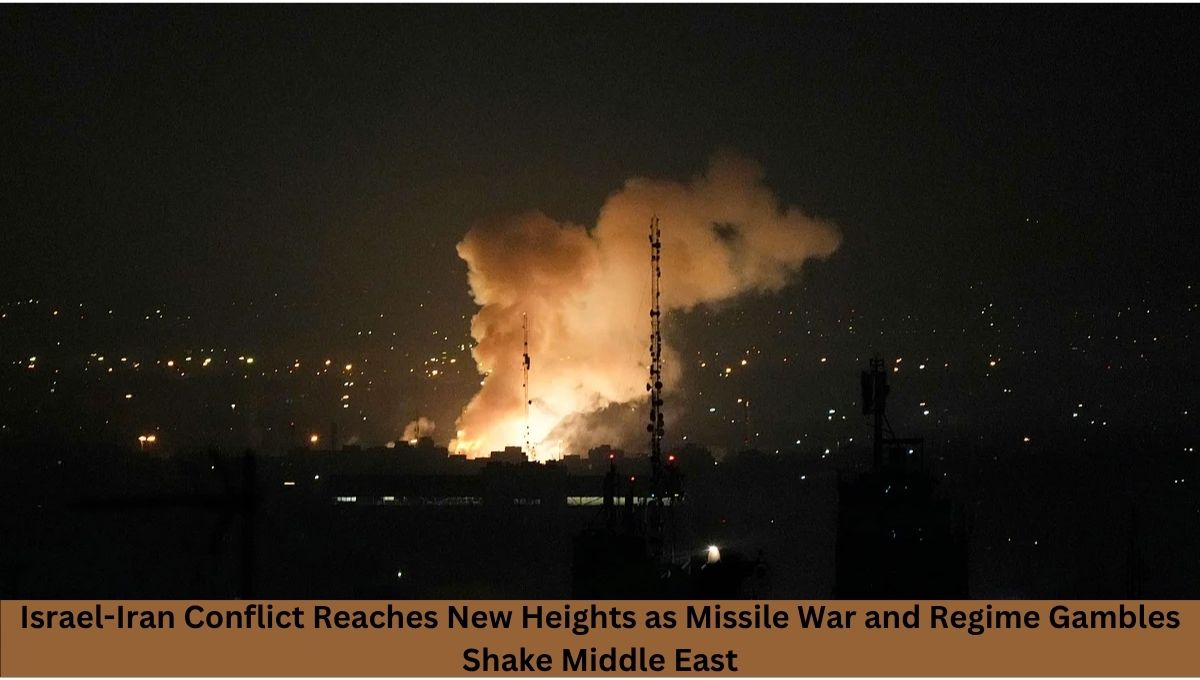
The tension in Israel-Iran Conflict Reaches New Heights as Missile War and Regime Gambles Shake Middle East. The Middle East is on the brink of catastrophe as Israel and Iran engage in the most open and intense military confrontation in their decades-long rivalry. The Operation Rising Lion and Iranian missile strikes signal open warfare.
What began as covert operations and proxy wars has erupted into full-scale missile exchanges, direct airstrikes, and a bold Israeli gamble for regime change in Tehran. Israel and Iran have entered their most dangerous conflict yet.
Israel-Iran Conflict Reaches New Heights as Missile War and Regime Gambles Shake Middle East
Operation Rising Lion: Israel’s Largest Assault on Iran
In a move that stunned global observers, Israel launched its biggest-ever military strike on Iranian soil under the codename Operation Rising Lion.
On Friday morning, more than 200 Israeli aircraft struck over 100 targets across Iran, including critical nuclear facilities at Natanz, Isfahan, and Fordow. Initial reports suggest the destruction of the Natanz pilot enrichment plant one of Iran’s key uranium processing sites.
But the operation was not limited to air power. In a stunning show of coordination, Mossad agents operating inside Iran for months had set up drone launch bases near Tehran.
Israeli intelligence sources confirm that explosive drones and precision-guided weapons were pre-positioned to pave the way for the airstrikes, which left Iran’s air defenses overwhelmed and ineffective.
Mossad Infiltration: The Turning Point in Israel-Iran Conflict
While Mossad’s covert activities in Iran are nothing new, the depth of infiltration during Operation Rising Lion marks a dramatic shift. From assassinations of Iranian nuclear scientists to the 2018 raid of Iran’s nuclear archive, Mossad has long played a shadowy but powerful role.
Now, their direct role in facilitating regime-targeted strikes signals a strategic leap. Israeli operations also reportedly killed high-ranking military figures, including General Hossein Salami, head of the Revolutionary Guard, and General Amir Ali Hajizadeh, architect of Iran’s ballistic missile program.
By targeting the upper echelons of Iran’s military structure, Israel sent a clear message: this is not just about neutralizing nuclear threats it’s psychological warfare aimed at regime destabilization.
Iran’s Response: Operation True Promise and Missile Retaliation
Iran retaliated swiftly on Saturday with Operation True Promise, unleashing dozens of ballistic missiles aimed at Israeli cities, including Tel Aviv and Jerusalem.
Air raid sirens echoed across the country as the Iron Dome defense system intercepted many incoming projectiles but not all.
One man and one woman were killed in Rishon Lezion, and at least 34 others were injured in Tel Aviv and surrounding areas.
Israel confirmed additional casualties in the West Bank, where a missile strike killed five Palestinians, including three children blamed on Iran-aligned Houthi rebels launching attacks from Yemen.
Iran also claimed that Israeli missiles struck Mehrabad Airport and military installations in Tehran, with over 78 fatalities reported, including senior IRGC officials.
Netanyahu’s Broader Agenda: Regime Change in Iran?
While Israel defends its military strikes as self-defense against a nuclear threat, Prime Minister Benjamin Netanyahu’s statements suggest a much larger ambition: regime change.
In an unprecedented message directed at the Iranian people, Netanyahu urged them to “rise up” against their “oppressive regime,” hinting that Israel hopes to trigger domestic unrest from within.
By decapitating Iran’s military leadership and destabilizing the government’s sense of control, Netanyahu appears to be betting on psychological pressure and internal dissent to push the regime to collapse or at least crack.
Iran’s Strategic Dilemma: Retaliate or Return to Talks?
Tehran now finds itself in a precarious position. If it escalates further, it risks inviting U.S. intervention and plunging the region into an all-out war.
But returning to the nuclear negotiation table would appear weak especially after such a public military humiliation. Iran’s Foreign Ministry has already downplayed the upcoming Oman-hosted nuclear talks, accusing the U.S. of hypocrisy.
Supreme Leader Ayatollah Khamenei vowed that “nowhere in Israel will be safe,” suggesting more retaliatory strikes are imminent.
Meanwhile, Iran has ruled out diplomacy with Washington, calling nuclear talks “a dead process” due to the U.S.’s failure to restrain Israeli aggression.
Trump Steps In: Urges Diplomacy, Warns of Escalation
Former U.S. President Donald Trump has reentered the spotlight, calling for diplomacy and offering to restart talks with Iran. In a surprising intervention, Trump revealed that U.S. air defenses had assisted in intercepting Iranian missiles aimed at Israeli cities.
He warned Tehran that continued aggression could lead to “even more devastating” retaliation. “I tried very hard to save Iran from humiliation and death,” Trump said. “It’s not too late.
They can still choose peace.” However, Iranian leaders have swiftly rejected the overture, reinforcing their belief that diplomacy with Washington is futile.
High-Profile Iranian Deaths Spark Outrage in Tehran
Israeli operations killed several top Iranian commanders, sparking outrage and public mourning across Iran. Among those confirmed dead are:
- General Mohammad Bagheri, Chief of the Armed Forces
- General Hossein Salami, Revolutionary Guard commander
- General Amir Ali Hajizadeh, head of the missile program
Khamenei addressed the nation directly, branding Israel a “malevolent enemy” and promising “a heavy and ruinous” response. Anti-Israel rallies erupted in major Iranian cities, further inflaming tensions.
Planning Began After Hezbollah Leader’s Assassination
Israeli intelligence sources suggest that planning for Operation Rising Lion began as early as November 2024, following the controversial assassination of Hassan Nasrallah, the Hezbollah leader.
Analysts now see the strike as part of a broader strategy aimed at reshaping the regional power balance and dismantling the Iran-Hezbollah alliance.
With Hezbollah and Hamas severely weakened in earlier Israeli operations, Tehran now finds itself increasingly isolated even among its traditional proxies.
Global Reactions: Calls for De-escalation
Global leaders have called for immediate restraint. U.N. Secretary-General Antonio Guterres appealed for a halt to hostilities, stating, “Diplomacy must prevail over war.”
India issued a statement expressing “deep concern” over the airstrikes and confirmed that Prime Minister Narendra Modi spoke directly with Netanyahu to urge de-escalation.
There are growing fears that neighboring countries like Syria and Iraq, where Israeli and Iranian forces have clashed before, could become new battlefronts in an expanding war.
Regime Collapse or Regional Chaos?
Even if Israel succeeds in toppling the Iranian regime, what comes next is unclear. Figures like Reza Pahlavi, son of the late Shah, have visited Israel and received symbolic support, but they lack a strong domestic base.
Other opposition groups like the MEK are viewed with suspicion and offer no clear democratic alternative. Iran’s internal opposition remains fragmented.
Despite waves of dissent, including the 2022 “Woman, Life, Freedom” protests, there’s no unified movement ready to replace the Islamic Republic. A sudden collapse could plunge Iran and the broader region into chaos and instability.
Final Word: A Region on the Edge
The Israel-Iran conflict has reached a dangerous new phase. What was once a covert cold war has become an open military confrontation, with Operation Rising Lion and Operation True Promise dragging the region toward full-scale war.
With major cities bombed, nuclear facilities destroyed, and military leaders assassinated, the stakes couldn’t be higher. Whether diplomacy can pull both sides back from the brink or whether the Middle East is now locked into a new era of instability remains to be seen.
Also Read: Trump Hails Israeli Strike on Iran as “Excellent,” Warns Tehran to Make a Deal or Face More Attacks
Also Read: Israel-Iran conflict: Crude oil prices jump over 13%; Brent crude oil above $73 per barrel
Related Posts:
- Afghanistan–Pakistan War 2025: Inside the 48-Hour Ceasefire

- In 8 Moves, EU Targets China-Linked Refineries and…

- 7 Powerful Measures: Trump Sanctions Russian Oil…

- Trump’s 20-Point Gaza Peace Plan Gains Urgent Global…

- Dramatic Moments Behind Trump’s Gaza Peace Push and…

- 7 Powerful Insights into Zohran Mamdani’s Historic…