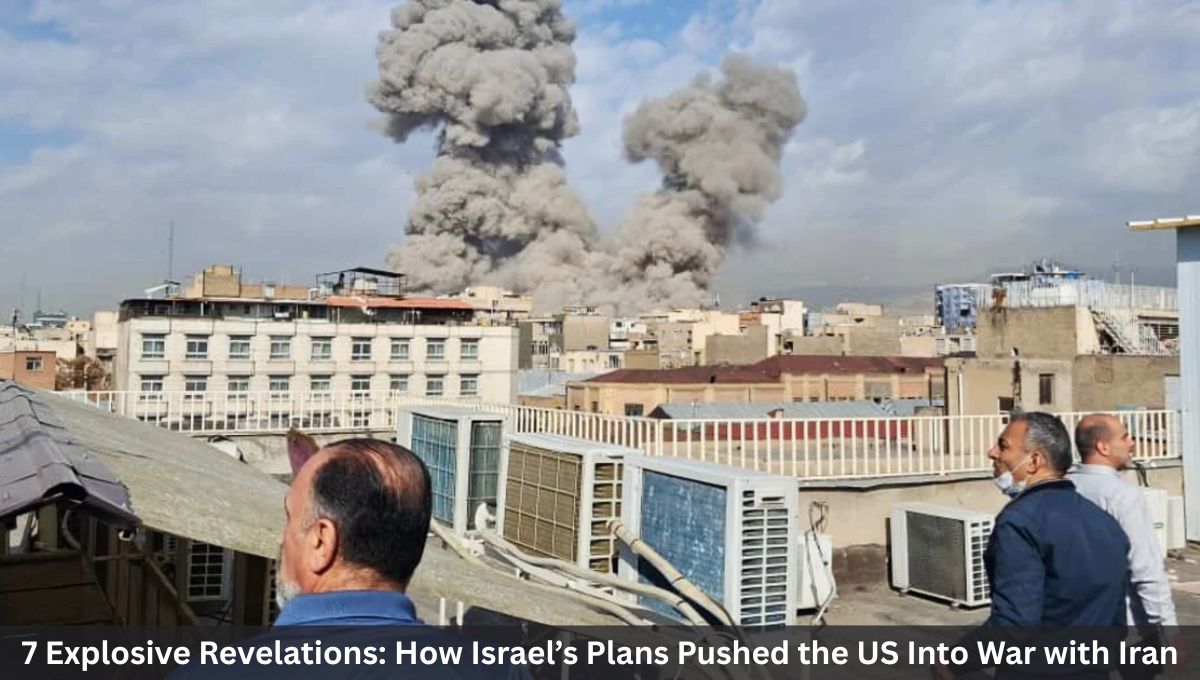
7 Explosive Revelations: How Israel’s Plans Pushed the US Into War with Iran and Washington’s strike on Iran was pre-emptive. The United States entered direct conflict with Iran only after concluding that Israel was poised to launch its own attack — and that Tehran would almost certainly retaliate by striking American forces across the Middle East.
That was the clearest explanation yet offered by Marco Rubio, who on Monday publicly defended Washington’s decision to conduct pre-emptive airstrikes alongside Israel, sharply escalating a regional war already destabilizing the global order.
Speaking at the US Capitol ahead of a classified briefing for lawmakers, Rubio said American intelligence had reached a stark conclusion:
if Israel attacked Iran first, US troops would inevitably become targets — and waiting would have cost American lives.
7 Explosive Revelations: How Israel’s Plans Pushed the US Into War with Iran
Why Washington Chose to Strike First
“We knew that there was going to be an Israeli action,” Rubio told reporters. “We knew that that would precipitate an attack against American forces.”
According to Rubio, Iranian commanders had been instructed to automatically target US personnel and installations if Iran came under attack by any party.
Faced with that intelligence, the Trump administration decided that absorbing the first blow was not an option.
“If we didn’t pre-emptively go after them before they launched those attacks,” Rubio said, “we would suffer much higher casualties.”
The strikes, he insisted, were framed inside the administration as a defensive necessity, not an elective war.
The “Imminent Threat” Argument
A central controversy surrounding the US strikes is whether Iran posed an imminent threat — a key legal threshold under American and international law, especially as the US Constitution grants Congress the authority to declare war.
Pressed repeatedly on that point, Rubio again pointed to Israel’s plans.
“There absolutely was an imminent threat,” he said. “The imminent threat was that we knew that if Iran was attacked — and we believed they would be attacked — that they would immediately come after us.”
In short, Rubio argued that Israel’s certainty of action created immediacy, even if Iran had not yet fired a shot at the United States.
Congress Briefed — and Divided
Rubio’s remarks came as members of Congress received the first closed-door briefing since Donald Trump ordered US forces into the conflict.
Also present were:
- John Ratcliffe
- Dan Caine
The briefing preceded an expected House vote on a war powers resolution that could compel Trump to end hostilities unless Congress formally authorizes the war.
Republicans control both chambers, making passage unlikely — but the debate has exposed sharp political and constitutional fault lines.
Democrats Push Back: “A War of Choice”
Democratic lawmakers reacted with alarm, arguing Rubio’s explanation suggested that Israel’s unilateral decision-making had dragged the United States into war.
Representative Joaquin Castro called the situation “unacceptable,” writing that Israel’s actions had placed American troops at risk.
Senate Democratic leader Chuck Schumer described the conflict as a “war of choice” and said the administration’s answers raised more questions than they resolved.
“This is Trump’s war,” Schumer said. “He has no strategy. He has no endgame.”
Concerns Over a Dangerous Precedent
Perhaps the most serious warning came from Mark Warner, vice-chair of the Senate Intelligence Committee.
Warner cautioned that equating a threat to Israel with an imminent threat to the United States could fundamentally reshape US war-making standards.
“If we equate a threat to Israel as the equivalent of an imminent threat to the United States,” he said, “then we are in uncharted territory.”
His remarks underscored fears that alliance dynamics — not direct attacks — could become triggers for future wars.
JD Vance: The Nuclear Objective
Vice President JD Vance, speaking separately to Fox News, framed the conflict more narrowly.
“The president wants to make it clear,” Vance said, “that Iran cannot have a nuclear weapon.”
Unlike Rubio, Vance has historically opposed foreign military interventions and has spoken less frequently about the Iran operation, making his comments closely watched.
Iran, for its part, continues to deny seeking a nuclear bomb.
What the US Says the War Is — and Is Not — About
Rubio emphasized that regime change is not the official military objective, even as senior US officials openly speculate about Iran’s future.
“The objectives of this operation are to destroy their ballistic missile capability and their naval capability,” Rubio said.
At the same time, he added:
“We would not be heartbroken if the Iranian people overthrow this government.”
The distinction — welcomed privately but denied publicly — has only deepened skepticism among lawmakers about Washington’s true endgame.
Israel’s Role: Acting With or Without Washington
House Speaker Mike Johnson defended Trump’s decision, arguing Israel would have acted regardless of US support.
“Israel faced what they deem to be an existential threat,” Johnson said. “They were determined to act with or without American backing.”
That assessment aligns with comments from Israeli Prime Minister Benjamin Netanyahu, who said Iran was nearing a point where its missile and nuclear programs would become immune to attack.
“If no action was taken now,” Netanyahu warned, “no action could be taken in the future.”
Escalation Across the Middle East
Since the war began:
- US and Israeli forces have launched waves of airstrikes across Iran
- Tehran has retaliated with drone and missile attacks on US-aligned states
- Senior Iranian political and military leaders have been killed
- Six US service members have died, according to the Pentagon
Iranian officials report more than 500 civilian deaths, while regional instability has spread rapidly.
The Death of Khamenei and the Shockwaves That Followed
Among those killed was Iran’s supreme leader, Ayatollah Ali Khamenei, a development that has profoundly altered the strategic landscape.
His death removed the central pillar of Iran’s political system and intensified fears of:
- Internal collapse
- Uncontrolled retaliation
- Proxy warfare spiraling into direct state conflict
Energy Markets and Global Fallout
The conflict has already rattled the global economy.
Oil and gas prices surged after Iranian actions near the Strait of Hormuz, a chokepoint for nearly one-fifth of the world’s oil supply.
Rubio said the administration anticipated the shock and is preparing mitigation measures led by Treasury Secretary Scott Bessent and Energy Secretary Chris Wright.
Americans Urged to Leave the Region
As security deteriorated, the US State Department urged American citizens in more than a dozen Middle Eastern countries — including Gulf states, Israel, Lebanon, Syria and Egypt — to “depart now” using commercial transportation.
The advisory reflects mounting fears that the conflict could widen further.
The War Powers Vote Ahead
The House of Representatives is expected to vote later this week on the war powers resolution.
Even if it passes:
- Trump could veto it
- Overriding the veto would require a two-thirds majority
- Republicans have signaled strong opposition
Previous war powers efforts in this Congress have failed, and Johnson expressed confidence the latest measure would also be defeated.
“The Hardest Hits Are Yet to Come”
Perhaps the most sobering note came when Rubio was asked how long the conflict might last.
“I don’t know how long it will take,” he said. “The hardest hits are yet to come.”
The statement reinforced fears that the most destructive phase of the war may still lie ahead.
Conclusion: A War Shaped by Alliance, Not Attack
Rubio’s explanation marks a pivotal moment in US foreign policy.
For the first time in decades, Washington has openly acknowledged launching a major war not because it was attacked, but because an ally’s actions made retaliation against American forces inevitable.
Whether that logic holds — legally, strategically, or historically — will be debated long after the bombs stop falling.
For now, the Middle East stands on edge, global markets are bracing for shocks, and the world is watching how far this conflict will go.
Also Read: 27 Powerful Assassinations: How Israel’s Strikes Decimated Iran’s Top Leadership
Also Read: Netanyahu reportedly pushed Trump to war with Iran for months
Related Posts:
- Marco Rubio Visits Israel After Israeli Strike on…

- 7 Powerful Measures: Trump Sanctions Russian Oil…

- Massive Nationwide Protests Demand 'Hands Off!' from…

- 11 Explosive Warnings as Trump Vows to ‘Knock the…

- 17 Explosive Strikes: Israel-US Launch Power Play as…
- Trump’s 20-Point Gaza Peace Plan Gains Urgent Global…
