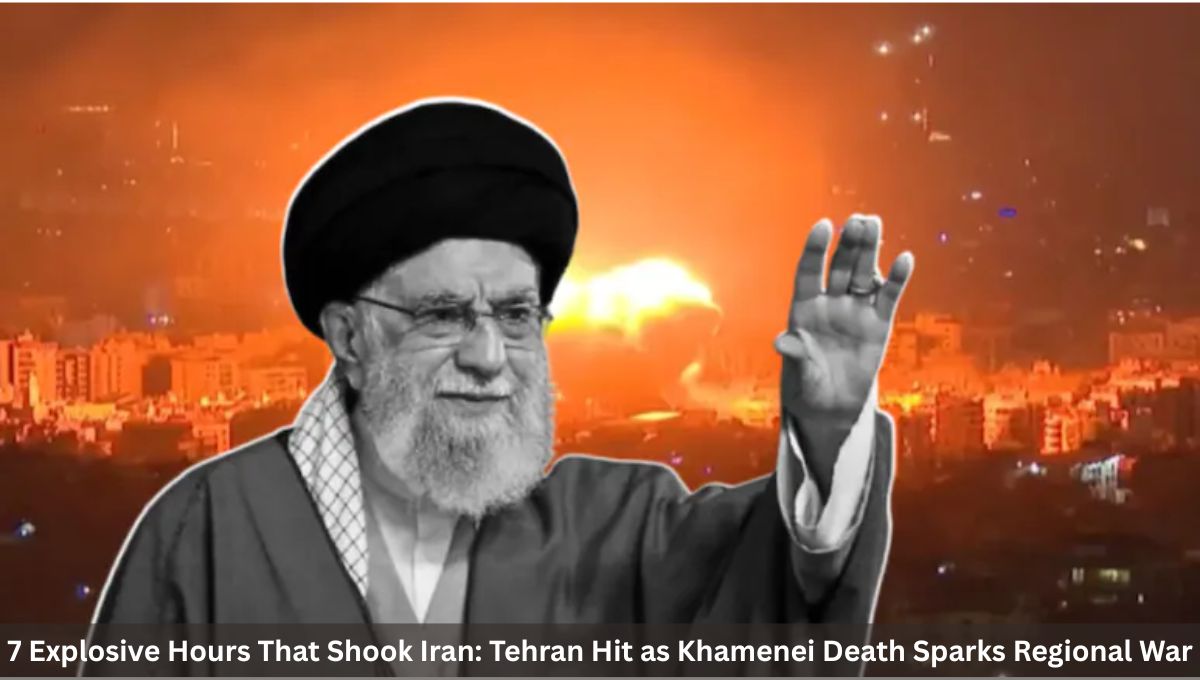
7 Explosive Hours That Shook Iran: Tehran Hit as Khamenei Death Sparks Regional War and Iran declares 40-Day national mourning. Multiple explosions tore through Tehran on Sunday as Israel confirmed it was striking the “heart” of the Iranian power structure—just hours after Iran vowed revenge for the confirmed killing of its Supreme Leader, Ayatollah Ali Khamenei, in joint US-Israeli attacks.
The rapidly escalating conflict has pushed the Middle East into one of its most dangerous moments in decades, with missile strikes reported across several Gulf states, leadership decapitation claims shaking Iran’s political foundations, and growing fears that the confrontation could spiral into a full-scale regional war.
7 Explosive Hours That Shook Iran: Tehran Hit as Khamenei Death Sparks Regional War
Explosions Rock Tehran as Israel Targets Iran’s Core
Residents in northern Tehran reported multiple loud blasts early Sunday, with videos circulating online showing a towering plume of smoke rising from a struck building.
In a statement, the Israel Defense Forces said its air force was carrying out large-scale strikes deep inside the Iranian capital.
“The IDF is striking targets belonging to the Iranian terror regime in the heart of Tehran. Over the past day, the Israeli Air Force conducted extensive operations to establish aerial superiority and pave the path to Tehran,” the statement said.
Israeli officials described the strikes as part of a broader campaign aimed at dismantling Iran’s military, missile, and command infrastructure following stalled nuclear negotiations and intelligence claims that Tehran had resumed prohibited nuclear activities.
Iran Vows Revenge After Khamenei’s Death Confirmed
The latest attacks came hours after Iranian state television confirmed that Supreme Leader Ayatollah Ali Khamenei had been killed in coordinated US-Israeli airstrikes launched the previous day.
Khamenei, 86, had ruled Iran since 1989 and was the ultimate authority over the military, judiciary, foreign policy, and nuclear strategy.
His death represents the most severe blow to Iran’s leadership since the 1979 Islamic Revolution. Iran’s Revolutionary Guards issued a stark warning shortly after confirmation.
“The most ferocious offensive operation in the history of the Islamic Republic’s armed forces will begin any moment now,” the Islamic Revolutionary Guard Corps said in a Telegram post, vowing to strike “occupied territories and American terrorist bases” across the region.
Missiles Fly Across the Gulf as Region Braces for War
Iranian retaliation began swiftly. Missiles and drones were launched toward Israel and US military installations across the Middle East, with explosions and interceptions reported in Qatar, the United Arab Emirates, Bahrain, Kuwait, Saudi Arabia, Jordan, and Iraq.
Gulf cities including Dubai and Abu Dhabi activated emergency security alerts as air defenses engaged incoming threats.
Debris from intercepted missiles caused damage in parts of the UAE, while ports and critical infrastructure were temporarily shut down as a precaution.
Israel confirmed that Iranian strikes had reached its territory, including Tel Aviv, where air-raid sirens sounded repeatedly overnight.
Operation ‘Epic Fury’: The Strike That Changed the Region
The US-Israeli campaign—named Operation Epic Fury—reportedly targeted Iranian missile sites, air defenses, nuclear-linked facilities, and senior leadership compounds across multiple provinces.
According to Iranian media, Khamenei was killed inside his secure compound during the opening wave of strikes.
State outlets later reported that his daughter, son-in-law, and grandchild were also killed, alongside senior security officials.
US President Donald Trump publicly confirmed the death in a social media post, calling the operation a decisive blow against what he described as a global security threat.
“If Iran retaliates, it will be met with a force never seen before,” Trump warned in a follow-up message.
Israeli Prime Minister Benjamin Netanyahu said there were “many signs” that Khamenei was no longer alive and urged Iranians to rise against the ruling system.
Iran Enters 40-Day Mourning as Protests and Rallies Erupt
Iranian authorities declared a 40-day national mourning period following Khamenei’s death, with President Masoud Pezeshkian announcing additional public holidays.
Reporting from Tehran, Al Jazeera correspondents said thousands of mourners poured into the streets despite ongoing bombardment.
Large crowds gathered at major religious sites, including the shrine of Imam Reza in Mashhad, where state television showed scenes of grief, chanting, and collapse.
At the same time, Reuters cited witnesses reporting small pockets of celebration in parts of Tehran, Karaj, and Isfahan—highlighting deep internal divisions within Iranian society.
Regional Fallout: Iraq, Pakistan, and Beyond
The shockwaves spread far beyond Iran’s borders.
In Iraq, authorities declared three days of mourning as protesters stormed areas near Baghdad’s Green Zone, clashing with security forces and attempting to mobilize toward the US Embassy.
In Pakistan’s Karachi, crowds set fire to and vandalized the US consulate, according to verified footage aired by regional broadcasters.
Across Lebanon, Yemen, and Syria, Iran-aligned groups issued statements praising Khamenei as a martyr and warning that retaliation would be prolonged and multi-front.
Who Governs Iran Now? Interim Leadership Explained
Following the Supreme Leader’s death, Iranian state media announced that an interim three-member council would temporarily assume leadership responsibilities.
The council consists of:
- The president
- The head of the judiciary
- A senior jurist from the Guardian Council
This arrangement is provided for under Iran’s constitution until a new Supreme Leader is formally selected.
The ultimate authority to appoint a successor rests with the Assembly of Experts, an 88-member clerical council whose members are vetted by the Guardian Council.
Succession Spotlight: Who Is Mojtaba Khamenei?
Speculation has intensified around Mojtaba Khamenei, the late leader’s second-eldest son, as a possible successor.
A powerful behind-the-scenes figure, Mojtaba has long maintained close ties with the IRGC and Iran’s security apparatus.
However, his candidacy faces major obstacles:
- He does not hold the rank of ayatollah
- Hereditary succession is deeply controversial in Iran
- Senior clerics remain divided over his religious credentials
Despite this, analysts note that in times of crisis, power dynamics—particularly IRGC backing—may outweigh formal clerical norms.
IRGC’s Central Role in the Post-Khamenei Era
The IRGC now stands at the center of Iran’s power structure.
Answering directly to the Supreme Leader, the Guards control:
- Iran’s missile and drone programs
- The Quds Force and regional proxy networks
- Internal security via the Basij
With Khamenei gone, the IRGC is expected to wield unprecedented influence during the transition, shaping both military responses and political outcomes.
Civilian Toll Mounts as Attacks Continue
Iranian state media reported that at least 201 people were killed and more than 700 wounded in the initial US-Israeli strikes across 24 provinces.
One of the deadliest incidents occurred in southern Iran, where an airstrike reportedly hit an elementary girls’ school in Minab, killing at least 148 people.
The figures could not be independently verified.
Israel and the US maintain that their targets were military and leadership facilities, while Iran has accused them of war crimes.
International Alarm and UN Warnings
An emergency meeting of the UN Security Council exposed sharp divisions, with the US defending the strikes as lawful and necessary, and Iran condemning them as crimes against humanity.
UN Secretary-General António Guterres urged all sides to halt attacks and return to diplomacy.
“The alternative is a wider conflict with grave consequences for civilians and regional stability,” he warned.
Why This Moment Is Historic—and Dangerous
The confirmed killing of Iran’s Supreme Leader is a geopolitical earthquake.
It has:
- Removed the central pillar of Iran’s political system
- Triggered immediate regional retaliation
- Opened an uncertain and potentially violent succession process
- Raised the risk of a multi-front Middle East war
Even as missiles continue to fly and leaders trade threats, one reality is clear: the Middle East has entered uncharted territory.
What Comes Next
- Iran’s retaliation is ongoing
- Israel and the US signal readiness for escalation
- The IRGC consolidates power during transition
- Succession battles loom behind closed doors
Above all, the situation remains fluid, volatile, and extraordinarily high-stakes—where every strike, statement, and decision could reshape the region for years to come.
Also Read: 11 Explosive Signals From US–Iran Nuclear Talks as War Fears Rise and Khamenei Warns Trump
Also Read: Ayatollah Arafi to lead Iran temporarily after Supreme Leader Khamenei’s death
Related Posts:
- 17 Explosive Strikes: Israel-US Launch Power Play as…
- 11 Explosive Warnings as Trump Vows to ‘Knock the…

- 11 Explosive Developments as Iran Warns US Over…
- Israel Strikes Iranian Airfields, Destroys 15 Jets…
- 7 Dead in Explosive Iran Protests as Economic Anger…

- Afghanistan–Pakistan War 2025: Inside the 48-Hour Ceasefire
