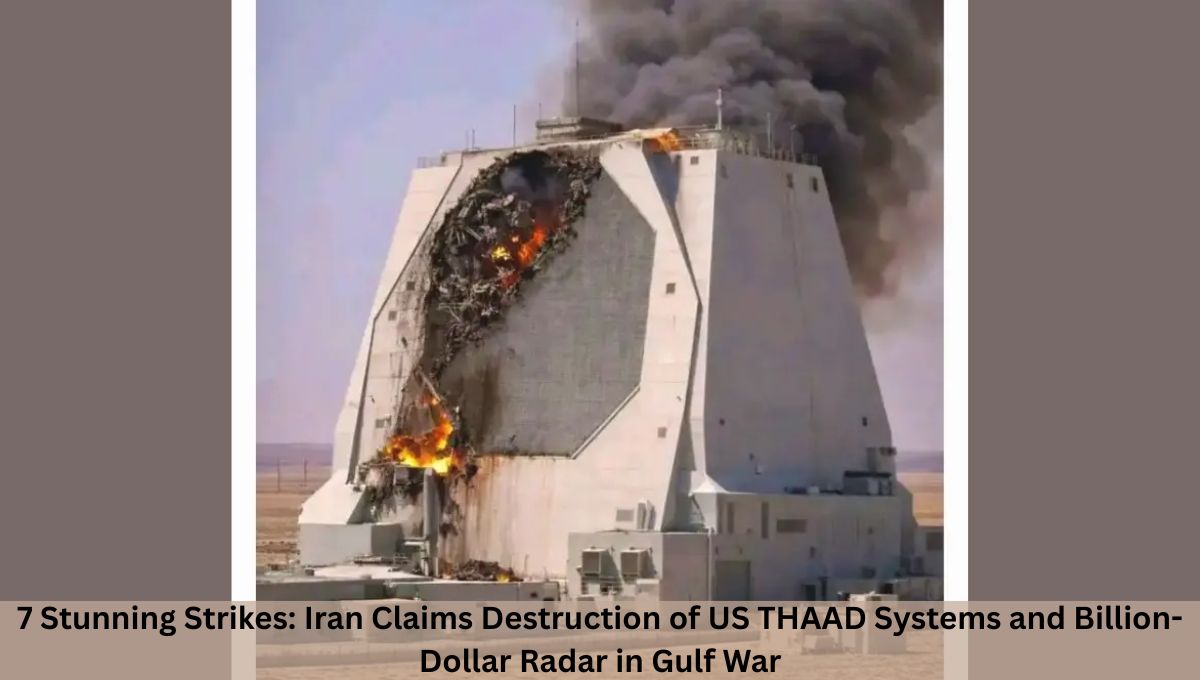
7 Stunning Strikes: Iran Claims Destruction of US THAAD Systems and Billion-Dollar Radar in Gulf War, weakening regional missile defenses. The ongoing war in West Asia has entered a dangerous new phase after Iran’s Islamic Revolutionary Guard Corps (IRGC) claimed it destroyed multiple high-value American missile defense assets across the Persian Gulf.
In a statement published by its official news outlet Sepah News, the IRGC said it successfully struck and disabled a second Terminal High Altitude Area Defense (THAAD) system — one of the world’s most advanced and expensive missile defense platforms — deployed in the United Arab Emirates (UAE).
If confirmed, the development would mark one of the most significant battlefield losses for US missile defense technology and could drastically weaken the region’s defensive shield against ballistic missile attacks.
Iranian officials also claim their forces destroyed the AN/FPS-132 early-warning radar at Al Udeid Air Base in Qatar — a billion-dollar surveillance system considered the backbone of the United States’ missile detection architecture in the Gulf.
While some details remain disputed, analysts say the damage could temporarily degrade regional missile defense capabilities and increase vulnerability across Gulf states, particularly the UAE.
7 Stunning Strikes: Iran Claims Destruction of US THAAD Systems and Billion-Dollar Radar in Gulf War
What Is the THAAD Missile Defense System?
The Terminal High Altitude Area Defense (THAAD) system is one of the most sophisticated anti-ballistic missile systems ever developed.
Designed to intercept short-, medium-, and intermediate-range ballistic missiles, THAAD destroys incoming threats using a “hit-to-kill” mechanism — meaning the interceptor physically collides with the target at extremely high speeds rather than relying on an explosive warhead.
Developed by Lockheed Martin, the system is capable of intercepting missiles both inside and outside the Earth’s atmosphere.
According to the manufacturer, THAAD interceptors can travel at speeds approaching Mach 8 — nearly 9,900 kilometers per hour — allowing them to destroy enemy missiles during their final descent toward a target.
However, the advanced capabilities come at an enormous cost. A single THAAD battery can cost anywhere between $1 billion and $2.7 billion depending on configuration. Each interceptor missile costs roughly $12 million.
Only ten THAAD batteries have been built worldwide. Seven are operated by the United States, two were sold to the UAE, and one is deployed by Saudi Arabia.
Because of their rarity and strategic importance, the reported destruction of two such systems — if verified — would represent a significant military and symbolic loss.
Iran Claims Second THAAD Battery Destroyed in UAE
According to the IRGC, Iranian forces used precision-guided missiles to strike a THAAD battery located at a military installation in the UAE.
Iran had earlier claimed it destroyed the AN/TPY-2 radar component of another THAAD system deployed at Al-Ruwais Industrial City, an important energy infrastructure hub in the UAE.
Open-source intelligence imagery has reportedly shown evidence suggesting a successful hit, though independent confirmation remains limited. The radar component alone is estimated to be worth around $500 million.
In its statement, the IRGC said the destruction of the air-defense systems had opened what it described as the “missile hand of the Islamic Republic,” allowing Iran to strike targets with greater freedom and accuracy.
Military analysts say eliminating radar nodes can significantly degrade the effectiveness of missile defense networks because radar provides the targeting data necessary for interceptors to engage incoming threats.
Without it, even advanced missile defense systems can become partially blind.
Billion-Dollar Early Warning Radar in Qatar Damaged
Another major blow reportedly came when an Iranian missile struck the AN/FPS-132 early-warning radar at Al Udeid Air Base in Qatar. The radar was built by the United States in 2013 at a cost of approximately $1.1 billion.
Qatar has confirmed that the system was damaged during the attack, although the full extent of the destruction remains unclear.
The AN/FPS-132 radar is part of the Upgraded Early Warning Radar (UEWR) program and is designed to detect ballistic missile launches at distances exceeding 5,000 kilometers.
Its coverage area includes Iran, Iraq, Syria, Turkey, Central Asia, and large parts of the Indian Ocean. Because of its immense range and tracking ability, the radar serves as the “eyes” of the US missile defense network in the Gulf.
Experts say its damage could significantly reduce the reaction time available to defensive systems such as Patriot and THAAD batteries deployed across the region.
Why the Radar System Is So Important
Unlike older mechanical radars that rely on rotating antennas, the AN/FPS-132 uses a solid-state phased-array design.
This allows the radar beam to be electronically steered across the sky within milliseconds without any physical movement.
The system can simultaneously track multiple ballistic missiles and provide precise trajectory data.
That data is then shared with interceptor systems across the region, enabling them to calculate intercept solutions and destroy incoming missiles before they reach their targets.
Because the radar serves as a central node for missile tracking and targeting, analysts often compare it to the nervous system of the entire missile defense architecture.
Damage to the radar could therefore reduce situational awareness and compress the time available for interceptors to react.
Some experts warn that parts of the Gulf’s air defense network may now be operating with limited coverage.
US and Israel Launch Operation “Epic Fury”
The escalation began after the United States and Israel launched a major military operation against Iran.
The joint offensive — reportedly named “Operation Epic Fury” — involved a large deployment of American and allied military assets.
Among them were B-2 stealth bombers, one of the most expensive aircraft ever built, costing more than $1 billion per unit.
Other systems deployed included guided-missile destroyers, aircraft carriers, Patriot missile batteries, and THAAD missile defense systems.
The operation targeted multiple locations in Iran and resulted in the death of several senior Iranian leaders, including Supreme Leader Ayatollah Ali Khamenei.
Iran responded with a massive wave of retaliatory attacks targeting Israel and US bases across the region.
Iran’s Missile and Drone Barrage Across the Gulf
Since the start of the conflict, Iran has reportedly launched hundreds of ballistic missiles and drones at regional targets.
The United Arab Emirates appears to have faced the largest share of these attacks.
According to available data, Iran has launched approximately:
- 863 missiles and drones toward the UAE
- 562 toward Kuwait
- 162 toward Qatar
- 113 toward Israel
The numbers suggest that the UAE has been the primary focus of Iranian retaliatory strikes.
Military analysts say the strategy could reflect Tehran’s attempt to pressure Gulf states that host American military bases.
UAE Faces Unique Strategic Risks
The UAE’s vulnerability extends beyond military considerations.
Unlike many oil-dependent economies in the region, the UAE has spent the past two decades transforming itself into a global financial, tourism, and logistics hub.
Dubai and Abu Dhabi have become major centers for banking, international business, aviation, and real estate.
By 2025, the non-oil sector accounted for roughly 77.5% of the UAE’s real GDP, reflecting the country’s successful diversification strategy. However, that transformation depends heavily on stability and security.
Every missile or drone that penetrates the country’s air defense system threatens not only physical infrastructure but also the perception of safety that underpins its economy.
Financial markets, tourism flows, and foreign investment could all be affected if the country is seen as vulnerable to sustained attacks.
Interceptor Shortages Raise Additional Concerns
Adding to the uncertainty are reports that several Gulf states may be running low on interceptor missiles.
According to a report by Bloomberg, Qatar may have only four days’ worth of Patriot interceptor missiles remaining during the early stages of the conflict.
The UAE has reportedly sought additional medium-range air defense systems from allies. Both governments have denied these reports, calling them misleading.
Nevertheless, experts note that high-intensity missile warfare can rapidly deplete interceptor stockpiles, particularly when attackers use saturation tactics involving large numbers of drones and missiles.
Because interceptors are expensive and time-consuming to produce, replenishing them during an active conflict can be challenging.
Qatari Jets Intercept Iranian Bombers
In one dramatic incident, Qatari fighter jets reportedly intercepted Iranian bombers heading toward the Al Udeid Air Base.
According to reports, Iranian Su-24 tactical bombers attempted to approach the base at extremely low altitude — roughly 80 feet above the surface — to evade radar detection.
Qatar’s F-15 fighter jets intercepted the aircraft just minutes before they reached their targets. Both Iranian bombers were reportedly shot down over the Persian Gulf.
The incident marked the first recorded air-to-air combat in the history of the Qatari air force.
Massive Economic Cost of the War
The financial impact of the conflict is already staggering.
According to estimates compiled from defense data, the United States has suffered nearly $2 billion in military equipment losses within the first four days of the campaign. The most expensive asset damaged was the $1.1 billion AN/FPS-132 radar in Qatar.
Additional losses include three F-15E Strike Eagle fighter jets destroyed in a friendly-fire incident involving Kuwaiti air defenses. The loss of the aircraft alone is estimated at around $282 million.
Iran has also claimed it struck a US Navy destroyer in the Indian Ocean with ballistic and cruise missiles, though this claim has not been independently verified.
Strategic Implications for US Missile Defense
If Iran’s claims about the destruction of THAAD batteries are confirmed, the implications could extend beyond the current conflict.
The United States has long promoted THAAD as one of the most advanced and reliable missile defense systems in the world.
A successful strike against multiple THAAD installations could raise questions about the survivability of expensive air-defense systems during high-intensity warfare.
It may also influence future defense procurement decisions by countries considering purchasing the system.
Nations may begin to question whether such costly platforms can survive in an environment saturated with drones and ballistic missiles.
The Changing Nature of Modern Warfare
Military experts say the conflict highlights an important reality of modern warfare. Defensive systems must intercept every incoming missile or drone to prevent damage.
Attackers, however, only need a single successful strike to destroy a high-value target. This asymmetry can make defending against large-scale missile attacks extremely difficult.
As one security analyst noted, the economics of warfare increasingly favor the attacker. Low-cost drones or missiles can potentially destroy infrastructure worth billions of dollars.
Regional Tensions Continue to Rise
The war has also strained relations between Iran and neighboring Gulf states.
Qatar and the UAE have both criticized Iranian attacks targeting their territory. Qatari officials described the attempted bombing of Al Udeid as a dangerous escalation.
The UAE has also condemned Iran’s strikes, warning that targeting neighboring countries could drag the entire region into a wider war.
Meanwhile, Iran insists its actions are legitimate retaliation for the killing of its Supreme Leader and senior military commanders.
A Conflict With Global Consequences
The Gulf region remains one of the most strategically important areas in the world due to its role in global energy markets.
Any prolonged conflict involving major regional powers could disrupt oil and natural gas supplies, potentially affecting global energy prices and economic stability.
Shipping routes through the Persian Gulf and Strait of Hormuz — vital corridors for international trade — could also face increased risks.
As the conflict intensifies, international observers are closely watching whether diplomatic efforts can prevent further escalation.
Uncertain Future for Gulf Missile Defense
Despite the damage reported so far, the United States still operates a vast global network of surveillance satellites and radar systems.
However, replacing large fixed installations such as the AN/FPS-132 radar could take considerable time.
If regional defenses remain degraded, Gulf states may need to rely more heavily on mobile defense systems and allied support. For now, the strategic balance in the region appears increasingly uncertain.
Whether Iran’s claims are fully verified or not, the attacks have already demonstrated the vulnerability of even the most sophisticated defense networks in modern warfare.
And as missile technology continues to evolve, the race between offensive weapons and defensive systems is likely to intensify in the years ahead.
Also Read: 9 Shocking Ways AI Helped Shape the US–Iran War
Also Read: Blinding the US? How Iran destroyed the $1.1-billion American missile radar in Qatar
Related Posts:
- 7 Powerful Truths: UAE Golden Visa vs Saudi Premium…

- 7 Powerful Measures: Trump Sanctions Russian Oil…

- In 8 Moves, EU Targets China-Linked Refineries and…

- Afghanistan–Pakistan War 2025: Inside the 48-Hour Ceasefire

- Trump’s 20-Point Gaza Peace Plan Gains Urgent Global…

- 7 Dead in Explosive Iran Protests as Economic Anger…
