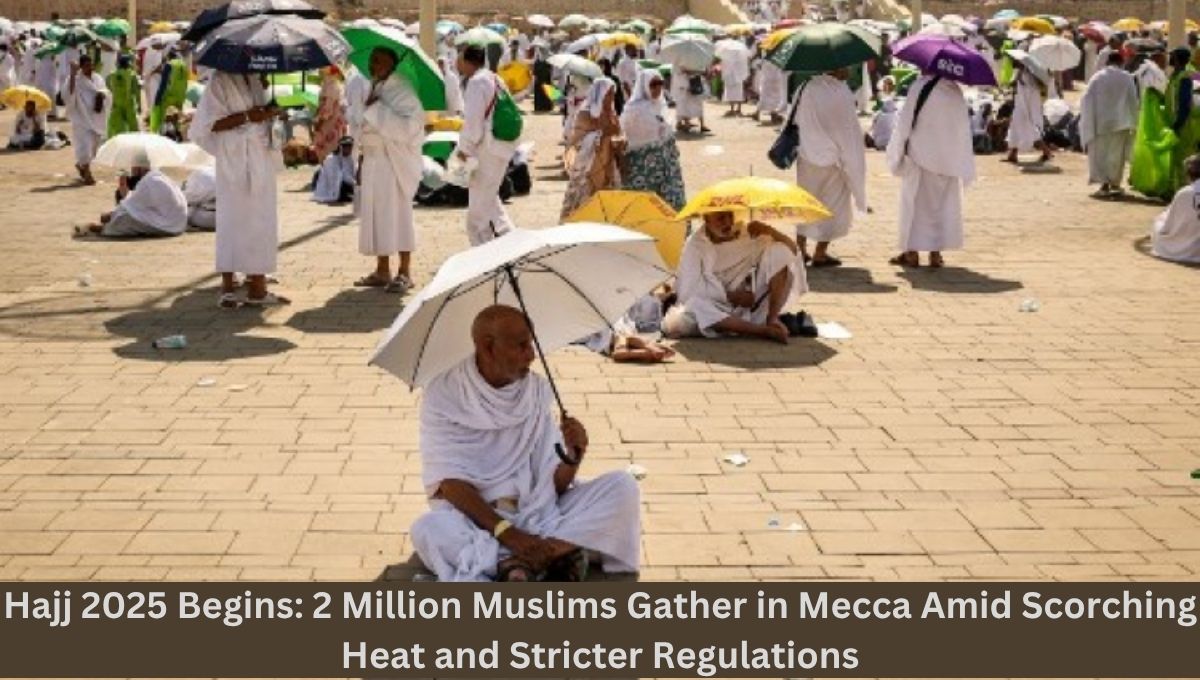
Officially Hajj 2025 Begins: 2 Million Muslims Gather in Mecca Amid Scorching Heat and Stricter Regulations. Mecca, Saudi Arabia – Hajj 2025 began on Wednesday, June 4, drawing over 2 million Muslims from across 180 countries to the holiest city in Islam. Spanning five days until Sunday, June 8, the pilgrimage involves a deeply spiritual journey filled with traditional Islamic rituals, many of which date back more than 1,400 years.
This year’s Hajj is taking place under the blazing Arabian summer, with temperatures reaching 41°C (106°F) and forecasts predicting highs of 44°C (111°F). Saudi officials have urged pilgrims to take heat precautions, avoid direct sun exposure, and remain hydrated.
Hajj 2025 Begins: 2 Million Muslims Gather in Mecca Amid Scorching Heat and Stricter Regulations
What is Hajj and Why is it Important?
Hajj is one of the Five Pillars of Islam, a mandatory pilgrimage for all physically and financially able Muslims to perform at least once in their lifetime. It is observed during the 12th month of the Islamic lunar calendar, Zil-Hajj, specifically from the 8th to the 13th.
The pilgrimage includes visits to sacred sites such as the Kaaba, Mount Arafat, and Mina, reflecting the spiritual steps once taken by the Prophet Muhammad (PBUH) and his followers.
India’s Quota and New Travel Rules
India was allocated a Hajj 2025 quota of 1.75 lakh pilgrims, with 1,22,518 traveling under the Hajj Committee of India and the remaining through private tour operators. However, Saudi Arabia has tightened travel regulations this year.
To prevent unauthorized pilgrimages, short-term visas for 14 countries including India, Pakistan, Bangladesh, and Egypt have been suspended. Authorities have fined over 269,000 people for trying to enter Mecca without valid permits and warned that violators face fines up to 20,000 riyals (~$5,330 USD) and a 10-year ban.
Dress Code and Spiritual Conduct During Hajj
All pilgrims adhere to a strict dress code. Men wear two unstitched white cloths (Ihram), symbolizing purity and unity, while women wear loose, modest white clothing, covering everything but their faces and hands. Personal grooming and the use of perfumes are forbidden.
Pilgrims must avoid arguments, foul speech, and sexual activity during Hajj to maintain spiritual purity. The goal is to renew faith, seek forgiveness, and express devotion to God.
Key Hajj 2025 Rituals and Timeline
- Tawaf and Sa’i – Pilgrims begin with seven rounds around the Kaaba (Tawaf) and walk between the hills of Safa and Marwa (Sa’i).
- Mina – On Day 1, pilgrims move to Mina, 5km from Mecca, and stay overnight in tents.
- Mount Arafat – On Day 2, June 5, pilgrims gather at Mount Arafat, where Prophet Muhammad (PBUH) gave his final sermon. This day is considered the holiest of the year.
- Muzdalifah – After sunset, pilgrims move to Muzdalifah, where they collect pebbles for the stoning ritual.
- Stoning of the Devil – On June 6, pilgrims throw stones at three pillars in Mina, symbolizing Prophet Ibrahim’s rejection of Satan.
- Eid al-Adha and Qurbani – The feast of sacrifice begins after the first stoning, honoring Ibrahim’s willingness to sacrifice his son.
- Final Tawaf (Tawaf al-Wada) – Before leaving Mecca, pilgrims perform a farewell circuit around the Kaaba, signifying the end of Hajj.
Extreme Heat and Safety Concerns
Last year’s Hajj saw over 1,300 heat-related deaths, mostly among unregistered pilgrims who lacked access to air-conditioned accommodations and medical services. In response, Saudi Arabia has:
- Installed 400+ cooling units
- Planted 10,000 trees for shade
- Built rubberized, cooled roads
- Expanded shaded areas by 50,000 square meters
- Tripled the number of paramedics
Despite these efforts, heat remains a critical challenge in Hajj 2025, and children under 12 are banned from attending to reduce risk.
Cost of Hajj and Flexible Payment Options
The cost of performing Hajj ranges from $4,000 to $20,000, depending on country, length of stay, and accommodation quality. Due to high inflation and currency depreciation, many countries have lowered government-sponsored Hajj program costs.
For instance, Pakistan introduced installment plans, while Saudi domestic pilgrims can now pay in three phases: 20% upon booking, 40% during Ramadan, and 40% the following month.
Still, millions remain on waiting lists. Indonesia, with 5.4 million registered, sees a demand far exceeding its quota, while India restricts repeat pilgrims through its Hajj Committee to make space for first-timers.
Spiritual Reflection and Global Unity
The Hajj offers a unique chance for Muslims to experience deep spirituality, unity, and equality. Pilgrims leave behind their worldly identities and immerse themselves in communal worship, seeking forgiveness, blessings, and closeness to God.
Even amid sweltering heat and logistical hurdles, the devotion of over 2 million people gathered in Mecca for Hajj 2025 stands as a testament to the enduring significance of this once-in-a-lifetime journey.
Conclusion
As Hajj 2025 continues through this week, the focus remains on balancing spiritual fulfillment with safety and health concerns. Saudi Arabia’s enhanced measures aim to prevent a repeat of last year’s tragedy, while pilgrims from around the globe strive to complete one of the most sacred duties in Islam under challenging conditions. For those unable to make the journey this year, the lessons of patience, unity, and faith remain ever-present, echoing through the rituals of Hajj and the hearts of the global Muslim community.
Also Read: Thai Monk Scandal: ₹100 Crore Blackmail Rocks Buddhist Clergy
Also Read: The water of Hajj: A simple illustrated guide to Zamzam
Related Posts:
- Insights from Pakistan Navy’s $1 Billion Arabian Sea…

- Trump Threatens Military Action in Nigeria Over…

- ‘Dragon and Elephant Must Come Together’: PM Modi…

- Saudi Arabia to Open Property Market to Foreign…

- Afghanistan–Pakistan War 2025: Inside the 48-Hour Ceasefire

- Chemistry Nobel Prize 2025: Groundbreaking Discoveries