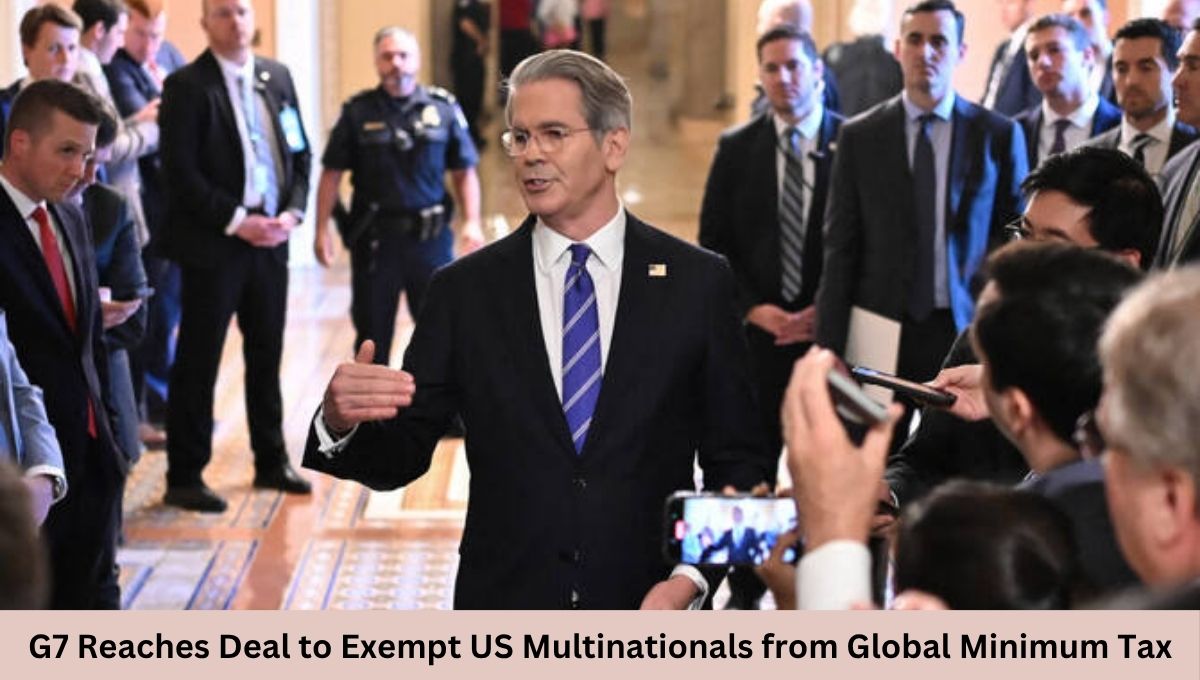
In a move that reshapes the global tax landscape, the G7 Reaches Deal to Exempt US Multinationals from Global Minimum Tax. The Group of Seven (G7) nations announced on Saturday that they have agreed to exempt US multinational corporations from parts of the global minimum tax regime.
The deal, centered on a “side-by-side” system, comes after months of negotiations and represents a major victory for the Trump administration, which pushed hard to protect US business interests. The announcement, released by Canada, which currently holds the G7’s rotating presidency, stated that the side-by-side arrangement will allow US companies to be taxed solely at home on both their domestic and foreign profits. This marks a significant deviation from the 2021 OECD global tax agreement.
G7 Reaches Deal to Exempt US Multinationals from Global Minimum Tax
The Side-by-Side Tax System: What It Means
The side-by-side tax system acknowledges the existing US minimum tax structure, effectively exempting American multinationals from additional levies overseas.
In other words, if companies already pay taxes in the US, they will not be subject to extra taxes in other jurisdictions under the OECD framework.
This compromise is seen as a way to provide greater certainty and long-term stability in the international tax system, which has faced turbulence over digital services taxes, profit shifting, and tax avoidance strategies.
Section 899 Removed: The ‘Revenge Tax’ Scrapped
A key condition for the G7 deal was the removal of Section 899 from President Donald Trump’s sweeping tax-and-spending bill, nicknamed the “One Big Beautiful Bill.”
This controversial clause labeled by critics as a “revenge tax” would have imposed punitive taxes on foreign companies operating in the US, especially those based in countries Washington viewed as discriminatory to American firms.
The Trump administration agreed to scrap the clause in exchange for G7 support of the side-by-side model.
US Treasury Secretary Scott Bessent confirmed on Thursday that he asked Senate and House leaders to remove the section, citing the progress made in G7 negotiations.
Global Minimum Tax Origins and US Opposition
The global minimum tax agreement was first negotiated in 2021 under the Biden administration, with support from nearly 140 countries and spearheaded by the Organisation for Economic Co-operation and Development (OECD).
It features two pillars:
- Pillar One: Reallocates some taxing rights to countries where consumers are located, targeting large digital and tech firms.
- Pillar Two: Establishes a 15% minimum corporate tax rate globally to deter tax base erosion and profit shifting.
President Donald Trump, who returned to office in January 2025, rejected the global minimum tax via executive order, arguing it undermines US tax sovereignty and penalizes American companies.
Saturday’s G7 decision, in effect, rewrites how the US fits into the international tax framework, ensuring US firms can avoid double taxation while maintaining compliance with domestic tax obligations.
G7 Statement: “Stability, Certainty, and Cooperation”
The G7 communiqué, released after a joint session of finance ministers, emphasized that the agreement seeks to bring: “Greater stability and certainty in the international tax system moving forward.”
The G7 also affirmed their support for continuing discussions within the OECD Inclusive Framework, which remains the platform for finalizing the new side-by-side arrangement.
The group said it is committed to a solution that is “acceptable and implementable to all,” signaling that while a deal has been reached among G7 members, global consensus is still pending.
UK Also Benefits: British Firms Spared Higher Taxes
While the focus has been on US multinationals, UK-based companies also stand to gain from the revised agreement. The removal of Section 899 ensures that British firms operating in the US won’t face retaliatory taxes either.
UK Finance Minister Rachel Reeves welcomed the news, stating: “Today’s agreement provides much-needed certainty and stability for businesses after they had raised concerns. More work is needed, however, to tackle aggressive tax planning and avoidance.”
The decision was made after some British businesses voiced alarm over the potential financial impact of Section 899, which is now no longer a threat.
Digital Services Tax: An Issue Left Unresolved
Despite this breakthrough, digital services taxes (DST) a contentious issue in tax talks remain unresolved. Some European countries, including France and Italy, impose DSTs on US-based tech giants like Amazon and Meta Platforms.
These taxes target profits generated from digital advertising and user data in local markets. The G7’s latest agreement only partially addresses DSTs. Officials stated that the side-by-side deal will include:
“A constructive dialogue on the taxation of the digital economy and on preserving the tax sovereignty of all countries.”
This suggests that future negotiations will need to balance national digital tax policies with multilateral tax agreements a difficult task given competing interests.
Trump’s Executive Order and Policy Leverage
Earlier this year, President Trump issued an executive order declaring that the OECD global tax deal was not applicable in the US, effectively withdrawing from the Biden-era agreement.
At the same time, Trump threatened to impose retaliatory taxes like Section 899 on countries that taxed US multinationals under the OECD framework.
This hardline stance, while controversial, appears to have been effective in forcing a compromise at the G7 level.
With the support of allies like Canada, the UK, and Japan, the US successfully negotiated a carve-out from global tax obligations, preserving its corporate tax autonomy.
OECD’s Role: Decision Still Pending
Despite the G7 breakthrough, the final decision on the US exemption rests with the OECD and its broader membership under the Inclusive Framework, which includes over 140 nations.
The OECD has yet to confirm whether it will formally adopt the side-by-side system. Still, the G7’s unified position is likely to sway ongoing negotiations, especially with US political backing and major economies behind the deal.
Looking Ahead: New Norms in Global Taxation
The G7 tax deal marks a turning point in international tax diplomacy. By accommodating US concerns, the agreement may prevent a global tax war, but it also raises questions about equity and consistency in multinational taxation.
Critics argue that special treatment for US firms could undermine the integrity of the OECD’s broader goals, which include curbing profit shifting, ensuring fair taxation, and reining in corporate tax avoidance.
Yet, for now, the deal is being hailed as a pragmatic step forward—one that balances national sovereignty with multilateral cooperation in a deeply interconnected economy.
Conclusion: A Strategic Win for the US and Its Allies
With the side-by-side tax system in place and Section 899 eliminated, US and UK multinationals can breathe a sigh of relief. The G7’s decision shows that economic diplomacy and political negotiation still play a central role in shaping the rules of global finance.
While challenges remain especially around digital services taxes and global implementation the agreement sets the tone for a more flexible and customized tax regime in the years ahead.
As the world watches the next steps from the OECD Inclusive Framework, the message from the G7 is clear: cooperation matters but so does protecting national interest.
Also Read: ‘Melodi’ Moment at G7: PM Modi, Italy’s Meloni Highlight Growing India-Italy Friendship
Also Read: G7 reach agreement on global minimum tax