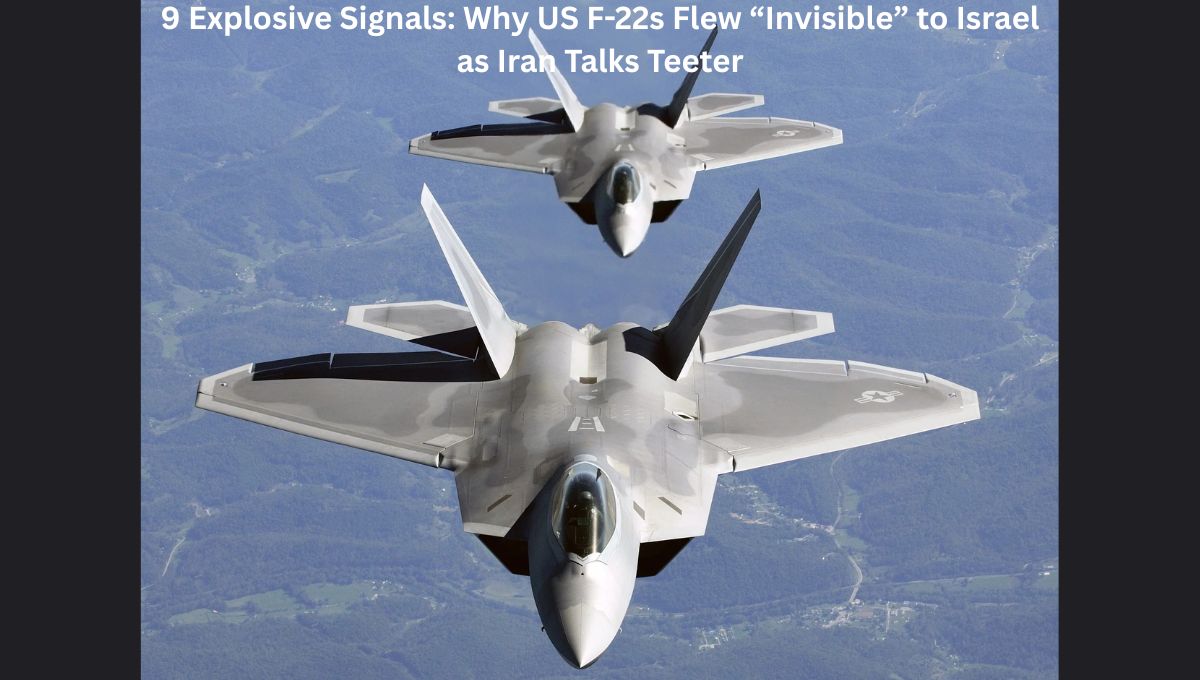
9 Explosive Signals: Why US F-22s Flew “Invisible” to Israel as Iran Talks Teeter — A strategic warning. When nearly a dozen F-22 Raptor stealth fighters touched down at an Israeli air base in the Negev desert this week, the deployment was not announced, not briefed, and not officially acknowledged.
Yet it was unmistakable.
Tracked leaving RAF Lakenheath, escorted by tanker aircraft, and then disappearing from public flight-tracking systems, the jets arrived in southern Israel just as US–Iran nuclear talks entered what diplomats privately describe as a “make-or-break phase” in Geneva.
The detail that drew the most attention was not just where the F-22s went — but how they got there.
Their transponders were switched off. In modern warfare, that is not merely a technical footnote. It is a message.
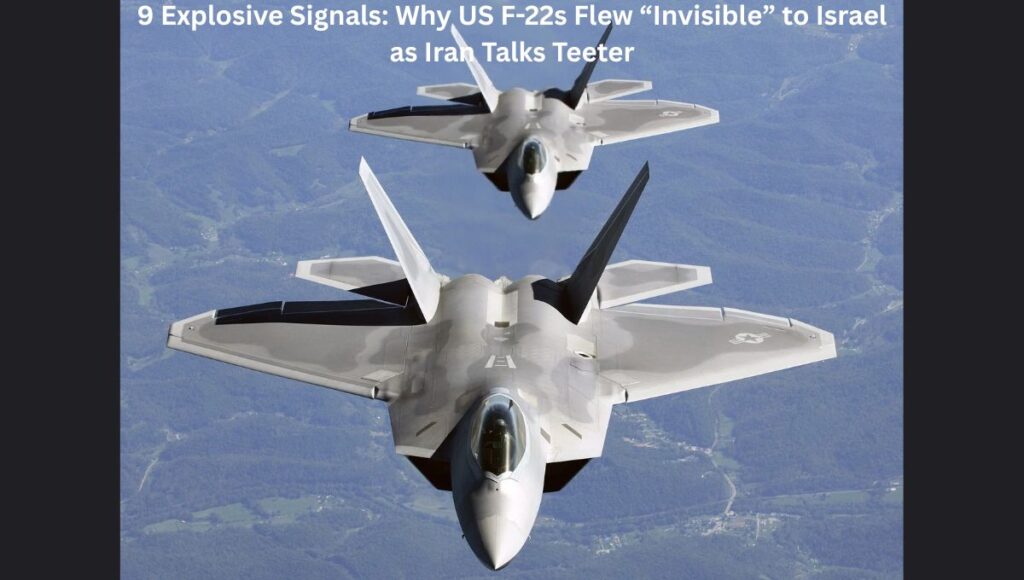
9 Explosive Signals: Why US F-22s Flew “Invisible” to Israel as Iran Talks Teeter
1. What Happened: A Rare and Highly Sensitive Deployment
Around a dozen US Air Force F-22 Raptors landed at an Israeli Air Force base in southern Israel early this week, according to multiple open-source flight trackers and confirmations from US and Israeli media.
Key facts established by independent monitoring:
- The jets departed RAF Lakenheath on February 24
- One aircraft reportedly returned due to a technical issue
- The remaining fighters continued onward to Israel
- Aerial refuelling tankers flew with transponders on
- The F-22s flew with transponders off for much of the route
The aircraft reportedly landed at Ovda Airbase, a strategic installation in the Negev that has hosted joint US-Israeli activity before — but never US stealth fighters for potential wartime missions.
2. Why This Is Unusual — Even by Military Standards
US aircraft regularly operate across the Middle East. US-Israeli military cooperation is deep and long-standing.
But this deployment crosses several historical thresholds at once.
What makes it different
- First known forward basing of F-22s in Israel for a potential contingency
- A break from decades of US policy avoiding offensive aircraft basing on Israeli soil
- Occurs amid active diplomatic talks rather than after their collapse
- Executed with deliberate opacity
As former US officials have acknowledged, operating American combat aircraft from Israeli bases had long been avoided to prevent alienating Arab partners.
That taboo has now been broken.
3. Transponders Explained: Why Go “Dark”?
What is a transponder?
A transponder broadcasts an aircraft’s identity, altitude, speed, and location to air traffic control and civilian tracking networks.
Turning it off does not make an aircraft invisible to military radar — but it does remove it from public, civilian awareness.
Why fighters turn them off
Fighter aircraft deactivate transponders when:
- Operational security is critical
- Routes and timing must remain ambiguous
- Adversaries are monitoring open-source intelligence
- Strategic signalling is desired without public escalation
This is not an accident or a malfunction. It is a doctrinal choice.
4. Radar Ghosts and Strategic Ambiguity
Flying “dark” creates what analysts call deliberate uncertainty.
Iran, Russia, and China all monitor commercial flight-tracking platforms, satellite imagery, and social media posts.
Turning off transponders forces adversaries to rely on less precise tools and incomplete data.
In short:
- Allies know the jets are there
- Adversaries know the jets might be there
- Nobody knows the full picture
That ambiguity itself is a weapon.
5. Why the F-22 Matters More Than Any Other Jet
The F-22 Raptor is not just another fighter.
It remains the most capable air-superiority aircraft ever built, combining:
- Extreme stealth (very low radar cross-section)
- Supercruise above Mach 1.5 without afterburners
- Advanced sensor fusion
- Dominance in air-to-air combat
Combat role
The F-22 is designed to:
- Enter heavily defended airspace first
- Destroy enemy fighters and air defences
- Clear the way for bombers and strike aircraft
- Escort high-value assets such as B-2 bombers
During Operation Midnight Hammer, F-22s escorted stealth bombers during strikes on Iranian nuclear facilities — a role they would almost certainly reprise in any future conflict.
6. Designed for Iran’s Airspace
Iran possesses one of the densest air defence networks in the region, including:
- Russian-supplied systems
- Indigenous radar arrays
- Layered missile coverage
The F-22 was built specifically to survive in environments like this.
Its forward deployment to Israel drastically shortens response times, increases sortie rates, and complicates Iranian defensive planning.
7. Diplomacy Under Pressure: The Geneva Talks
The timing is no coincidence.
US and Iranian negotiators are currently engaged in renewed talks in Geneva aimed at:
- Limiting Iran’s nuclear enrichment
- Addressing missile development concerns
- Preventing further regional escalation
In his State of the Union address, Donald Trump reiterated:
“My preference is to solve this problem through diplomacy. But I will never allow the world’s number one sponsor of terror to have a nuclear weapon.”
At the same time, he warned that “bad things” would happen if talks fail.
The F-22 deployment gives that warning physical credibility.
8. Deterrence While Talking: A Classic US Playbook
The United States has long paired diplomacy with force posture.
The logic is straightforward:
- Diplomacy without force invites delay
- Force without diplomacy invites war
- Together, they compress decision-making
By deploying F-22s before talks conclude, Washington signals that:
- Military options are not theoretical
- Preparations are already in motion
- Time is not unlimited
This is coercive diplomacy in its purest form.
9. Why Israel Is Central to the Strategy
Israel provides what few others can:
- Proximity to Iran
- Advanced layered air defences
- Operational experience against Iranian proxies
- Political willingness to cooperate
Israeli systems such as Iron Dome, David’s Sling, and Arrow help protect high-value US assets on the ground.
For American planners, Israel offers both capability and reliability at a moment when other regional partners have imposed limits.
10. Regional Basing Constraints Are Shrinking
Saudi Arabia and the UAE have reportedly signalled they would not allow their territory or airspace to be used for strikes on Iran.
That leaves fewer options:
- Jordan
- Diego Garcia
- Israel
By dispersing aircraft to Israel, the US avoids concentrating assets in vulnerable clusters and reduces dependence on politically constrained partners.
11. A Broader Military Surge
The F-22 deployment is part of a vast regional buildup that includes:
- Over 150 US aircraft repositioned
- F-35s, F-15s, F-16s across Europe and West Asia
- F-16s deployed to Diego Garcia
- Two carrier strike groups in or near the region
The USS Gerald R. Ford and USS Abraham Lincoln together represent nearly a third of active US naval power.
12. Why the US Broke a 30-Year Taboo
For decades, Washington avoided basing offensive combat aircraft in Israel to preserve Arab coalition cohesion. That calculus has changed.
The Abraham Accords, shifting regional alliances, and Iran’s expanding capabilities have altered US risk assessments.
As former officials note, this deployment reflects:
- Growing US-Israel integration
- Fewer reliable regional basing options
- Greater urgency around Iran
13. Iran’s View: Pressure or Prelude?
From Tehran’s perspective, the deployment is deeply concerning.
Iran has warned repeatedly that:
- US bases supporting strikes would be legitimate targets
- Retaliation would be regional, not symbolic
Yet Iranian officials continue to publicly support negotiations, insisting they seek sanctions relief and recognition of peaceful nuclear rights.
The contradiction is deliberate.
14. Markets, Oil, and Global Stakes
Energy markets are already reacting.
Brent crude has climbed toward seven-month highs as traders price in:
- Strait of Hormuz risk
- Supply disruptions
- Regional escalation
Saudi Arabia has reportedly increased production as a contingency measure, underscoring the global economic stakes of any breakdown.
15. What Comes Next
Three broad paths remain:
1. A Deal Under Pressure
Military buildup succeeds in forcing concessions.
2. Prolonged Brinkmanship
Talks drag on, deployments intensify.
3. Limited Military Action
Targeted strikes aimed at coercion rather than regime change.
The presence of F-22s in Israel shortens timelines for all three scenarios.
Conclusion: Stealth as a Signal
The F-22s that flew to Israel with their transponders switched off were not hiding.
They were being seen — selectively.
In modern geopolitics, visibility is calibrated, not binary. Stealth is no longer just about radar. It is about narrative control.
As US–Iran nuclear talks hang by a thread, Washington has chosen to speak in two languages at once:
- Diplomacy in Geneva
- Stealth over the Negev
Whether that dual message produces a deal — or a detonation — will shape the Middle East for years to come.
Also Read: 9 Explosive Signals as Trump Cancels Iran Talks and Urges Protesters to Seize Power
Also Read: ‘You Really Ought to Go Home’: Stealth F-22 Fighter Flew Under Iran F-4 Undetected