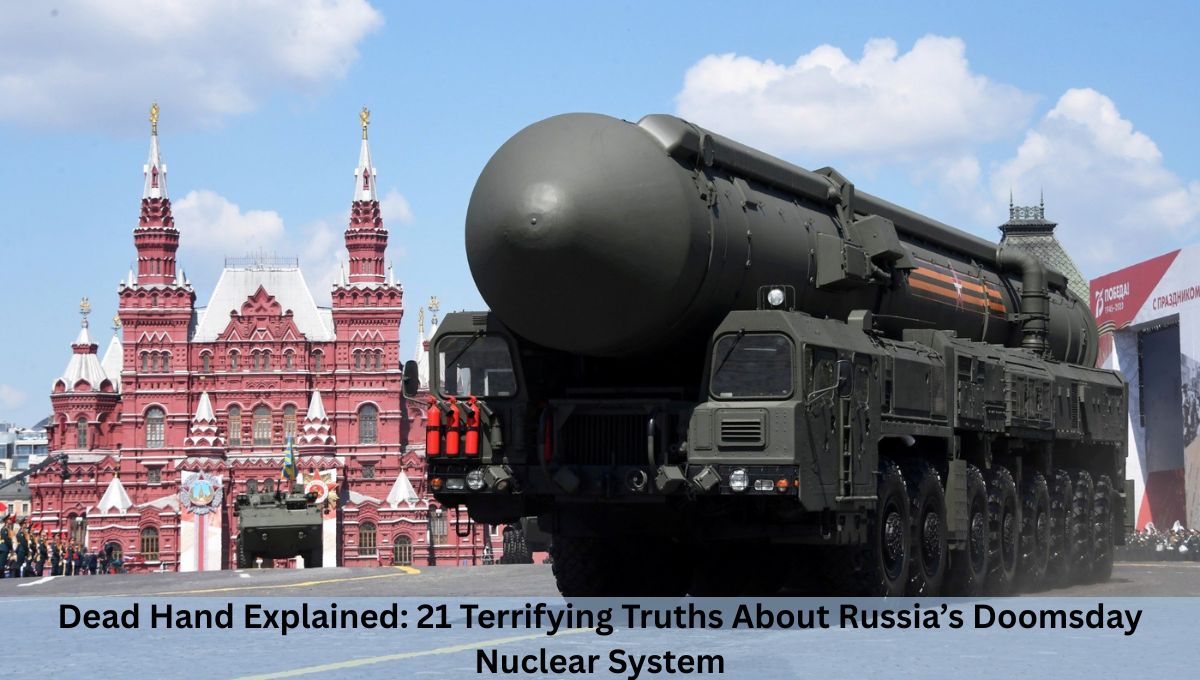
Dead Hand (Systema Perimeter)Explained: 21 Terrifying Truths About Russia’s Doomsday Nuclear System. It sounds cinematic. Apocalyptic. Almost absurd.
Yet “Dead Hand” refers to a real nuclear command-and-control system, designed during the Cold War to answer one horrifying question:
What if a nuclear attack kills everyone in charge before they can respond?
The Soviet Union’s answer was Perimeter—known in the West as Dead Hand—a system meant to guarantee retaliation even after national annihilation.
Decades after the Cold War, this dormant fear has re-entered global headlines, referenced by senior Russian officials amid escalating rhetoric with the United States.
This article explains—without hype or conspiracy—what Dead Hand is, how it works, why it exists, what is confirmed, and what remains unknown.
Dead Hand Explained: 21 Terrifying Truths About Russia’s Doomsday Nuclear System
What Is the Dead Hand Nuclear System?
Dead Hand, officially Systema Perimeter, is a semi-automated nuclear command-and-control system developed by the Soviet Union and believed by most defense analysts to still exist in modernized form in Russia.
Its mission is singular:
Guarantee nuclear retaliation if Russia is attacked and leadership cannot respond.
It is not a first-strike weapon. It is a doomsday insurance policy, rooted in the logic of Mutually Assured Destruction (MAD).
Why the Soviet Union Built Dead Hand
Fear of a Decapitation Strike
During the late Cold War, Soviet planners feared a sudden US nuclear attack aimed at:
- Moscow
- The Kremlin
- Central military command bunkers
Such a decapitation strike could theoretically eliminate leadership before retaliation orders were issued—collapsing deterrence.
Dead Hand was built to make that impossible.
A “Fail-Deadly” System, Not Fail-Safe
Most safety systems shut down when something goes wrong.
Dead Hand does the opposite.
If:
- The system is activated during crisis
- Nuclear detonations are detected
- Command authority goes silent
…it moves forward, assuming the worst.
This does not mean immediate automatic launch—but it does mean silence is treated as catastrophe.
Dead Hand Is Not Always Active
One of the most persistent myths is that Dead Hand is permanently “on.”
That is false.
According to declassified Soviet accounts:
- The system is dormant in peacetime
- It must be explicitly activated by senior leadership
- Activation is meant to reduce panic, not increase it
Dead Hand is only armed when leaders already believe nuclear war is possible.
How Dead Hand Detects Nuclear War
The Sensor Network
Once activated, Perimeter monitors a network of sensors designed to detect correlated signs of nuclear attack, including:
- Light flashes consistent with nuclear detonations
- Radiation spikes
- Seismic shocks resembling nuclear blasts
- Atmospheric overpressure
- Widespread communication disruption
No single signal is sufficient. Correlation is key.
The Crucial Check: Is Anyone Still in Command?
Detection does not trigger launch.
The system first checks:
- Are communication links to national command still functioning?
If command responds, Dead Hand stands down.
If command is silent after a defined interval, the system assumes leadership destruction.
The Human Element: The Final Decision
Despite popular portrayals, Dead Hand is not fully autonomous.
At the final stage, launch authority is believed to transfer to human officers in deeply hardened bunkers.
These officers:
- Are pre-delegated authority
- Operate under extreme isolation
- Can theoretically choose not to launch
But refusal would mean accepting total defeat.
Command Rockets: How Orders Are Sent After Apocalypse
Dead Hand does not fire warheads directly.
Instead, it launches command rockets—missiles carrying powerful radio transmitters.
They:
- Fly across Russian territory
- Broadcast encrypted launch codes
- Transmit on frequencies designed to survive nuclear chaos
Even damaged silos can receive the signal.
Why Missiles Could Launch “Even If Everyone Is Dead”
If silos remain functional and receive valid launch codes, they are programmed to launch automatically.
In that sense, retaliation can occur without living decision-makers.
This is why Dead Hand is often described as retaliation by the dead.
Is Dead Hand Still Active Today?
Russia has never fully confirmed its current operational status.
However:
- Russian officials acknowledged its existence in 2011
- Western analysts believe it still exists in modernized form
- Recent rhetoric strongly implies continuity
There is no evidence it is AI-controlled.
Why Dmitry Medvedev Revived the Term
Dead Hand returned to headlines after comments by Dmitry Medvedev, following remarks by Donald Trump.
Medvedev’s reference was:
- Symbolic
- Deliberately ambiguous
- A deterrence signal, not an operational threat
The Stanislav Petrov Lesson
In 1983, Soviet officer Stanislav Petrov ignored a false nuclear warning caused by sunlight reflecting off clouds.
Had a machine made that decision, nuclear war may have begun.
Dead Hand was designed to reduce panic—but it also reduces discretion.
AI, Automation, and Nuclear Risk
Why AI Is Dangerous in Nuclear Decision-Making
AI systems:
- Rely on statistical inference
- Perform poorly with rare events
- Generate false positives
Nuclear war is the rarest event imaginable.
The False Positive Trap
Even a system that is 99% accurate will generate frequent false alarms when monitoring rare phenomena.
If an AI concludes with 99% confidence that nuclear war has begun—should it fire?
Why Machines Lack What Matters Most: Hesitation
Some argue machines are more rational.
In nuclear strategy, that is a flaw.
Fear, hesitation, and restraint have saved humanity before. Emotionless systems remove those brakes.
Russia’s Poseidon and Autonomy Concerns
Russia’s Poseidon is described as an autonomous, nuclear-powered underwater weapon.
What remains unknown:
- How autonomous it truly is
- Whether it can decide to attack
Uncertainty alone is destabilizing.
Does the US Need Its Own Dead Hand?
Some US analysts have proposed AI-enabled backup systems due to shrinking decision times.
Senior Pentagon leadership has repeatedly rejected the idea.
Human control remains official policy.
Why Time Compression Is Driving Fear
Hypersonic weapons, cyberattacks, and space warfare have reduced decision windows to minutes.
This pressures states to automate—but automation increases catastrophic risk.
What Needs to Happen
Human Control Must Be Mandatory
International law does not explicitly ban autonomous nuclear launch.
That must change.
Under the Nuclear Non-Proliferation Treaty, amendments could require meaningful human control.
AI Has a Role—But Not That Role
AI can assist with:
- Sensor fusion
- Early warning analysis
- Decision support
It must never decide to use nuclear weapons.
The Real Warning of Dead Hand
Dead Hand is not a bluff.
It is not a movie plot.
It is not meant to be used.
It exists to ensure no leader believes nuclear war is survivable.
Final Takeaway: Deterrence Without Wisdom Is Fragile
The return of Dead Hand to public rhetoric signals something dangerous:
- Erosion of diplomatic guardrails
- Normalization of nuclear language
- Shortening decision windows
If Dead Hand teaches one lesson, it is this:
The world is safest not when doomsday systems work—but when they never need to.
Also Read: 11 Stark Realities as a Crucial US-Russia Nuclear Treaty Collapses
Also Read: Putin Says Russia Tests New, Nuclear-Capable Remote Torpedo Dubbed ‘Doomsday Machine’
Related Posts:
- Trump vs. Medvedev: Nuclear Brinkmanship Returns in…

- E-4B ‘Doomsday Plane’ Lands in DC as Trump Mulls Iran Strike

- 600-Year Dormant Russian Volcano Erupts After…

- 7 Astonishing Twists in the $100 Million Louvre…

- Trump’s 2025 Middle East Peace Plan – Hamas Rejects…

- Trump Ends 33-Year Pause: U.S. to Resume Nuclear…
