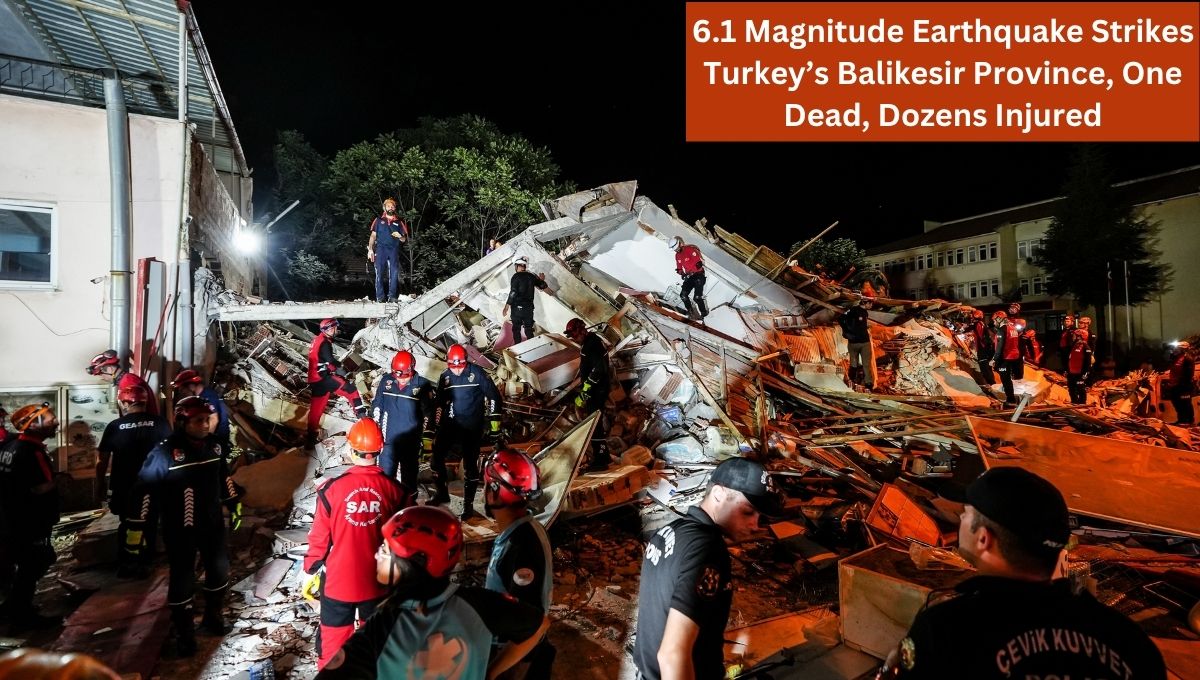
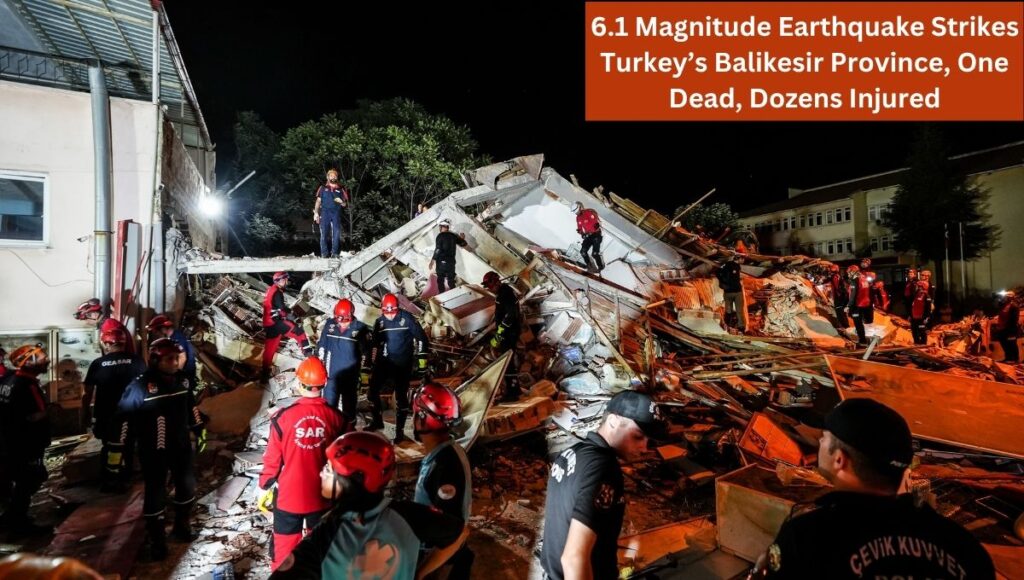
A strong jolt of 6.1 Magnitude Earthquake Strikes Turkey’s Balikesir Province, One Dead, Dozens Injured. On Sunday evening, a powerful 6.1 magnitude earthquake shook Balikesir province in north-western Turkey, killing one person and injuring at least 29 others. The tremor struck at 7:53 PM local time (16:53 GMT), with its epicentre in the town of Sindirgi.
According to Turkey’s Disaster and Emergency Management Authority (AFAD), the quake was felt in multiple western cities, including Istanbul 200 km away and the tourist hub of Izmir. Residents across the affected regions reported strong shaking that lasted several seconds. Witnesses described scenes of panic as people ran into the streets, fearing aftershocks and structural collapses.
6.1 Magnitude Earthquake Strikes Turkey’s Balikesir Province, One Dead, Dozens Injured
One Fatality and Dozens Injured
The only confirmed fatality so far is an 81-year-old woman who was rescued alive from under the rubble but later died in hospital.
Turkish Interior Minister Ali Yerlikaya confirmed the casualty during a press briefing in Sindirgi, stating:
“An 81-year-old person died soon after having been rescued from under the rubble. Another 29 people were injured, but none seriously.”
The victim was among six residents trapped in a collapsed three-storey building in Sindirgi’s city centre.
Four people were pulled out alive, while rescue teams worked tirelessly to extract the remaining two.
Sixteen Buildings Collapsed, More Damaged
Initial assessments indicate that 16 buildings collapsed in Sindirgi and surrounding areas. Of these, four were inhabited at the time of the quake.
Damage was also reported in nearby villages, where several houses and a mosque minaret fell.
Sindirgi’s Mayor Serkan Sak told local media:
“Buildings and mosques were destroyed, but we have no reports of further loss of life. Rescue efforts were swift, and first responders acted quickly.”
Photographs from the scene show entire buildings reduced to rubble, twisted metal beams protruding from debris, and residents sifting through personal belongings amid the wreckage.
Emergency Response and Search Operations
Within minutes of the quake, AFAD deployed 319 first responders to the disaster zone.
Search-and-rescue teams, paramedics, and disaster specialists arrived with heavy equipment and sniffer dogs.
Minister Ali Yerlikaya confirmed that search-and-rescue operations have now concluded, with no additional casualties found.
“We are monitoring the situation moment by moment,” he said. “As of now, no other signs of serious damage or casualties have been reported.”
AFAD also reported at least 20 aftershocks ranging from magnitude 3.5 to 4.6 following the main tremor. Citizens were urged not to re-enter damaged buildings due to the risk of further collapses.
President Erdogan’s Message to the Nation
President Recep Tayyip Erdogan issued a statement on X (formerly Twitter), expressing condolences and solidarity:
“I wish a swift recovery to all affected citizens. All recovery efforts are being closely monitored. May God protect our country from any kind of disaster.”
The Turkish government confirmed that emergency aid has been allocated for the affected areas, and temporary shelters are being set up for displaced residents.
Location and Seismic Details of the Quake
According to AFAD, the earthquake struck at a depth of 11 km (6.8 miles), making it relatively shallow often a factor in increased surface damage.
The German Research Centre for Geosciences (GFZ) measured the tremor at magnitude 6.19 and a depth of 10 km.
The epicentre was located:
- 51 km southeast of Balikesir
- 128 km southwest of Bursa
- 206 km southwest of Istanbul
Shaking was reported across western Turkey, with residents in Izmir, Bursa, and Canakkale feeling the tremor.
Turkey’s History of Seismic Activity
Turkey sits at the intersection of three major tectonic plates the Eurasian, Arabian, and African plates making it one of the most earthquake-prone countries in the world.
The North Anatolian Fault, which runs just south of Istanbul, is one of the most active fault lines globally. Experts have long warned of the potential for a large earthquake in the region.
The February 2023 earthquake in southeastern Turkey measuring magnitude 7.8 was the deadliest in the country’s modern history, killing over 53,000 people in Turkey and 6,000 in Syria.
Hundreds of thousands remain displaced even two years later.
Local Accounts and Survivor Stories
Survivors in Sindirgi recounted moments of fear and chaos.
One resident, Mehmet Kaya, told reporters:
“I was having dinner when the house began to shake violently. The power went out, and I grabbed my children and ran outside. I saw dust clouds and heard screams from nearby buildings.”
Another, Ayse Demir, described the rescue efforts:
“Rescuers worked through the night. They pulled out my neighbour, but sadly, she didn’t survive. It’s heartbreaking.”
Official Warnings and Preparedness
Authorities urged residents to remain cautious, avoid damaged structures, and prepare for further aftershocks.
Engineers have begun structural safety assessments in affected areas to prevent secondary disasters.
AFAD released guidelines for earthquake safety, emphasizing:
- Staying away from damaged buildings
- Avoiding blocked roads to allow emergency vehicles through
- Keeping emergency supplies ready in case of further quakes
International Concern and Solidarity
Several countries expressed condolences and offered assistance. Humanitarian organizations are also on standby should Turkey request international aid.
The European-Mediterranean Seismological Centre (EMSC) and United States Geological Survey (USGS) both registered the quake and noted its potential to cause significant local damage, although its moderate magnitude and shallow depth limited the affected radius.
Sindirgi: The Epicentre in Focus
Sindirgi, a small town in Balikesir province, is known for its agriculture and textile production.
While not densely populated, its older building stock made it vulnerable to structural failures during seismic events.
Many residents live in multi-story buildings constructed decades ago, often without modern earthquake-resistant engineering.
This contributed to the collapse of several structures during Sunday’s quake.
The Road to Recovery
With the immediate search-and-rescue phase concluded, attention now turns to recovery and rebuilding.
Authorities are:
- Providing temporary shelter for displaced residents
- Offering medical care and psychological support for survivors
- Launching investigations into building code compliance
Turkey’s government has pledged financial assistance for reconstruction and promised stricter enforcement of earthquake-resistant building standards.
Expert Opinions: What Comes Next?
Seismologists note that while the 6.1 quake is significant, it is not considered “major” in global terms. However, its location along active faults means it could be part of a longer seismic sequence.
Dr. Nihat Ozdemir, a Turkish geophysicist, warned:
“This event reminds us that preparedness is essential. Western Turkey is seismically active, and Istanbul remains at risk for a much larger earthquake.”
Conclusion: A Sobering Reminder
Sunday’s earthquake in Balikesir’s Sindirgi district serves as another stark reminder of Turkey’s seismic vulnerability.
While the casualty toll was far lower than past disasters, the destruction of homes and infrastructure has once again shaken public confidence in building safety.
As recovery efforts proceed, experts stress the importance of preparedness, stricter building codes, and public education to reduce risks from future earthquakes.
Final Word
For the people of Sindirgi and surrounding towns, life will not return to normal immediately. But the rapid emergency response, resilience of survivors, and nationwide solidarity offer hope as the region begins its recovery.
Also Read: Massive 8.8 Earthquake Hits Russia’s Kamchatka, Triggers Tsunami Alerts Across Pacific
Also Read: Has Erdogan delivered on promises he made after Turkey’s last earthquake?
Related Posts:
- 6.1-Magnitude Earthquake Rocks Western Türkiye:…
- 6.3-Magnitude Earthquake Devastates Northern Afghanistan
- 7 Alarming Facts About Super Typhoon Fung-wong
- Massive 8.8 Earthquake Hits Russia’s Kamchatka,…
- Trump’s 20-Point Gaza Peace Plan Gains Urgent Global…

- 9 Powerful Moments as 6.5 Quake Shakes Mexico, Halts…