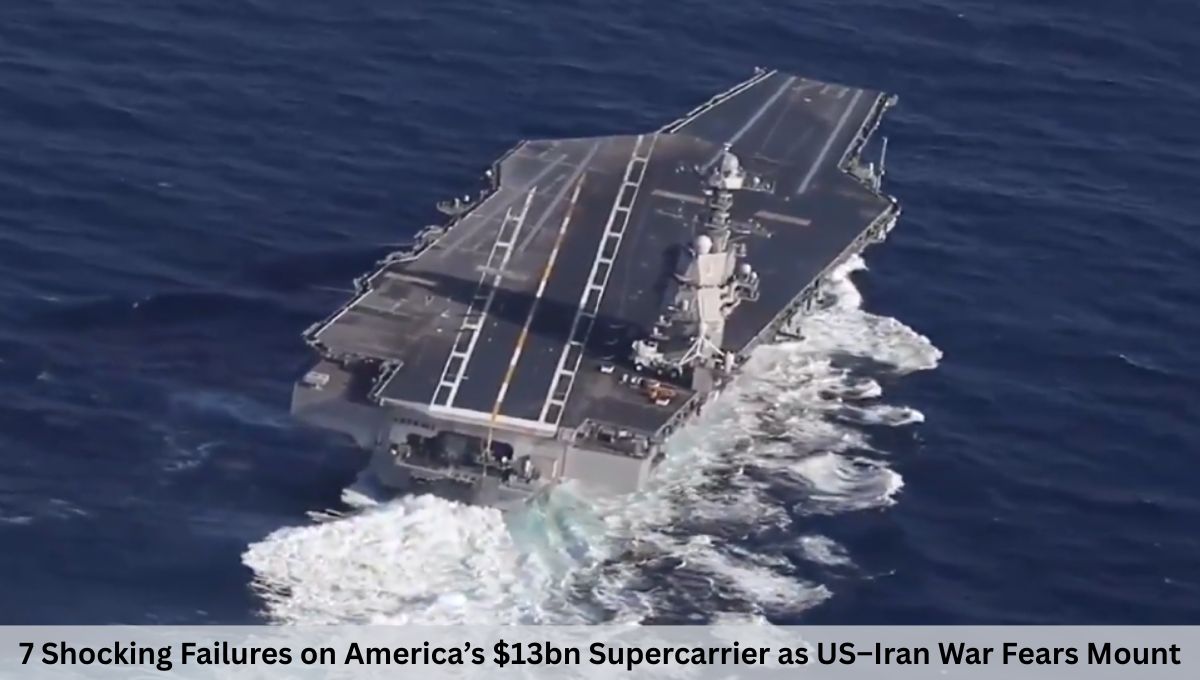
7 Shocking Failures on America’s $13bn Supercarrier as US–Iran War Fears Mount amid sewage crisis. As global attention focuses on rising tensions between Washington and Tehran, an unexpected issue has emerged aboard America’s most expensive warship.
The USS Gerald R. Ford, a $13 billion symbol of U.S. naval dominance, is reportedly struggling with persistent sewage system failures—raising uncomfortable questions about crew welfare, endurance, and operational readiness at a critical geopolitical moment.
From clogged toilets and narrow pipes to exhausted engineering crews and mounting frustration among sailors, the problems come as the carrier heads toward West Asia amid escalating rhetoric and military positioning involving Iran.
7 Shocking Failures on America’s $13bn Supercarrier as US–Iran War Fears Mount
America’s Costliest Warship, an Unexpected Weakness
Commissioned in 2017, the USS Gerald R. Ford represents the cutting edge of U.S. naval engineering.
Designed to replace aging Nimitz-class carriers, it introduced new technologies across aviation, power generation, and ship systems.
Yet one of its most basic onboard necessities—the sewage system—has become a recurring failure point.
According to multiple reports, the carrier’s vacuum-based sewage system, adapted from cruise ship designs to conserve water, has struggled under real-world operational conditions.
Narrow pipes, heavy use by a crew exceeding 4,600 sailors, and design constraints have resulted in chronic clogs and system breakdowns.
A System Built for Efficiency, Not Reality
The ship supports more than 600 toilets divided into 10 independent zones, all connected through the Vacuum Collection, Holding, and Transfer (VCHT) system.
In theory, the design reduces water consumption and improves efficiency.
In practice, sailors report frequent failures where a single clogged toilet can disable an entire zone.
When that happens, crews are forced to queue for functioning heads, roam the ship in search of usable facilities, or clean up unsanitary overflows during routine maintenance periods.
Engineering teams responsible for repairs have complained of exceptionally long shifts, burnout, and repetitive maintenance cycles that fail to deliver lasting solutions.
205 Breakdowns in Just Four Days
The scale of the problem became stark during earlier deployments. Reports indicate that during a 2025 mission near Venezuela, the carrier recorded at least 205 sewage-related breakdowns in four days, prompting what sailors described as a near-constant maintenance call.
Clogs were frequently caused by “improper materials” flushed into the system—such as T-shirts, mop heads, and wipes—yet engineers argue that the system’s undersized piping makes it inherently vulnerable even under disciplined use.
Fixing severe blockages reportedly requires specialized acid flushes costing around $400,000 per procedure, according to earlier defense industry estimates.
Life on Board: Exhaustion, Frustration, and Morale
For sailors, the sewage failures compound the stresses of extended deployments.
According to reporting by the Wall Street Journal, crew members and their families describe growing frustration as missions are extended and return dates remain uncertain.
Some sailors have reportedly missed funerals, births of children, and long-planned leave.
Several have indicated they are considering leaving the Navy once their deployment ends, citing exhaustion and deteriorating living conditions.
While seasoned naval personnel note that sewage problems are common on warships, critics argue that such persistent failures aboard a flagship vessel raise deeper questions about design oversight and lifecycle testing.
Does a Sewage Crisis Affect Combat Readiness?
The U.S. Navy insists that sanitation issues, while unpleasant, do not compromise combat capability.
Warships are designed to fight through mechanical failures, and veteran sailors emphasize that systems often degrade during long deployments in harsh maritime environments.
However, analysts caution that crew morale and endurance are not trivial concerns—especially if operations stretch into months under high-stress conditions.
With sailors working long hours under unsanitary conditions, even minor quality-of-life issues can accumulate into broader readiness challenges over time.
Why the Timing Matters: US–Iran Tensions
The sewage controversy would likely have remained a niche defense story if not for its timing.
The USS Gerald R. Ford is moving toward the eastern Mediterranean and potentially closer to the Middle East as U.S.–Iran tensions reach a new peak.
According to the New York Times, two U.S. aircraft carrier strike groups are now positioned within striking distance of Iran—representing the largest American naval buildup in the region in more than two decades.
President Donald Trump has reportedly signaled openness to significant military action if diplomacy fails to curb Iran’s nuclear ambitions.
Military Pressure Meets Diplomatic Off-Ramps
Despite the massive military buildup, quiet diplomatic efforts are underway.
Negotiators from Washington and Tehran are reportedly discussing a limited “off-ramp” proposal that would allow Iran to maintain a narrowly defined nuclear enrichment program solely for medical research.
The idea, attributed to IAEA leadership, would allow both sides to claim victory—Tehran preserving enrichment in principle, and Washington ensuring no weapons-grade capability.
Still, public positions remain hardened. U.S. officials continue to insist on “zero enrichment,” while Iranian leaders maintain their sovereign right to nuclear fuel production.
Why the Ford Still Matters Militarily
Despite its plumbing woes, the USS Gerald R. Ford remains a formidable platform.
Its advanced radar systems, including the AN/SPY-3 multi-function radar, offer significant improvements over legacy systems aboard older carriers.
Paired with electronic warfare aircraft like EA-18G Growlers, the carrier can support large-scale jamming operations capable of blinding adversary radar networks—an essential advantage in any potential confrontation with Iran.
Military planners emphasize that these capabilities, not sanitation systems, ultimately determine strategic outcomes.
Expert View: Normal Problem or Design Failure?
Naval veterans note that sewage failures are common across fleets worldwide.
Warships operate in corrosive environments under constant vibration, with thousands of crew members using systems around the clock.
However, critics argue that the Ford’s issues are unusually persistent for a ship intended to define the next generation of carriers.
The reliance on cruise-ship-style vacuum systems, combined with undersized piping, may reflect a mismatch between efficiency goals and military realities.
Long-term fixes may only be possible during major maintenance periods once the ship returns to home port.
Politics, Perception, and Propaganda
Some analysts warn that adversaries may amplify stories of crew hardship to undermine public support for U.S. military operations.
Images of sailors battling overflowing toilets can resonate emotionally, even if operational capability remains intact.
Historically, public pressure has influenced American strategic decisions, from Vietnam to more recent conflicts.
Defense experts caution against allowing quality-of-life narratives—however valid—to overshadow broader security considerations.
What Happens Next?
In the short term, the USS Gerald R. Ford is expected to continue its mission, sewage problems notwithstanding.
Temporary mitigation measures, stricter discipline around system use, and continuous repairs are likely to keep essential facilities operational.
In the longer term, the Navy faces difficult questions:
- Should the Ford-class sewage system be redesigned?
- Were efficiency trade-offs worth the operational cost?
- How do prolonged deployments affect sailor retention and morale?
These issues will likely shape future procurement and modernization decisions well beyond the current Iran crisis.
Conclusion: War Decisions Won’t Be Made in the Bathroom
The image of America’s most powerful warship battling clogged toilets is undeniably jarring. Yet history suggests that wars are not won—or lost—on plumbing alone.
The USS Gerald R. Ford remains a centerpiece of U.S. power projection, even as it exposes the challenges of integrating cutting-edge technology into real-world military operations.
As tensions with Iran continue to simmer, the ultimate decisions will be made in the White House and Congress—not in the ship’s heads. But for the sailors living this reality day after day, the crisis is far more than symbolic.
It is a reminder that even the most advanced machines depend, fundamentally, on human endurance.
Also Read: 7 Explosive Moments as US Jet Shoots Down Iran Drone Near Aircraft Carrier
Also Read: ‘Sewage crisis’ hits USS Gerald Ford aircraft carrier: report
Related Posts:
- 7 Powerful Measures: Trump Sanctions Russian Oil…

- In 8 Moves, EU Targets China-Linked Refineries and…

- Afghanistan–Pakistan War 2025: Inside the 48-Hour Ceasefire

- Trump’s 20-Point Gaza Peace Plan Gains Urgent Global…

- 11 Explosive Revelations From Ted Cruz’s Leaked…

- 15 Explosive Signals as the US Masses War-Ready…