
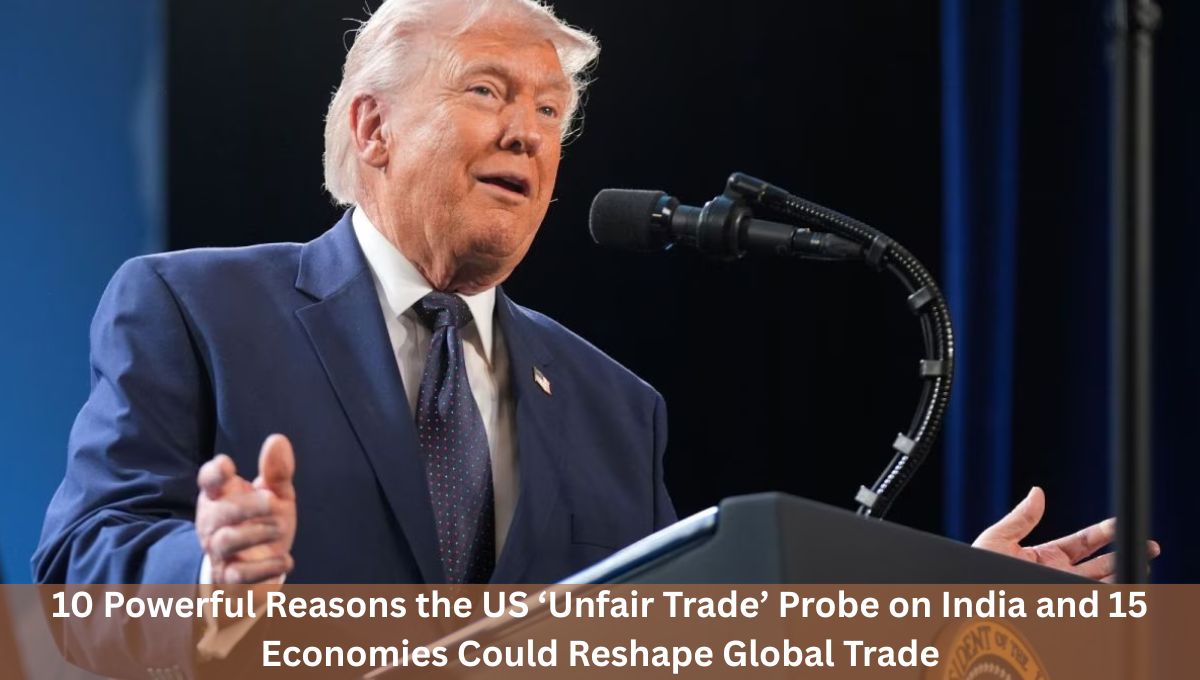
10 Powerful Reasons the US ‘Unfair Trade’ Probe on India and 15 Economies Could Reshape Global Trade and billions in exports. The United States has launched a sweeping investigation into what it describes as “unfair trade practices” by some of its largest trading partners — a move that could reignite global tariff tensions and reshape international commerce.
The probe targets 16 major economies, including India, China, the European Union, Japan, South Korea, and Mexico, and is being conducted under Section 301 of the US Trade Act of 1974, one of the most powerful trade enforcement tools available to Washington.
If the investigation concludes that these countries have engaged in practices that harm American businesses, the United States could impose new tariffs, trade restrictions, or other retaliatory measures as early as this summer.
The announcement comes at a sensitive moment for global trade. Just weeks earlier, the US Supreme Court struck down a major portion of President Donald Trump’s tariff programme, forcing the administration to search for alternative legal pathways to maintain pressure on trading partners.
Below are the 10 most important developments and implications of this major trade investigation.
10 Powerful Reasons the US ‘Unfair Trade’ Probe on India and 15 Economies Could Reshape Global Trade
1. The US Has Targeted 16 Major Trading Partners
The investigation focuses on some of the world’s largest economies and most important US trading partners.
Countries included in the probe are:
- India
- China
- European Union member states
- Japan
- South Korea
- Mexico
- Taiwan
- Vietnam
- Thailand
- Malaysia
- Cambodia
- Singapore
- Indonesia
- Bangladesh
- Switzerland
- Norway
Together, these economies account for a massive share of global manufacturing output and international trade.
The investigation signals that Washington is prepared to confront a wide range of partners simultaneously over industrial policies and trade practices.
2. The Probe Is Being Conducted Under Section 301
The investigation is being carried out under Section 301 of the Trade Act of 1974, a powerful legal mechanism that allows the US government to investigate and respond to foreign trade practices that it considers unfair.
Under Section 301, the United States Trade Representative (USTR) can take unilateral action against other countries if their policies are deemed to harm US commerce.
Possible actions include:
- Tariffs on imported goods
- Import restrictions
- Fees on services
- Market access barriers
- Other retaliatory trade measures
Section 301 has historically been used to launch some of the most aggressive US trade actions.
For example, it served as the legal foundation for the 25% tariffs on hundreds of billions of dollars of Chinese imports during the US-China trade war.
3. The Investigation Focuses on “Excess Manufacturing Capacity”
The central issue being examined in the probe is global manufacturing overcapacity.
US officials argue that several countries have developed industrial sectors that produce far more goods than their domestic markets can absorb.
According to the US Trade Representative’s office, this situation can distort global trade by flooding international markets with artificially cheap exports.
Washington claims this can occur due to government policies such as:
- Heavy subsidies for manufacturing
- Cheap state-backed financing
- Support for state-owned enterprises
- Suppressed wages
- Weak labor and environmental standards
- Currency manipulation
These policies, US officials argue, allow foreign producers to sell goods at lower prices than American manufacturers.
4. The Move Follows a Major US Supreme Court Ruling
The investigation was triggered in part by a major legal setback for the Trump administration.
In February, the US Supreme Court ruled that the administration had exceeded its authority when it imposed sweeping tariffs under the International Emergency Economic Powers Act (IEEPA).
The ruling invalidated a large portion of the administration’s global tariff regime.
In response, the White House introduced a temporary 10% global tariff under another law, Section 122 of the Trade Act.
However, that measure can only remain in effect for 150 days, creating pressure on the administration to establish a more durable legal basis for tariffs.
The Section 301 investigation is widely seen as an effort to build that legal foundation.
5. India’s Inclusion Comes After a New Trade Framework
India’s inclusion in the probe has drawn particular attention.
Just weeks earlier, Washington and New Delhi had announced a framework for an interim bilateral trade agreement, aimed at strengthening economic ties between the two countries.
The agreement included several commitments:
- India would reduce tariffs on certain US industrial and agricultural products
- The United States would lower reciprocal tariffs on Indian goods
- Both countries pledged to expand market access
- India committed to purchasing $500 billion worth of US goods over five years
Despite this progress, US officials have made clear that ongoing trade negotiations do not exempt countries from Section 301 investigations.
6. Several Major Indian Export Sectors Could Be Affected
The United States is India’s largest export market.
If tariffs are eventually imposed as a result of the investigation, several major Indian industries could face significant pressure.
Key Indian exports to the United States include:
- Electronics and smartphones
- Textiles and apparel
- Pharmaceuticals
- Engineering goods
- Metals and industrial equipment
- Gems and jewellery
- Auto components
- Solar energy equipment
Between April and January of FY26 alone, India exported more than $100 billion worth of goods to the United States.
Even modest tariffs could affect billions of dollars in trade.
7. The Probe Could Lead to New Tariffs by Summer
The Trump administration has outlined a relatively fast timeline for the investigation.
The process will include:
- Public comments accepted until April 15
- A public hearing expected around May 5
- Final findings before July
If the investigation concludes that unfair trade practices exist, the US government could impose tariffs or other trade restrictions soon after.
Officials have indicated that any new tariffs could replace the temporary measures currently in place.
8. A Separate Probe Will Target Forced Labor
In addition to the manufacturing investigation, the United States plans to launch another Section 301 probe focused on imports produced using forced labor.
This investigation could cover more than 60 countries.
The United States already prohibits the import of goods made using forced labor under the Tariff Act of 1930.
Additional restrictions were introduced through the Uyghur Forced Labor Prevention Act, which targets goods linked to China’s Xinjiang region.
The new investigation could significantly expand enforcement across global supply chains.
9. The Probe Comes Amid Rising Global Trade Tensions
The new investigation arrives at a time of growing economic rivalry between major global powers.
Several issues are contributing to rising trade tensions:
- Competition over advanced manufacturing
- Subsidies for electric vehicles and green technology
- Supply chain security concerns
- Strategic competition between the US and China
Washington has repeatedly warned that state-supported industrial expansion in certain countries could undermine American manufacturing.
The probe signals that tariffs remain a central tool in the administration’s economic strategy.
10. The Outcome Could Reshape Global Trade Relations
The ultimate impact of the investigation remains uncertain.
Several outcomes are possible:
- New tariffs on selected industries
- Sector-specific trade restrictions
- Negotiated settlements with trading partners
- Broader trade disputes between major economies
Given the scale of the countries involved, any significant trade measures could ripple across global supply chains.
For businesses, exporters, and investors, the investigation introduces a new layer of uncertainty in international trade.
A New Phase in Global Trade Policy
The United States’ decision to launch sweeping trade investigations marks a significant escalation in its economic strategy.
By targeting some of the world’s largest economies simultaneously, Washington is signaling that it intends to aggressively challenge what it views as unfair trade practices.
For countries like India, the investigation presents both risks and opportunities. While tariffs could affect major export sectors, ongoing trade negotiations may also provide a pathway to resolve disputes before they escalate.
As the investigation unfolds in the coming months, the outcome could shape the future of global trade — and determine whether the world moves toward cooperation or a new era of tariff-driven economic rivalry.
Also Read: 9 Strategic Reasons the US Allowed India to Buy Russian Oil Again
Also Read: US ‘Unfair Trade’ Probe On India, 15 Others: What It Means, Why It Matters
Related Posts:
- 7 Powerful Reasons Mexico’s Shock Tariffs Hit India…
- 7 Alarming Reasons Mexico’s Shock Tariffs Hammer…
- Trump Targets Sri Lanka, BRICS with Sweeping Tariffs
- 11 Explosive Revelations From Ted Cruz’s Leaked…
- In 8 Moves, EU Targets China-Linked Refineries and…

- Xi Jinping, Lula, and Jaishankar Call for BRICS…
