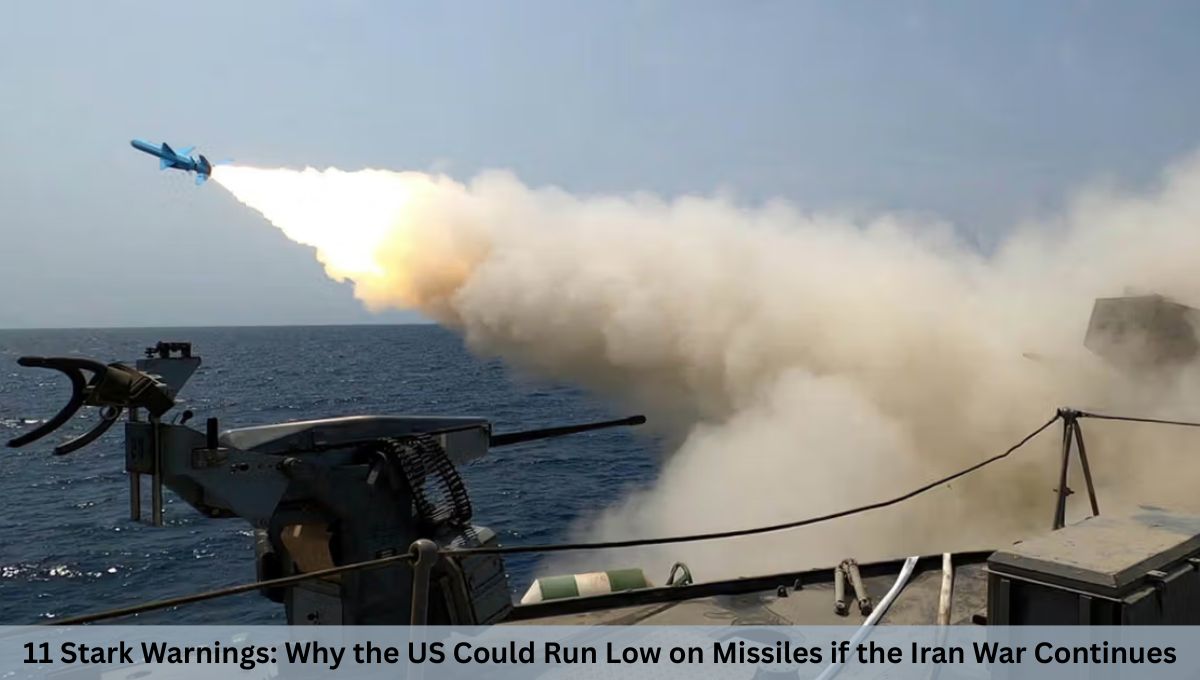
11 Stark Warnings: Why the US Could Run Low on Missiles if the Iran War Continues beyond 10 days. As the war between the United States, Israel, and Iran enters its most dangerous phase, a quiet but consequential concern has begun to dominate strategic discussions in Washington: missile depletion.
Leaks from inside the Pentagon, corroborated by reporting from Al Jazeera, CNN, Reuters, and The Wall Street Journal, suggest that if the current pace of operations continues for another 10 days, the US could face serious shortages of key interceptor missiles and high-end precision munitions.
While President Donald Trump has publicly insisted that America can fight wars “forever,” defence officials and independent analysts describe a far more fragile reality—one governed not by rhetoric, but by industrial capacity, production timelines, and basic mathematics.
This article explains why missile stockpiles matter, which weapons are most at risk, how much the war is costing, and why the outcome of the Middle East conflict may ultimately be decided by who runs out of interceptors first.
11 Stark Warnings: Why the US Could Run Low on Missiles if the Iran War Continues
1. The Pentagon’s Quiet Warning
According to multiple officials cited in US and international media, senior Pentagon leaders—including Joint Chiefs Chairman Gen. Dan Caine—have repeatedly warned the White House that a prolonged war with Iran carries material risks.
Among the most urgent:
- Rapid depletion of interceptor missiles
- High costs and long timelines for replenishment
- Reduced readiness in other theatres, including Europe and the Indo-Pacific
Officials stressed that missile defence inventories—already stretched by support for Ukraine, Israel, and operations against Houthi forces in Yemen—could become the limiting factor in how long the US can sustain the campaign.
2. Trump vs the Pentagon: Conflicting Messages
Despite these warnings, Trump has taken a sharply different tone.
In a post on Truth Social, the president claimed:
“The United States Munitions Stockpiles have… never been higher or better… We have a virtually unlimited supply. Wars can be fought ‘forever.’”
Defence analysts say this statement conflates aggregate stockpiles with specific, high-demand weapons, particularly interceptor missiles that cannot be mass-produced quickly.
In modern warfare, not all missiles are equal—and some are far scarcer than others.
3. Why Interceptors Matter More Than Bombs
Unlike offensive weapons such as bombs or rockets, interceptor missiles are purely defensive.
They are used to:
- Destroy incoming ballistic missiles
- Intercept cruise missiles
- Shoot down drones
In the Iran conflict, interceptors have been fired at an extraordinary rate, often requiring two or more interceptors per incoming missile to ensure a kill.
This has created a burn rate that far exceeds production capacity.
4. The Weapons Most at Risk
THAAD Interceptors
The Terminal High Altitude Area Defense (THAAD) system—manufactured by Lockheed Martin—is one of the most advanced missile defence systems in the world.
Key facts:
- Only nine active THAAD batteries exist globally
- A single battery costs $1–1.8 billion
- Each interceptor costs millions of dollars
- Production is slow and complex
During the 12-day Iran–Israel war last year, the US fired over 150 THAAD interceptors, roughly 25% of its global inventory.
Patriot and SM-3 Missiles
Other systems under strain include:
- Patriot PAC-3 interceptors
- Standard Missile-3 (SM-3), a ship-launched ballistic missile interceptor produced by Raytheon
Manufacturing rates for these systems remain limited, while global demand continues to surge.
5. Iran’s Advantage: Quantity Over Cost
Iran’s strategy relies on volume and attrition.
With an antiquated air force, Tehran has instead invested in:
- Ballistic missiles
- Cruise missiles
- One-way attack drones
According to US officials, Iran produces:
- 100+ missiles per month
- Thousands of drones, even under sanctions
By contrast, the US and its allies can manufacture only a handful of interceptors per month.
This asymmetry lies at the heart of the conflict.
6. A “Salvo Competition”
Military analysts describe the war as a salvo competition—a contest to see who has the deeper magazines.
Stacie Pettyjohn of the Center for a New American Security explained:
“The question is who has the deeper magazines of key weapons.”
If air defence stocks run low, even a technologically superior force may be forced to scale back operations or seek a ceasefire.
7. The Cost of Shooting Down Cheap Weapons
One of the most punishing dynamics of the war is cost asymmetry.
- An Iranian drone may cost a few thousand dollars
- An interceptor missile may cost hundreds of thousands—or millions
Kelly Grieco of the Stimson Center estimates intercepting a drone can cost five times more than producing one.
Over time, this dynamic favours the attacker.
8. How Much Has the War Already Cost the US?
Estimates suggest:
- $779 million spent in the first 24 hours
- $630 million for pre-strike military buildup
- $6.5 million per day to operate a single carrier strike group
With two carrier groups deployed—including the USS Gerald R. Ford—costs escalate rapidly.
Fiscal analysts warn a prolonged war could exceed $200 billion.
9. The Global Ripple Effect
Missile shortages do not exist in isolation.
Every interceptor fired in the Middle East is:
- One less available for Ukraine
- One less reserved for a potential China–Taiwan contingency
- One less for homeland defence
A Heritage Foundation study warns US munitions could be depleted within 25 days of a high-intensity conflict with China.
Beijing is watching closely.
10. Gulf States Under Pressure
US allies across the Gulf—including Qatar, Saudi Arabia, and the UAE—have burned through large numbers of interceptors defending against Iranian attacks.
Officials privately acknowledge that difficult choices may soon arise:
- What to protect
- What to let through
“There is no such thing as 100% defence,” said missile expert Tal Inbar.
11. A War Decided by Math, Not Firepower
Despite US and Israeli air superiority, analysts warn the conflict’s outcome may hinge on logistics rather than battlefield dominance.
Iran’s strategy appears designed to:
- Wear down defences
- Raise financial costs
- Test political endurance
As one analyst put it:
“This is death by a thousand cuts.”
Conclusion: The Limits of Military Power
America possesses unmatched military strength—but not infinite resources.
Carriers cannot be everywhere. Factories cannot triple output overnight. Interceptors cannot be replaced at the speed they are fired.
If the war with Iran drags on, missile stockpiles—not battlefield victories—may dictate strategy. The Pentagon understands this reality. The world is beginning to see it. And Iran is betting on it.
Also Read: 7 Shocking Failures on America’s $13bn Supercarrier as US–Iran War Fears Mount
Related Posts:
- Trump’s 20-Point Gaza Peace Plan Gains Urgent Global…

- Murdoch vs. Trump: A Media Feud with Press Freedom…

- 9 Explosive Signals as Trump Targets Cuba’s Oil…

- Afghanistan–Pakistan War 2025: Inside the 48-Hour Ceasefire

- 7 Powerful Measures: Trump Sanctions Russian Oil…

- In 8 Moves, EU Targets China-Linked Refineries and…
