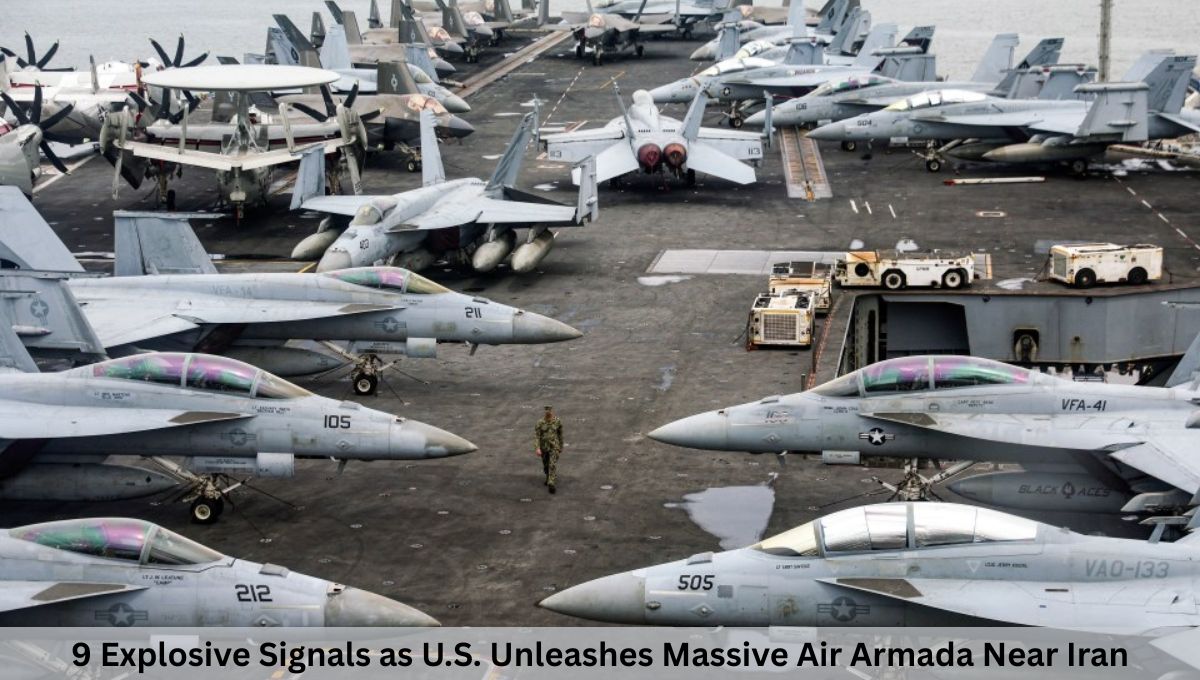
9 Explosive Signals as U.S. Unleashes Massive Air Armada Near Iran and sets a 10–15-day deadline for a nuclear deal. The Middle East is once again at the center of global geopolitical anxiety. Over the past several weeks, the United States has quietly — and then unmistakably — assembled its largest concentration of air and naval power in the region since the 2003 invasion of Iraq.
Advanced stealth fighters, command-and-control aircraft, missile-defense systems, and two aircraft carrier strike groups are converging on waters and bases within striking distance of Iran. All that remains, according to multiple U.S. and allied officials, is a final political decision from Donald Trump.
The question confronting world capitals, energy markets, and military planners alike is stark:
Is this a pressure campaign meant to force diplomacy — or the opening act of a sustained air war against Iran?
9 Explosive Signals as U.S. Unleashes Massive Air Armada Near Iran
1. The Largest U.S. Air Power Buildup Since 2003
Flight-tracking data and defense reporting indicate a rapid influx of U.S. Air Force assets into the region, particularly to Jordan and Saudi Arabia, as Washington compensates for denied airspace in some Gulf states.
According to reporting by The Wall Street Journal, the deployment includes:
- F-22 Raptor stealth fighters
- F-35 Lightning II multirole jets
- F-15 and F-16 strike aircraft
- E-3 airborne warning and control systems
- E-11 battlefield communications aircraft
- Dozens of KC-135 aerial refueling tankers
These assets provide air superiority, deep-strike capability, electronic warfare, and sustained operational reach — the full toolkit required for a prolonged air campaign.
2. Two Aircraft Carriers Signal Strategic Intent
The U.S. Navy has positioned 13 warships across the Middle East and eastern Mediterranean, anchored by two nuclear-powered aircraft carriers:
- USS Abraham Lincoln
- USS Gerald R. Ford
Each carrier strike group brings not just combat aircraft, but also guided-missile destroyers capable of intercepting Iranian ballistic missiles or launching Tomahawk cruise strikes.
This configuration allows Washington to strike Iran without relying on regional airbases, a critical consideration as several Gulf states fear Iranian retaliation.
3. Trump Sets a 10–15 Day Clock on Diplomacy
President Trump has escalated rhetoric alongside military pressure, publicly stating that Iran has roughly 10 to 15 days to reach a “meaningful” agreement with Washington.
“We’re either going to make a deal — or bad things happen,” Trump warned reporters.
While the White House insists diplomacy remains the preferred path, officials privately acknowledge that military readiness has reached a point where action could begin within days if talks collapse.
4. Nuclear Talks: Progress Claimed, Gaps Remain
Indirect negotiations between Washington and Tehran resumed in Geneva, with mediators reporting limited progress.
Iran’s foreign minister, Abbas Araghchi, said both sides had agreed on “guiding principles” for a possible framework. U.S. officials, however, describe the talks as “still very far apart”.
The core disputes remain unchanged:
- The U.S. demands zero uranium enrichment
- Iran insists enrichment is a sovereign right
- Washington wants limits on Iran’s ballistic missile program
- Tehran calls missiles a non-negotiable defense pillar
5. Why This Buildup Is Different From 1991 or 2003
While massive, today’s deployment is numerically smaller than those preceding the 1991 Gulf War or the 2003 Iraq invasion. However, the difference lies in capability, not scale.
Modern U.S. forces rely on:
- Precision-guided munitions
- Stealth penetration aircraft
- Real-time ISR (intelligence, surveillance, reconnaissance)
- Networked command-and-control
This allows Washington to inflict strategic damage with fewer platforms, potentially sustaining a weeks-long air war without ground troops or a formal coalition.
6. Iran’s Retaliation Options Are Real — and Dangerous
Tehran is far from helpless.
Iran retains:
- A sizable ballistic and cruise missile arsenal
- Armed regional proxies
- Naval forces capable of disrupting shipping
- Anti-ship missiles targeting chokepoints
The most immediate risk lies in the Strait of Hormuz, through which roughly one-third of global seaborne oil transits.
Iran has already conducted live-fire drills in the area, briefly restricting maritime traffic under “security precautions.”
7. Oil Markets React as War Risk Grows
Energy traders are pricing in geopolitical risk.
Brent crude and U.S. West Texas Intermediate have surged as investors weigh the possibility of:
- Supply disruptions
- Insurance spikes for tankers
- Closure or partial closure of Hormuz
Even a limited exchange could ripple through global inflation, hitting emerging economies and energy-importing nations hardest.
8. Israel’s Calculations and the Regional Equation
Israel, which has long advocated tougher action against Iran, is preparing for potential retaliation.
Prime Minister Benjamin Netanyahu has warned that any Iranian strike on Israel would trigger an overwhelming response.
While Washington has not confirmed joint operations, Israeli participation — overt or covert — would dramatically widen the conflict’s scope.
9. The Core Dilemma: Deterrence or Regime-Shaking War
Inside the Trump administration, officials are divided. Some argue the buildup is coercive signaling — meant to force Iran into concessions without firing a shot.
Others acknowledge that current military planning includes:
- Strikes on nuclear facilities
- Missile depots and launchers
- Command-and-control nodes
- Potential decapitation scenarios targeting senior leadership
As retired Air Force General David Deptula noted, the deployment may itself be the message:
proof that Washington is prepared to act, not posture.
What Happens Next
The coming days are pivotal. If diplomacy succeeds, this armada may stand down — remembered as a near-miss that reshaped negotiations.
If talks fail, the world could witness:
- The first sustained U.S. air war against Iran
- A regional escalation involving proxies
- Severe disruption to global energy markets
Either way, the margin for error is vanishing. As military assets continue to pour into the region and rhetoric hardens on all sides, the line between pressure and war has never been thinner.
Final Word
This is not merely a U.S.–Iran standoff.
It is a test of deterrence, diplomacy, and credibility — with consequences that will be felt from Asian energy markets to European inflation and Middle Eastern stability.
The next 10 to 15 days may define the geopolitical trajectory of the decade.
Also Read: 9 Explosive Warnings as Hezbollah Backs Iran Against Trump Threats
Also Read: F-22 Raptors, F-35 Lightnings: US Unleashes Massive Air Armada, Iran Watches
Related Posts:
- Afghanistan–Pakistan War 2025: Inside the 48-Hour Ceasefire

- In 8 Moves, EU Targets China-Linked Refineries and…

- 7 Powerful Measures: Trump Sanctions Russian Oil…

- 15 Explosive Signals as the US Masses War-Ready…
- Trump’s 20-Point Gaza Peace Plan Gains Urgent Global…

- 11 Explosive Revelations From Ted Cruz’s Leaked…