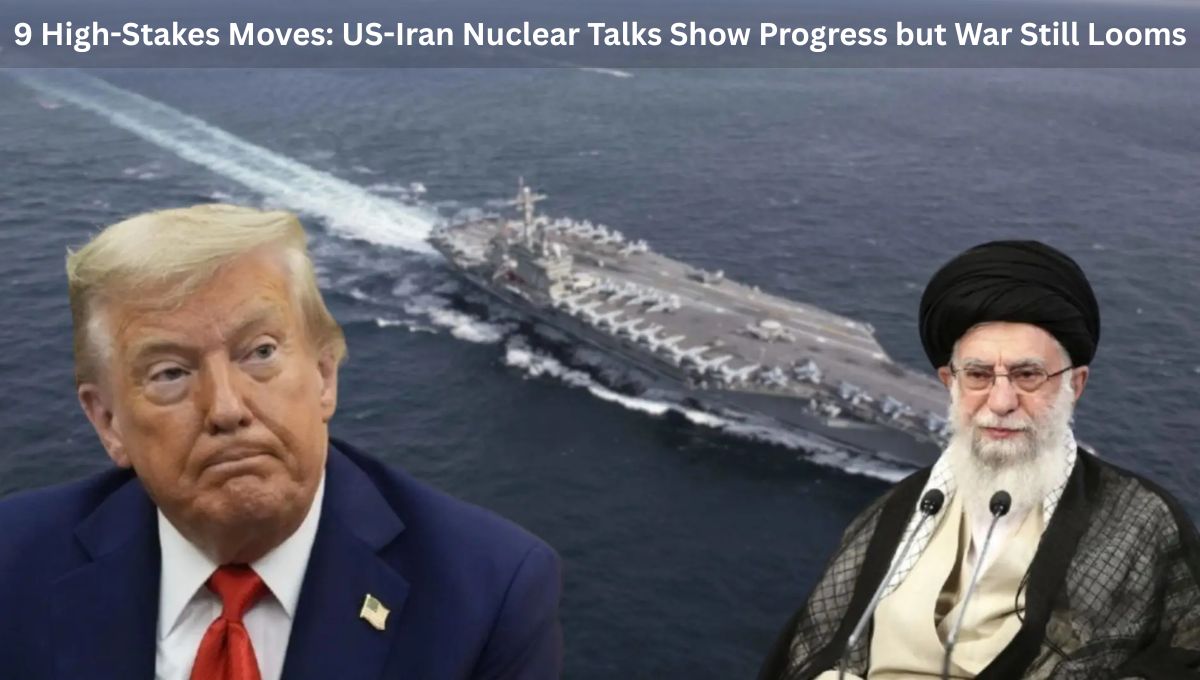
9 High-Stakes Moves: US-Iran Nuclear Talks Show Progress but War Still Looms amid disputes over enrichment. Indirect nuclear negotiations between the United States and Iran concluded in Geneva with cautious claims of progress — but without the clarity or concessions needed to defuse mounting fears of war.
While mediators described the talks as “serious,” “intense,” and even “significant,” officials on both sides offered few concrete details. Fundamental disagreements over uranium enrichment, sanctions relief, ballistic missiles, and the permanence of any future deal remain unresolved.
With US military assets massed across the Middle East and Iran’s economy buckling under crushing inflation and sanctions, the Geneva talks are increasingly seen as a last diplomatic window before confrontation.
9 High-Stakes Moves: US-Iran Nuclear Talks Show Progress but War Still Looms
Talks End Without a Deal, But Diplomacy Continues
The third round of indirect talks wrapped up Thursday after hours of negotiations conducted through Omani mediation.
Iran’s Foreign Minister Abbas Araghchi described the discussions as the most serious yet, confirming that technical talks will take place next week in Vienna.
“These were the most serious and longest talks,” Araghchi said, adding that progress had been “good,” though incomplete.
The negotiations were mediated by Oman’s foreign minister Badr bin Hamad Al Busaidi, who said both delegations would consult with their respective governments before the next round.
Despite optimistic language, neither side announced any breakthrough — a silence that underscores how fragile the process remains.
Who Was at the Table in Geneva
Iranian Delegation
- Led by Abbas Araghchi
- Backed by Iran’s Supreme National Security establishment
- Presented written proposals outlining Tehran’s expectations
US Delegation
- Led by Steve Witkoff
- Included Jared Kushner
- Operating under strict instructions from President Donald Trump
International Oversight
- Rafael Grossi, head of the International Atomic Energy Agency, participated due to the agency’s future verification role.
Indirect — and Briefly Direct — Engagement
While the talks were officially indirect, Iranian and US officials reportedly met briefly face-to-face, according to Iranian media.
Al Busaidi relayed messages between the two sides throughout the day, a format designed to allow dialogue without forcing political concessions at home.
During breaks in the negotiations, the US delegation also held separate talks related to Ukraine, underscoring the crowded geopolitical context surrounding the Iran file.
The Core Disputes Blocking a Deal
Despite positive rhetoric, deep structural disagreements remain.
1. Uranium Enrichment
Washington insists Iran must accept zero enrichment on its soil, even for civilian purposes.
Iran rejects this outright, arguing:
- Enrichment is permitted under the Nuclear Non-Proliferation Treaty
- It is a red line set by Supreme Leader Ali Khamenei
- Any deal eliminating enrichment would be politically unsustainable
2. Sanctions Relief
Iran demands immediate and verifiable sanctions relief.
The US insists sanctions can only be lifted after irreversible nuclear concessions, creating a sequencing deadlock.
3. Ballistic Missile Program
The Trump administration wants missiles included in the talks.
Iran has refused categorically, calling missiles a non-negotiable defensive capability.
4. Duration of a Future Deal
The US is pushing for an indefinite agreement.
Iran opposes permanent constraints, citing the US withdrawal from the 2015 deal as proof such commitments are unreliable.
The Shadow of the 2015 Nuclear Deal
The talks remain haunted by the collapse of the 2015 nuclear agreement, which Trump abandoned in 2018.
Under that deal:
- Iran accepted enrichment limits
- IAEA inspections expanded
- Sanctions were lifted
The agreement unraveled when Washington reimposed sanctions, devastating Iran’s economy and eroding trust.
Iranian officials repeatedly say any new deal must include guarantees preventing another unilateral US exit.
IAEA’s Role and Rising Tensions
The IAEA Board of Governors is set to meet in early March, just days after Trump floated a 10- to 15-day deadline for a deal.
Western media reports suggest the board could:
- Censure Iran again
- Increase diplomatic pressure
- Trigger further escalation
Iran has accused Grossi of politicization, especially after an IAEA resolution preceded Israeli strikes on Iranian targets last year.
Trump’s Deadline and Military Pressure
President Trump has repeatedly warned that failure to reach a deal would lead to “really bad things.”
In his State of the Union address, Trump:
- Reiterated that Iran must not obtain nuclear weapons
- Accused Tehran of sponsoring terrorism
- Said diplomacy was preferred — but not guaranteed
Since January, the US has:
- Deployed fighter jets
- Sent carrier strike groups
- Increased intelligence activity near Iran
The buildup has fueled speculation that Geneva diplomacy may be the final off-ramp.
Iran’s Counter-Narrative: Victim, Not Aggressor
Iranian President Masoud Pezeshkian pushed back strongly against US accusations.
He argued Iran has been a victim of terrorism, citing:
- Assassinations of Iranian scientists
- Attacks on officials
- Sabotage operations over decades
“If the realities are seen fairly, it will become clear that Iran is not a sponsor of terror, but one of its main victims,” Pezeshkian said.
Inside Iran: Preparing for War
Despite official optimism, many Iranians are bracing for conflict.
Across Tehran:
- Residents are stockpiling food and water
- Buying power banks and radios
- Preparing for internet blackouts
Memories remain fresh of:
- Internet shutdowns during protests
- Blackouts during previous conflicts
- Bombings during last year’s Israel-Iran war
Crushing Inflation Deepens Anxiety
Iran’s economy is under severe strain.
According to official data:
- Annual inflation exceeds 60 percent
- Food inflation has topped 100 percent
- Cooking oil prices surged over 200 percent
The Iranian rial has fallen to historic lows, trading near 1.66 million rials per US dollar.
For many Iranians, preparing for war is a luxury they cannot afford.
Iran’s Proposal: A ‘Win-Win’ Offer
Iranian officials say their Geneva proposal aims to test US seriousness.
Reported elements include:
- Diluting part of Iran’s 60% enriched uranium
- Keeping uranium inside Iran under IAEA supervision
- Allowing expanded inspections
- Seeking sanctions relief
In return, Iran is reportedly offering:
- Economic cooperation
- US access to oil and gas investments
- Aircraft purchases and industrial deals
A ‘Commercial Bonanza’ Strategy
Tehran appears to be appealing directly to Trump’s deal-making instincts.
Officials have floated:
- US investments in oil and gas
- Mining and critical minerals
- Joint energy projects
Iran holds:
- World’s 3rd-largest oil reserves
- World’s 2nd-largest gas reserves
Officials argue that economic incentives could anchor a sustainable deal — unlike the 2015 agreement.
US Skepticism Remains High
US officials have downplayed commercial discussions.
A senior US official said:
“President Trump has been clear: Iran cannot have a nuclear weapon or the capacity to build one.”
The White House remains focused on:
- Zero enrichment
- Uranium stockpile removal
- Permanent restrictions
Regional Stakes: A Wider War Risk
Failure in Geneva could:
- Trigger US or Israeli strikes
- Prompt Iranian retaliation
- Draw in Gulf states
- Disrupt global energy markets
Iran has warned it would respond fiercely to any new attack.
Gulf oil producers are watching nervously, fearing supply shocks and regional instability.
Supreme Leader’s Defiance
Supreme Leader Ali Khamenei has cast doubt on diplomacy, saying:
- The US cannot overthrow Iran’s system
- Leadership succession is guaranteed
- Pressure will not change Iran’s core positions
Araghchi reinforced this message, stating that Iran’s political system would survive even targeted assassinations.
What Happens Next
Short-Term Timeline
- Consultations in Washington and Tehran
- Technical talks in Vienna next week
- Possible fourth negotiation round
Key Unknowns
- Will the US soften on enrichment?
- Will Iran accept deeper verification?
- Will sanctions relief be front-loaded?
- Will military pressure increase?
Why These Talks Matter Globally
The outcome will affect:
- Global oil prices
- Middle East stability
- Nuclear non-proliferation norms
- US credibility in diplomacy
A deal could cool tensions. Failure could ignite a conflict with global consequences.
Conclusion: Progress Without Breakthrough
The Geneva talks delivered momentum, not resolution.
While both sides claim seriousness, their red lines remain intact. With deadlines looming and military forces in place, diplomacy is racing against time.
Whether Vienna becomes a bridge to peace — or merely a pause before war — will define the next chapter in one of the world’s most dangerous standoffs.
Also Read: Trump Floats $30 Billion Civil Nuclear Deal to Iran Amid Ceasefire
Also Read: US, Iran said to agree on further talks next week, as mediator claims progress
Related Posts:
- Trump’s 20-Point Gaza Peace Plan Gains Urgent Global…

- 7 Powerful Truths: UAE Golden Visa vs Saudi Premium…

- In 8 Moves, EU Targets China-Linked Refineries and…

- 7 Powerful Measures: Trump Sanctions Russian Oil…

- Afghanistan–Pakistan War 2025: Inside the 48-Hour Ceasefire

- Israel–Hamas Ceasefire Under Strain: 4 More Hostage…
