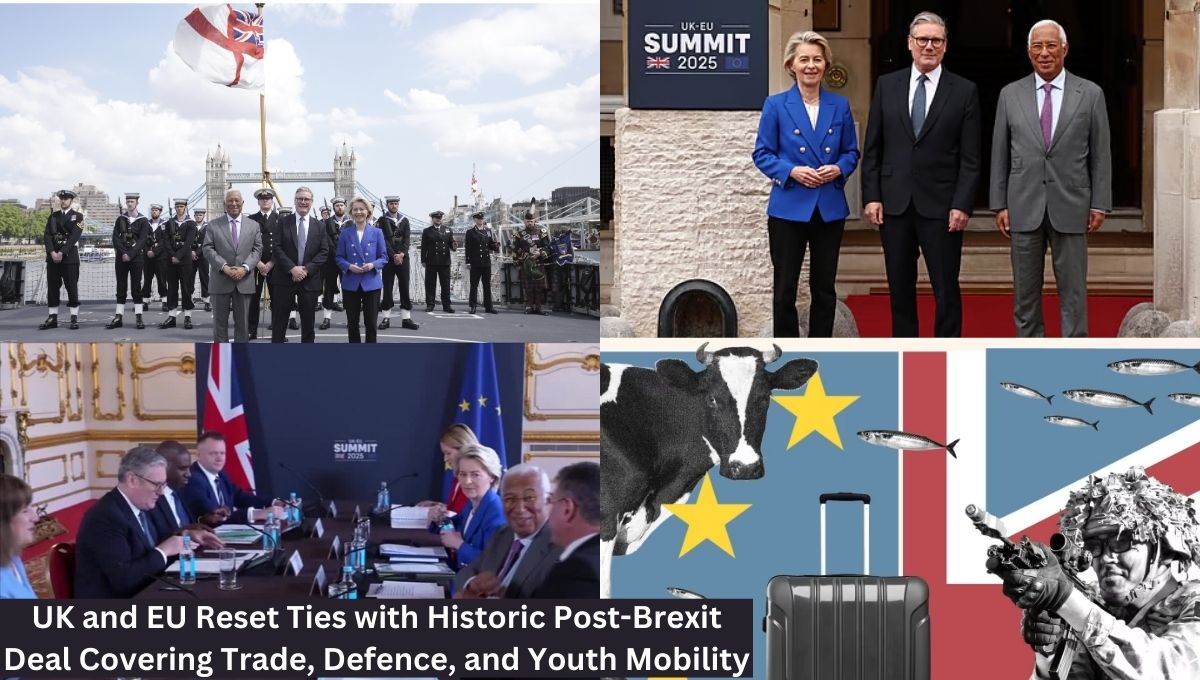
In a new phase of their relationship UK and EU Reset Ties with Historic Post-Brexit Deal Covering Trade, Defence, and Youth Mobility. In a pivotal shift nearly a decade after the Brexit referendum, the United Kingdom and the European Union have signed a comprehensive agreement aimed at resetting relations. The wide-ranging UK-EU deal 2025, announced during a landmark summit in London on May 19, represents the most significant thaw in diplomatic and economic ties since Britain’s EU departure in 2016.
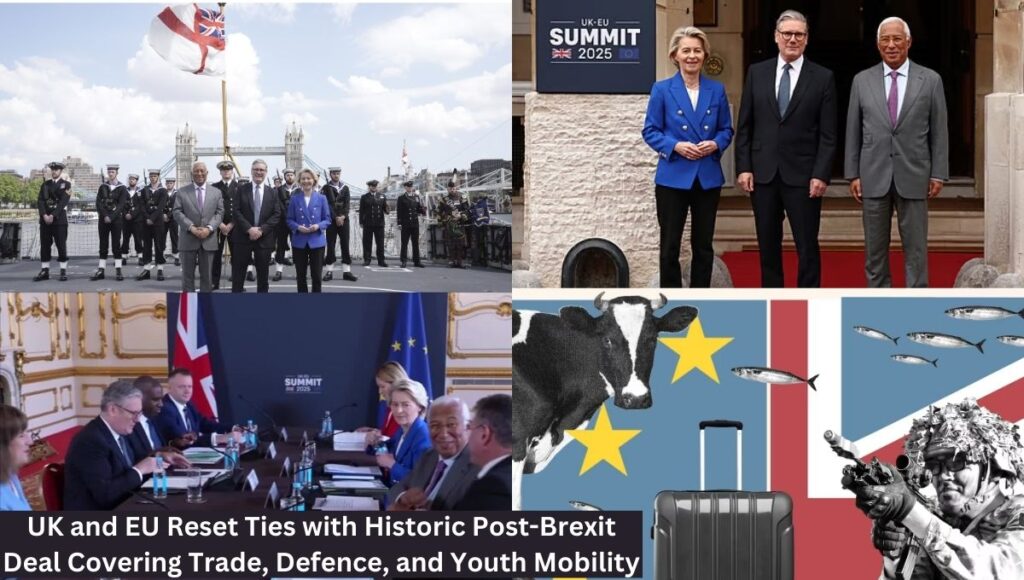
UK and EU Reset Ties with Historic Post-Brexit Deal Covering Trade, Defence, and Youth Mobility
A New Era for UK-EU Relations
Covering trade, defense, youth mobility, and migration, the agreement is being heralded as a “practical partnership” by both sides, and a clear break from the years of political turbulence and economic uncertainty that followed Brexit.
The Labour’s political opponents considered the deal as one-sided while the U.K. Prime Minister Keir Starmer, described the outcomes were a “win-win.”
Keir Starmer: “Britain Is Back on the World Stage”
Speaking from Lancaster House, Prime Minister Keir Starmer described the agreement as a “win-win,” emphasizing its alignment with the public mandate his Labour government received in the 2024 general election.
“Britain is back on the world stage,” Starmer declared, stressing that the UK can work closely with Europe without rejoining the single market or customs union.
He framed the agreement as a step forward that maintains British sovereignty while offering tangible benefits to the public.
European Commission President Ursula von der Leyen echoed the sentiment: “We are opening a new chapter in our unique relationship.”
Reducing Red Tape: Boost for UK Food and Agricultural Trade
A central component of the post-Brexit trade reset is the streamlining of customs procedures for UK-EU trade, particularly around food and agriculture.
Sanitary and phytosanitary (SPS) checks will be significantly eased, offering relief to UK exporters burdened by years of regulatory obstacles.
While the UK remains outside the EU’s single market, it has agreed to align with EU SPS rules to gain access to European markets. This move is expected to reduce costs, stabilize supply chains, and potentially lower prices for consumers.
Von der Leyen called the change “a win for farmers and food producers,” while UK officials project that it could inject nearly £9 billion into the economy by 2040.
EU Fishing Rights Extended: Strategic but Controversial
One of the more contentious elements of the UK-EU deal 2025 is the 12-year extension of EU fishing rights in British waters.
Replacing the annual negotiations that often stirred political conflict, the long-term arrangement provides predictability for coastal economies on both sides of the Channel.
However, it has sparked fierce backlash from Brexit hardliners. Reform UK leader Nigel Farage labeled it a “betrayal of Brexit,” while Conservative opposition figures called it a “surrender.”
Starmer defended the decision, saying it delivers practical stability while still upholding British sovereignty over territorial waters.
UK-EU Defence Pact: A New Strategic Alliance
In light of global instability, particularly Russia’s continued aggression in Ukraine, the UK and EU have also signed a new defence and security pact.
The agreement allows British firms to participate in the EU’s €150 billion defense procurement initiative a first since Brexit.
“This pact strengthens our collective security,” von der Leyen stated. British companies like BAE Systems and Rolls-Royce will now have access to lucrative EU contracts.
The deal also sets the stage for joint foreign policy dialogues, coordinated sanctions, and cooperative efforts to combat cyber threats, human trafficking, and visa fraud.
Youth Mobility Scheme and Erasmus Return: Investing in the Next Generation
One of the most applauded developments of the deal is the establishment of a youth mobility scheme UK for people under 30.
This initiative enables cross-border work and study opportunities, a significant step toward rebuilding post-Brexit educational ties.
Even more notably, British students will regain access to Erasmus+, the EU’s flagship student exchange programme. “This will build friendships that last a lifetime,” said von der Leyen.
While this doesn’t constitute a return to full freedom of movement, it marks a softening of the UK’s previously rigid stance on labor mobility and academic cooperation.
Smoother Travel: E-Gates for UK Citizens at EU Airports
UK travelers will soon benefit from streamlined border checks, as EU countries open their e-gates to British passport holders.
This change, aimed at reducing wait times and restoring ease of travel, addresses one of the most visible post-Brexit inconveniences for millions of Britons.
Migration Management and Security Coordination
The UK-EU deal 2025 also includes measures to combat illegal immigration and visa abuse. Intelligence sharing and joint policies will be implemented to disrupt smuggling networks and enforce stronger border controls.
This part of the agreement reflects mutual concerns over irregular migration and the need for cross-border coordination in an increasingly interconnected world.
Mixed Reactions from UK Political Landscape
Despite the practical focus of the agreement, political opposition remains strong. Reform UK and prominent Conservative figures have accused the Labour government of eroding Brexit gains and ceding ground to Brussels.
Former Prime Minister Boris Johnson called the deal “hopelessly one-sided,” while Conservative leader Kemi Badenoch referred to it as a “sellout.”
Yet polls suggest a majority of Britons regret Brexit, though few support full EU rejoining. Starmer is betting that voters prefer tangible economic and travel improvements over ideological battles.
Balancing Sovereignty and Pragmatism
Throughout the negotiation process, Prime Minister Starmer maintained the UK’s position outside the single market and customs union a line he insists won’t be crossed.
However, he emphasized that sovereignty doesn’t preclude cooperation.
“We are choosing partnerships that serve the national interest,” Starmer said. “It’s time to move on from the stale old debates.”
Conclusion: A Constructive Reset Without Rejoining
The UK-EU deal 2025 signifies a mature and forward-looking approach to international relations. While the UK remains outside key EU institutions, this reset establishes frameworks for collaboration that address real-world challenges from trade and defense to education and mobility.
With global power dynamics in flux, this agreement repositions Britain as a constructive partner in Europe. If successful, it may serve as a model for pragmatic, sovereignty-respecting partnerships in the post-Brexit world.
Also Read: UK and EU Seek Historic Reset in First Bilateral Summit Since Brexit
Also Read: UK and EU ‘reset’ relations after Brexit: How will it change work, trade and travel?
Related Posts:
- UK and EU Seek Historic Reset in First Bilateral…

- In 8 Moves, EU Targets China-Linked Refineries and…

- 7 Powerful Measures: Trump Sanctions Russian Oil…

- ‘Dragon and Elephant Must Come Together’: PM Modi…
- Afghanistan–Pakistan War 2025: Inside the 48-Hour Ceasefire

- 11 Explosive Revelations From Ted Cruz’s Leaked…