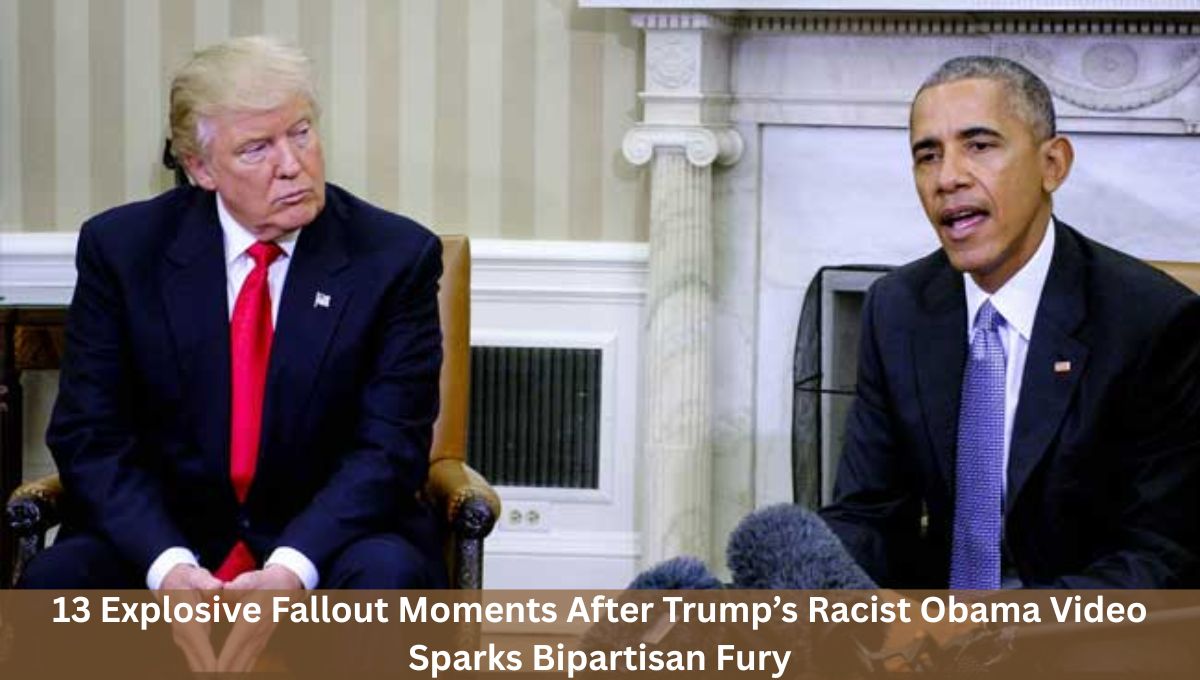
13 Explosive Fallout Moments After Trump’s Racist Obama Video Sparks Bipartisan Fury ahead of US midterms. A single one-minute video posted late at night has triggered one of the most intense political firestorms of President Donald Trump’s second term.
The clip—shared on Trump’s official Truth Social account—featured former President Barack Obama and former First Lady Michelle Obama depicted as apes, a racist trope with deep historical roots. Though the video was removed roughly 12 hours later, the damage was already done.
What followed was rare bipartisan condemnation, internal White House confusion, accusations of deliberate outrage-baiting, renewed scrutiny of Trump’s history with racist rhetoric, and growing concern about the political consequences ahead of the November US midterm elections.
Below is a comprehensive, global-audience explainer of what happened, why it matters, and how it may reshape American politics.
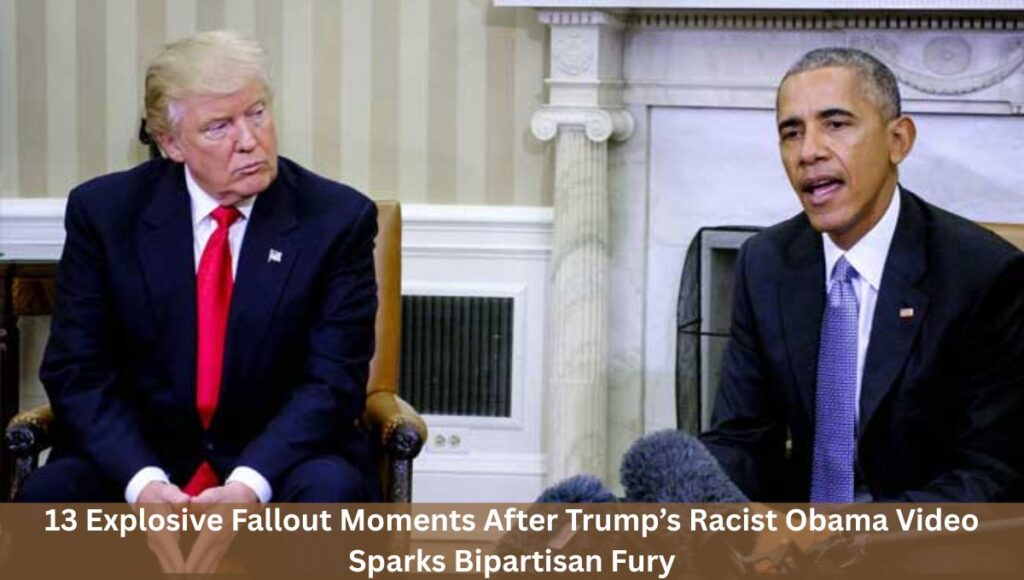
13 Explosive Fallout Moments After Trump’s Racist Obama Video Sparks Bipartisan Fury
1. The Video That Ignited the Outrage
The controversy began when Trump reposted a one-minute conspiracy video shortly before midnight Eastern Time.
What the video showed
- Repeated false claims that the 2020 election was stolen
- Attacks on voting-machine company Dominion Voting Systems
- Near the end, a brief AI-generated image showing Barack and Michelle Obama’s faces superimposed on ape bodies
- Background music: “The Lion Sleeps Tonight”
The racist imagery appeared for less than two seconds, but its symbolism was unmistakable.
By Friday morning, screenshots and screen recordings had already gone viral.
2. Why the Imagery Was Widely Condemned as Racist
Depicting Black people as monkeys or apes is one of the oldest racist dehumanisation tactics in Western history.
Civil rights advocates, historians, and lawmakers pointed out that:
- Such imagery was common during slavery and Jim Crow
- It has been used by white supremacist movements to justify discrimination and violence
- Even brief or “joking” use reinforces racial harm
Democratic Congressman Raja Krishnamoorthi described the clip as:
“Jim Crow-style dehumanisation… a disgrace to the office.”
3. Rare Republican Condemnation Breaks Through
What made this incident especially significant was the swift backlash from Trump’s own party.
Senator Tim Scott (South Carolina)
The only Black Republican in the US Senate, Scott wrote:
“Praying it was fake because it’s the most racist thing I’ve seen out of this White House.”
He explicitly called on Trump to remove the post.
Representative Mike Lawler (New York)
Facing a tough re-election battle, Lawler said:
“Incredibly offensive — whether intentional or a mistake — and should be deleted immediately with an apology.”
Senator Pete Ricketts (Nebraska)
“A reasonable person sees the racist context. The White House should remove this and apologise.”
Such open criticism from Republicans is unusual in the Trump era.
4. Democrats Go on the Offensive
Democrats seized on the moment as evidence of Trump’s longstanding racial insensitivity.
House Democratic leader Hakeem Jeffries wrote:
“President Obama and Michelle Obama represent the best of this country. Donald Trump is vile, unhinged and malignant.”
California Governor Gavin Newsom called the behavior:
“Disgusting… Every single Republican must denounce this. Now.”
Democratic strategists immediately began framing the incident as a character issue, not a one-off mistake.
5. The White House’s Conflicting Explanations
The administration’s response only added fuel to the fire.
Initial Defense
Press Secretary Karoline Leavitt dismissed the backlash as:
“Fake outrage”
She claimed the clip was part of a “Lion King meme” depicting Trump as a lion and Democrats as animals.
Later Reversal
Hours later, the White House quietly changed its stance:
- Said the video was posted “erroneously”
- Blamed a White House staffer
- Removed the video without apology
The shift raised questions about internal coordination and accountability.
6. Trump Refuses to Apologise
Speaking to reporters aboard Air Force One, Trump rejected calls for an apology.
“I didn’t make a mistake.”
He claimed he had only watched the beginning of the video, which focused on election fraud claims, before approving it.
When asked if he condemned the racist imagery:
“Of course I do.”
But he repeatedly refused to say sorry, reinforcing perceptions of defiance rather than remorse.
7. Trump’s Long History With Racist Rhetoric
Critics argue the video fits a broader pattern, not an isolated lapse.
Key examples
- Promoting the false “birther” conspiracy about Obama
- Calling some nations “shithole countries”
- Describing Somalis as “garbage”
- Posting AI images mocking Black lawmakers
Civil rights groups say such rhetoric has become normalized under Trump.
8. The Role of AI and Meme Politics
The Obama video was AI-manipulated, highlighting growing concerns about:
- Disinformation
- Political deepfakes
- Meme warfare in elections
Trump frequently reposts fan-generated content without verification, blurring lines between satire, propaganda, and hate speech.
Experts warn this tactic is especially dangerous coming from a sitting president.
9. Truth Social and Presidential Accountability
Trump’s Truth Social account has nearly 12 million followers.
Anything posted there:
- Moves markets
- Shapes diplomatic narratives
- Influences extremist communities
The episode raised urgent questions:
- Who controls Trump’s account?
- What review process exists?
- Can the president plausibly deny responsibility?
Even some Trump allies privately expressed alarm.
10. Why the Timing Matters Politically
The backlash comes at a critical moment:
- US midterm elections are approaching
- Republicans hold slim majorities
- Several GOP lawmakers face tight races
Trump has warned that losing Congress could expose him to:
- Investigations
- Impeachment proceedings
Moderate Republicans fear controversies like this could alienate swing voters.
11. Approval Ratings Take a Hit
Polling data released after the incident showed:
- Trump’s net approval underwater
- Particularly sharp disapproval among Black voters
- Erosion among independents
Civil rights leaders argue voters are increasingly sensitive to racial rhetoric, especially during Black History Month.
12. Obama Camp Declines to Respond
A spokesperson for Barack and Michelle Obama declined comment, a move seen as strategic.
Former Obama adviser Ben Rhodes summed up the contrast:
“Future Americans will embrace the Obamas as beloved figures while studying Trump as a stain on history.”
Silence, in this case, amplified criticism rather than defusing it.
13. What This Means for America’s Political Climate
The incident underscores several deeper trends:
- Increasing normalization of racial provocation
- Erosion of presidential decorum
- Weaponisation of outrage in digital politics
- Growing bipartisan anxiety about democratic norms
For many Americans—and global observers—the episode reinforced concerns about US leadership credibility.
Global Reaction and International Perception
Outside the US, the controversy was widely reported as:
- Another sign of polarisation
- A reputational challenge for American democracy
- Evidence of racial tensions still shaping US politics
Allied governments remained silent publicly, but diplomats privately expressed concern over America’s image abroad.
Civil Rights Groups Speak Out
The NAACP issued a blunt statement:
“Blatantly racist, disgusting, and utterly despicable. Voters will remember this.”
Advocacy groups say repeated incidents lower the threshold for acceptable public discourse.
Could This Have Legal or Ethical Consequences?
While the post is unlikely to trigger legal action, ethics experts note:
- Presidents are held to higher speech standards
- Dehumanising imagery can incite hate
- Repeated incidents shape institutional norms
Congressional Democrats are already discussing whether the episode should factor into future oversight efforts.
A Pattern of Retraction Without Accountability
Notably, the White House:
- Removed the post
- Blamed a staffer
- Offered no apology
- Identified no disciplinary action
Critics argue this approach encourages repetition rather than restraint.
Conclusion: A Defining Moment or Just Another Outrage?
Whether this controversy becomes a turning point or fades into the constant churn of US political scandals remains to be seen.
But one fact is undeniable:
A sitting US president shared racist imagery about his predecessor—and refused to apologise.
As America heads toward a pivotal election year, this episode may linger as a symbol of:
- Deep racial divides
- Eroding political norms
- The high stakes of digital misinformation
For global audiences watching the United States, the question is no longer whether outrage will erupt—but what it reveals about the future of American democracy.
Also Read: Trump Accuses Obama of Treason Over 2016 Russia Probe