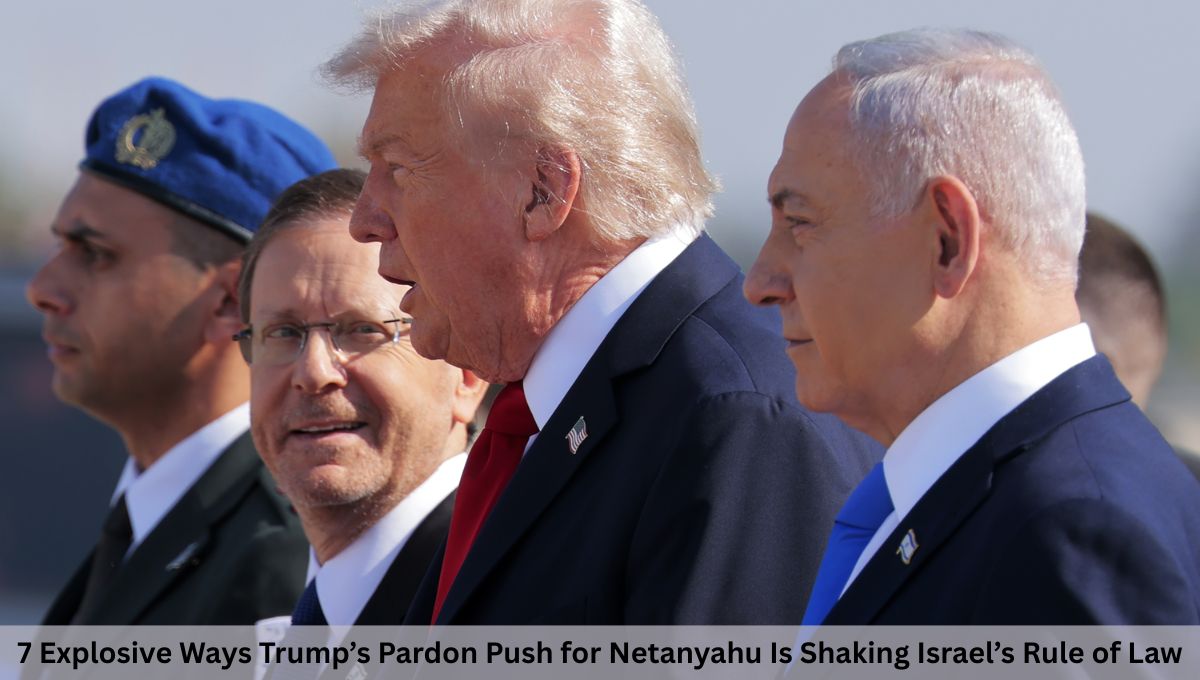
7 Explosive Ways Trump’s Pardon Push for Netanyahu Is Shaking Israel’s Rule of Law and sovereignty. The already volatile relationship between politics, war, and justice in Israel has entered a new and dangerous phase after Donald Trump publicly attacked Israeli President Isaac Herzog for refusing to pardon Prime Minister Benjamin Netanyahu, who is standing trial on corruption charges.
In remarks that stunned diplomats and legal scholars alike, Trump accused Herzog of being “ashamed of himself” and “disgraceful” for not granting clemency—language almost unheard of between leaders of two close allies.
The outburst has ignited a profound debate not only about Netanyahu’s legal fate, but also about Israel’s judicial independence, the limits of presidential power, and how far foreign leaders can go in influencing a sovereign democracy.
This confrontation comes against the backdrop of Israel’s devastating war in Gaza, rising international scrutiny, and Netanyahu’s long-running corruption trial—an explosive mix of law, war, and political survival.
7 Explosive Ways Trump’s Pardon Push for Netanyahu Is Shaking Israel’s Rule of Law
A Rare Diplomatic Broadside from Washington
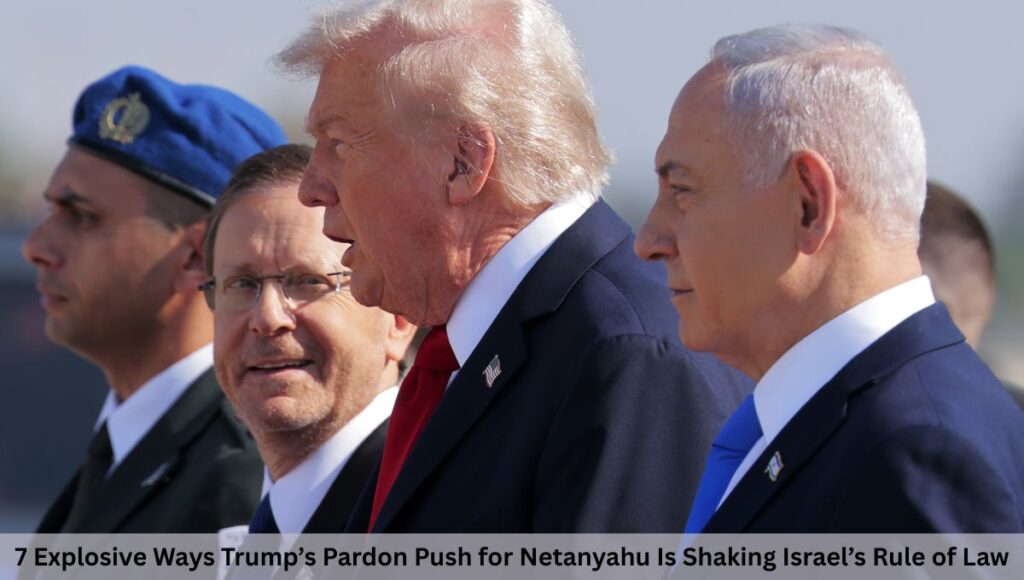
Trump’s remarks were delivered at the White House, just one day after hosting Netanyahu for talks that marked their seventh meeting since Trump’s return to power.
Asked about Netanyahu’s responsibility for the catastrophic security failures surrounding Hamas’s October 7, 2023 attack, Trump offered a hedged response—“I guess everybody’s responsible”—before pivoting quickly to praise Netanyahu as “a very good wartime prime minister.”
Then came the sharp turn.
Trump accused Herzog of refusing to exercise what he described as the Israeli president’s “primary power”—granting pardons—and urged the Israeli public to shame him into compliance.
The message was unmistakable:
Washington’s most powerful political figure was openly intervening in Israel’s domestic legal process.
For many observers, the tone marked a dramatic escalation from lobbying to public coercion.
Why Netanyahu’s Trial Matters So Much
Netanyahu is facing charges of fraud, bribery, and breach of trust in three major corruption cases, allegations he has consistently denied.
The cases involve claims that he received lavish gifts from wealthy benefactors and negotiated favourable media coverage in exchange for political advantages.
His trial, which began in 2020, has dragged on for nearly six years, repeatedly delayed by elections, regional conflict, and now full-scale war.
Netanyahu is the first sitting Israeli prime minister to stand trial for corruption—an unprecedented moment in Israel’s political history.
To his supporters, the trial is a politically motivated witch hunt. To critics, it is a defining test of whether even Israel’s most powerful leader is subject to the law.
Trump has made it clear where he stands.
Trump’s Argument: War Leadership Over Courtrooms
Trump has repeatedly framed the corruption case as a dangerous distraction during wartime. Downplaying the allegations, he has mocked them as a matter of “cigars and champagne,” arguing that Netanyahu’s focus should remain on national survival rather than legal proceedings.
From Trump’s perspective, the pardon is not merely an act of mercy—it is a strategic necessity. He argues that removing Netanyahu’s legal troubles would strengthen Israel’s leadership during a moment of existential threat, particularly from Iran and regional instability.
This logic reflects Trump’s broader view of executive power, where wartime leadership can justify extraordinary political interventions.
Herzog’s Firm but Calculated Rebuttal
Herzog’s response was measured, deliberate, and unmistakably defiant.
Issuing a statement while returning from a diplomatic visit to Australia, the Israeli president stressed that no decision has yet been made on Netanyahu’s pardon request.
Contrary to Trump’s claims, Herzog said the matter is still under review by Israel’s Justice Ministry, which must first provide a legal opinion.
“Only upon completion of that process,” Herzog’s office said, “will the president consider the request in accordance with the law, the best interests of the State of Israel, guided by his conscience, and without any influence from external or internal pressures of any kind.”
The wording was precise—and pointed.
‘Israel Is a Sovereign State Governed by the Rule of Law’
Perhaps the most consequential line in Herzog’s response was also the most restrained.
“Israel is a sovereign state governed by the rule of law.”
For diplomats and legal analysts, this was a clear rebuke to Trump’s pressure campaign, without naming it outright.
Herzog emphasized that the presidency would not be swayed by public shaming, foreign leaders, or domestic political storms.
When asked personally for his reaction while aboard the plane, Herzog delivered a remark that quickly went viral:
“To the best of my recollection, I am the president of Israel.”
The Legal Reality: Can Herzog Even Pardon Netanyahu Now?
A central issue often overlooked in political rhetoric is whether Herzog even has the authority to act at this stage.
Under Israeli law and long-standing precedent, presidential pardons are typically granted after legal proceedings conclude—often following an admission of guilt or conviction.
Netanyahu has not admitted wrongdoing and continues to fight the charges vigorously.
Some legal experts argue that granting a pardon mid-trial could undermine judicial independence and set a dangerous precedent, effectively allowing political leaders to escape accountability by invoking wartime necessity.
This legal ambiguity is one reason Herzog has proceeded with extreme caution.
Trump’s Long Campaign on Netanyahu’s Behalf
Trump’s pressure did not begin this week.
He has publicly urged Herzog to pardon Netanyahu since mid-2025, most notably during a speech at the Knesset, where he openly asked why clemency had not already been granted.
Weeks later, Trump followed up with a formal letter to Herzog, insisting that a pardon would unify Israel and dismissing the corruption case as politically motivated.
Herzog responded at the time by stating that he could only consider a request once Netanyahu formally submitted one—something the prime minister’s lawyers eventually did, notably without admitting guilt.
The Gaza War and the Shadow of the ICC
Complicating matters further is Netanyahu’s international legal exposure.
In addition to domestic corruption charges, Netanyahu is facing an arrest warrant from the International Criminal Court over alleged war crimes in Gaza, including the use of starvation as a weapon of war.
While Israel rejects the ICC’s jurisdiction, the warrant has intensified global scrutiny and added another layer of urgency—and controversy—to Trump’s pardon push.
For critics, Trump’s intervention appears less about justice and more about shielding an ally from mounting legal jeopardy at home and abroad.
Herzog’s Own Controversial War Rhetoric
Although often portrayed as a moderating, ceremonial figure, Herzog is no stranger to controversy.
Early in the Gaza war, he made remarks suggesting collective responsibility among Palestinians for Hamas’s October 7 attack—statements later cited by human rights groups and UN investigators as evidence of genocidal intent.
These comments complicate Herzog’s image internationally, even as he now presents himself as the guardian of legal process and constitutional restraint.
A Clash of Political Philosophies
At its core, the Trump–Herzog confrontation reflects two radically different views of power.
Trump sees the pardon as a political tool—one that should be deployed decisively in moments of national crisis. Herzog views it as a constitutional mechanism bound by legal norms, precedent, and restraint.
For Trump, leadership means cutting through institutions. For Herzog, leadership means defending them—even when it is politically inconvenient.
Why This Crisis Matters Beyond Israel
This dispute is about more than Netanyahu.
It raises fundamental questions with global implications:
- Can foreign leaders publicly pressure democratic allies to override legal processes?
- Do wartime conditions justify suspending judicial accountability?
- Where is the line between alliance and interference?
For democracies worldwide, the answers matter.
What Happens Next
Herzog has not set a timeline for his decision. Legal reviews continue. Netanyahu’s trial grinds on. Trump shows no sign of backing down.
What is certain is that Israel now faces a defining test—not just of one leader’s fate, but of whether the rule of law can withstand war, political loyalty, and pressure from even its closest allies.
As this unprecedented clash unfolds, the consequences will echo far beyond Jerusalem and Washington—shaping how power, justice, and sovereignty are understood in an increasingly unstable world.
Also Read: 7 Explosive Reasons Why Netanyahu’s Taped Phone Camera Has Everyone Talking
Also Read: Netanyahu urges Trump’s support in high-stakes push for Herzog pardon: Report