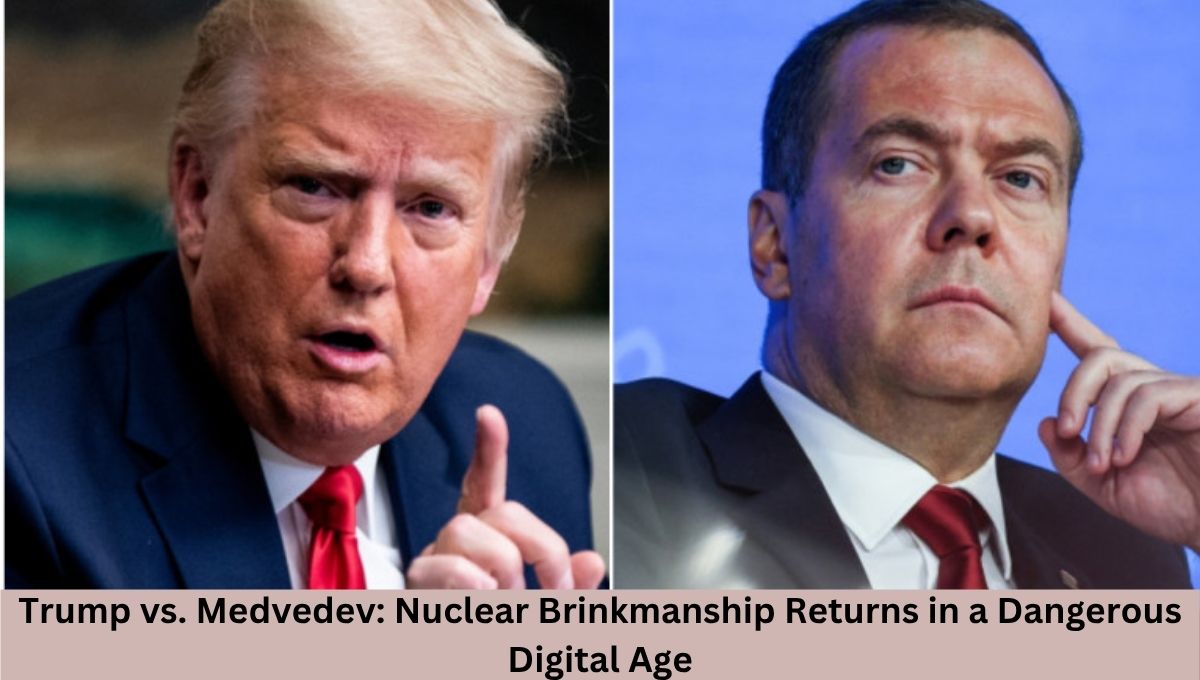
Clash over Cold War-era, it is Trump vs. Medvedev: Nuclear Brinkmanship Returns in a Dangerous Digital Age. In a chilling revival of Cold War anxieties, former U.S. President Donald Trump and former Russian President Dmitry Medvedev are embroiled in a volatile public exchange, complete with nuclear threats, military movements, and Cold War references that have left the world on edge.
This modern standoff fueled by social media posts, strategic posturing, and the resurrection of Russia’s infamous “Dead Hand” system has drawn intense comparisons to the Cuban Missile Crisis of 1962.
Trump vs. Medvedev: Nuclear Brinkmanship Returns in a Dangerous Digital Age
Medvedev’s Dead Hand Reference: The Spark That Lit the Fire
The diplomatic firestorm began when Dmitry Medvedev, now Deputy Chairman of Russia’s Security Council, took to Telegram to mock Donald Trump’s proposed tariffs on Russia and India.
In a cryptic message, he referenced the “Dead Hand,” also known as the Perimeter system a Cold War-era automated nuclear retaliation mechanism designed to ensure a counterattack even if Russian command is incapacitated.
Medvedev’s chilling post warned:
“Perhaps he should revisit his favorite movies about the living dead and recall just how dangerous the mythical ‘Dead Hand’ can be.”
The mere mention of the Perimeter system a concept that has haunted nuclear strategy circles for decades reignited fears that automatic retaliation systems may be back in political play.
Trump’s Submarine Deployment: “Words Have Consequences”
Trump’s reaction came swiftly on his Truth Social platform. The former president announced the deployment of two U.S. nuclear submarines to “appropriate regions,” a veiled reference to areas close to Russian influence zones.
“Words are very important and can often lead to unintended consequences,” Trump wrote, referencing Medvedev’s Dead Hand threat.
While the exact location of the submarines remains classified, the move signals one of the most aggressive military decisions in Trump’s second term.
Cold War Parallels: Are We Repeating 1962?
The current standoff draws eerie similarities to the Cuban Missile Crisis, when Soviet missiles in Cuba brought the world to the brink of nuclear annihilation.
The key difference today? In 1962, diplomacy was conducted privately. In 2025, it plays out online in full public view.
In the 20th century, John F. Kennedy and Nikita Khrushchev communicated via secret backchannels and ultimately reached a peaceful resolution.
Today, Trump and Medvedev exchange memes, insults, and nuclear threats on social media platforms.
From Trade Disputes to Nuclear Threats: How It Escalated
The tension didn’t begin with nuclear weapons. It started with Trump’s harsh criticism of India’s growing trade with Russia amid the Ukraine war.
“I don’t care what India does with Russia. They can take their dead economies down together, for all I care,” Trump posted.
This jab at two major global economies sparked outrage in Moscow and raised concerns in New Delhi.
Medvedev seized the moment, defending India and ridiculing Trump’s rhetoric, escalating the confrontation beyond U.S.-Russia bilateral tensions.
Medvedev’s Mockery and Trump’s Retaliation
Medvedev’s responses weren’t just policy critiques they were personal and cultural jabs. Referring to post-apocalyptic shows like The Walking Dead, he mocked Trump’s language and mental state:
“If a few words from a former Russian president can provoke such a nervous reaction from the sitting and supposedly formidable president of the United States, then clearly Russia is entirely in the right.”
Trump fired back:
“Tell Medvedev, the failed former President of Russia… to watch his words. He’s entering very dangerous territory!”
U.S. vs. Russian Submarine Power: Who Holds the Advantage?
As both leaders threaten and posture, experts are re-evaluating submarine capabilities the cornerstone of second-strike nuclear deterrence.
U.S. Submarine Fleet Highlights:
- Ohio-class SSBNs: 14 in active service, each capable of launching 20 Trident II D5 SLBMs
- Virginia-class fast attack subs: 24 operational, with cutting-edge stealth and strike capabilities
- Seawolf and Los Angeles-class: Older, but still formidable components of U.S. underwater dominance
Russian Submarine Fleet:
- Borei-class SSBNs: Equipped with 16 Bulava missiles; stealthier and newer than older Delta IVs
- Delta IV-class: Functional with Sineva SLBMs but aging
- Yasen and Akula-class: Silent, heavily armed, and versatile in offensive roles
While Russia may have more submarines deployed globally, most analysts agree U.S. technology provides a critical qualitative edge.
India: The Silent Flashpoint in a Growing Triangle
Trump’s blunt rhetoric on India’s trade with Russia introduced a new and potentially destabilizing element.
India, while officially neutral in the Ukraine conflict, has increased trade with Moscow primarily in energy and arms.
By roping India into the U.S.-Russia confrontation, Trump risks alienating a strategic partner vital to America’s Indo-Pacific ambitions.
So far, India has remained diplomatically silent, but behind closed doors, policymakers in New Delhi are likely weighing the impact on trade, defense, and regional strategy.
Russian Lawmakers and Analysts Respond: Dismissive and Defiant
Russian officials were quick to downplay Trump’s submarine order. Duma member Viktor Vodolatsky claimed:
“The subs that US President Donald Trump ordered to be redirected… have long been under our control.”
He further claimed that Russian nuclear subs outnumber and outmaneuver U.S. deployments, dismissing any need for retaliation.
Political analyst Fyodor Lukyanov took a more nuanced view:
“Trump reacts emotionally and spontaneously… I think the armed forces of the United States read this with great surprise.”
However, he warned that continued public posturing could force real-world actions.
The Ukraine War and Trump’s Increasing Frustration
This nuclear-laced rhetoric comes against the backdrop of Trump’s growing impatience with the Ukraine conflict.
Promising to end the war swiftly during his campaign, Trump has flip-flopped once calling Zelenskyy a dictator and more recently threatening Russia with new sanctions.
On July 28, he issued an ultimatum: Russia has 10–12 days to withdraw from Ukraine or face new secondary sanctions including on India.
These erratic statements add fuel to a situation already teetering on the edge.
The Doomsday Clock: 89 Seconds to Midnight
The Bulletin of the Atomic Scientists moved the Doomsday Clock to 89 seconds to midnight in January 2025 the closest it’s ever been. Their reasons?
- Ongoing Ukraine war
- Breakdown of arms control treaties
- Escalating nuclear modernization
- Social media-fueled diplomacy
The Trump–Medvedev exchange, referencing the Dead Hand and deploying submarines, directly embodies the Bulletin’s worst fears.
Arms Control Is Dead And That’s the Real Threat
In past decades, treaties like the INF Treaty, New START, and the Open Skies Agreement acted as safety rails. Today, most are defunct or in disrepair.
What’s left? Personality-driven diplomacy and performance politics. The world’s most destructive weapons now exist in a global environment with few constraints, poor communication, and no trust.
Medvedev’s invocation of the Dead Hand wasn’t just theatrical it was a stark reminder that some nuclear doctrines remove human judgment altogether.
What Happens Next? The Dangers of Miscalculation
While neither side likely wants war, the danger isn’t intention it’s miscalculation. As rhetoric grows sharper, military posturing intensifies, and diplomacy collapses into digital theatrics, even a single misunderstanding could trigger catastrophe.
Unlike 1962, we have no Kennedy-Khrushchev hotline. Instead, we have tweets, Telegram posts, and Truth Social rants.
That’s not strategy. That’s gambling with nuclear stakes.
Final Thoughts: Cold War 2.0 in a Social Media Era
The Trump–Medvedev standoff is more than political theater. It reveals the fragility of global diplomacy in 2025.
The systems remain.
The weapons remain.
But the safeguards private diplomacy, arms control, measured language have faded.
This isn’t just a “war of words.” It’s a dangerous dialogue between two nuclear-armed powers in a public space designed for engagement, not caution. Unless global leaders recalibrate, history may not just repeat it may explode.
Also Read: Trump Escalates Nuclear Brinksmanship With Russia Over Social Media Spat
Also Read: Russia Urges Caution after Trump’s Submarine Move Amid Rising Nuclear Tensions
Related Posts:
- 9 Explosive Signals as Trump Targets Cuba’s Oil…

- Trump’s 2025 Gaza Peace Plan Signing and Historic…

- 5 Powerful Highlights as Trump Lands Second Nobel…

- 11 Punitive Shockwaves from Trump’s Cuba Oil Tariff Threat

- Can the EU and NATO Impose Tariffs on India and…

- 7 Shocking Reasons FIFA’s Peace Prize for Trump…
