
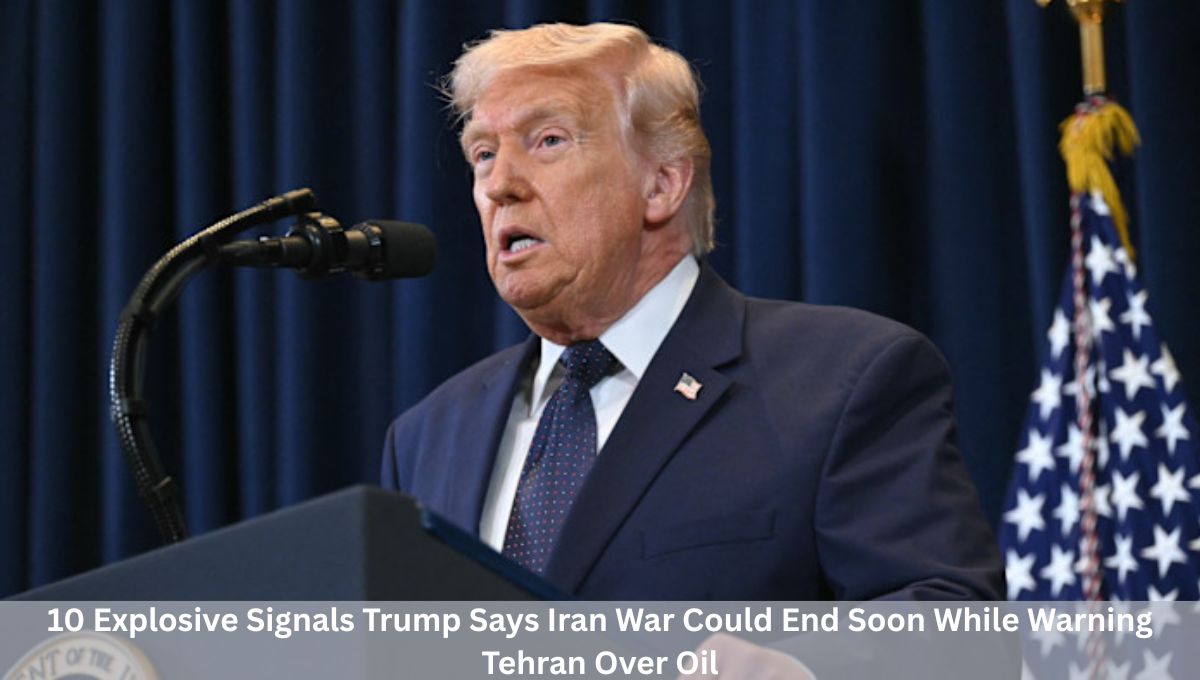
10 Explosive Signals Trump Says Iran War Could End Soon While Warning Tehran Over Oil shipment disruptions in the Strait of Hormuz. The war between the United States, Israel, and Iran has entered a volatile phase, with U.S. President Donald Trump claiming the conflict could end soon while simultaneously issuing stark warnings to Tehran about disrupting global oil supplies.
The conflict has already shaken global markets, triggered missile exchanges across the Middle East, and pushed oil prices to their highest levels in years. The appointment of Ayatollah Mojtaba Khamenei as Iran’s new supreme leader following the death of his father, Ali Khamenei, has added another layer of uncertainty. While Trump insists the war may be nearing completion, Iran’s military leadership says it will decide when the fighting ends.
Meanwhile, energy markets, governments, and millions of civilians across the region are bracing for what could become one of the most consequential geopolitical confrontations in decades.
10 Explosive Signals Trump Says Iran War Could End Soon While Warning Tehran Over Oil
The War That Shook the Middle East
The current war began on February 28, when the United States and Israel launched coordinated strikes against Iranian military infrastructure.
The operation targeted missile launch facilities, drone manufacturing sites, and strategic installations linked to Iran’s nuclear and military programs.
The opening phase of the conflict also saw a dramatic escalation when an airstrike killed Iran’s long-time supreme leader Ayatollah Ali Khamenei, a dominant figure in Iranian politics since 1989.
Iran quickly retaliated with missile and drone attacks against Israel and several Gulf countries hosting U.S. military bases.
Since then, the war has spread across multiple fronts including:
- Iran
- Israel
- Lebanon
- Gulf states
- International waters near the Strait of Hormuz
Thousands of civilians have been displaced, while air raids and missile alerts have become daily realities in many cities.
Trump Says War Could Be “Short-Term”
Speaking to Republican lawmakers at his golf club near Miami, Donald Trump described the war as a “short-term excursion.”
According to Trump, the United States and Israel have already severely degraded Iran’s military capabilities.
He claimed Iran has lost much of its navy, communications systems, and air force infrastructure.
Trump said the war had progressed faster than expected and suggested that American and Israeli forces were already “far ahead” of their initial military timeline.
However, the U.S. president also emphasized that the campaign would continue until what he called “ultimate victory.”
His mixed messaging — predicting an end while also threatening further escalation — has contributed to uncertainty among global markets and governments.
The Oil Warning That Shook Markets
Trump’s most dramatic warning came when he addressed the possibility of Iran interfering with oil shipments through the Strait of Hormuz, the narrow maritime passage that carries roughly 20% of the world’s oil supply.
In a fiery message posted on social media, Trump warned Tehran that any attempt to block the strait would trigger devastating retaliation.
He said the United States would strike Iran “twenty times harder” than previous attacks if global oil shipments were disrupted.
The warning reflected the enormous geopolitical importance of the strait.
Every day, millions of barrels of oil pass through the waterway, making it one of the most critical chokepoints in global energy supply chains.
Even a temporary disruption can trigger massive spikes in energy prices worldwide.
Oil Prices Surge Then Crash
The war has already created significant volatility in energy markets.
Oil prices surged dramatically as the conflict intensified. At one point, crude prices briefly approached $120 per barrel, the highest level since 2022.
The spike occurred shortly after Iran’s political leadership confirmed that Mojtaba Khamenei would succeed his father as the country’s new supreme leader.
Investors interpreted the appointment as a signal that Iran was unlikely to compromise quickly in the conflict.
However, oil prices later fell sharply after Trump suggested the war might end sooner than expected.
The market roller-coaster reflects how sensitive global energy prices are to developments in the Middle East.
Iran Names Mojtaba Khamenei as Supreme Leader
One of the most consequential developments during the conflict has been the rise of Ayatollah Mojtaba Khamenei.
At 56 years old, he has become only the third supreme leader in the history of the Islamic Republic of Iran.
His appointment followed the death of his father, whose assassination during the opening stage of the war stunned Iran’s political system.
Mojtaba Khamenei has long been considered a possible successor but his elevation has intensified debate about hereditary leadership within the Islamic Republic.
Critics argue that the transition resembles a dynastic transfer of power rather than the traditional clerical selection process.
Supporters say the move ensures continuity during a time of national crisis.
Iran’s Revolutionary Guard Signals Defiance
Iran’s powerful Islamic Revolutionary Guard Corps (IRGC) has responded defiantly to Trump’s statements.
A spokesperson for the paramilitary organization declared that Iran would decide when the war ends, rejecting the idea that Washington could dictate the timeline.
The IRGC also warned that continued attacks by the United States and Israel could trigger broader retaliation across the region.
The group has already launched missiles and drones targeting:
- Israeli cities
- U.S. military installations
- Gulf energy infrastructure
The Revolutionary Guard remains one of the most powerful institutions in Iran, controlling major military assets as well as significant parts of the country’s economy.
Escalation Across the Region
The conflict has expanded well beyond Iran and Israel. Several Gulf countries have been drawn into the crisis as Iranian missile and drone attacks have targeted energy facilities and military bases.
Among the countries affected:
Saudi Arabia
Saudi officials condemned an Iranian drone strike on the massive Shaybah oil field, warning that Tehran would be the “biggest loser” if it continued attacking Arab states.
United Arab Emirates
Authorities in Abu Dhabi reported missile interceptions and injuries caused by falling debris after Iranian projectiles were shot down.
Bahrain
Iranian attacks reportedly struck residential areas in the capital Manama, killing at least one civilian.
Kuwait and Qatar
Both countries reported incoming missiles during the escalating wave of attacks.
The widening scope of the conflict has raised fears that the war could transform into a full-scale regional confrontation.
Hezbollah Opens Another Front
Iran’s ally Hezbollah, the powerful Lebanese militant group, has also joined the conflict.
Rockets fired from southern Lebanon into northern Israel have forced Israeli forces to respond with airstrikes in Beirut and other locations.
Hezbollah’s involvement raises the possibility that the war could expand into Lebanon, potentially triggering another devastating conflict similar to the 2006 Israel-Hezbollah war.
Israel Intensifies Air Campaign
Israel has continued large-scale airstrikes across Iran.
The Israeli military said it carried out “a wide-scale wave of strikes” targeting infrastructure connected to the Revolutionary Guard.
Key targets included:
- Drone command centers
- Missile launch facilities
- Military bases
- Logistics hubs
Air raid sirens have repeatedly sounded across Israeli cities as Iranian missiles continue to target population centers.
The ongoing missile exchanges have turned the conflict into one of the most intense confrontations between Israel and Iran in history.
Tehran Under Heavy Bombardment
Iran’s capital, Tehran, has experienced some of the heaviest air raids since the conflict began. Multiple explosions were reported across the city as Israeli strikes targeted military facilities and infrastructure.
Black smoke was seen rising over parts of the capital after an oil refinery was reportedly hit. Health officials warned that the fires could contaminate air, food, and water supplies.
The bombardment has caused millions of residents to seek shelter while many foreign nationals have fled the country.
Civilian Casualties Rise
The human cost of the war has continued to rise.
According to official figures and international reports:
- More than 1,200 people have been killed in Iran
- Nearly 400 people have died in Lebanon
- At least 11 people have been killed in Israel
Thousands more have been injured across the region. The conflict has also claimed the lives of several American service members stationed in the Middle East.
Large numbers of civilians have been displaced as cities come under repeated missile and drone attacks.
Strait of Hormuz: The World’s Most Dangerous Chokepoint
Much of the world’s attention remains focused on the Strait of Hormuz.
The narrow waterway connects the Persian Gulf with the Arabian Sea and serves as a vital route for global oil shipments.
Roughly one-fifth of the world’s oil supply passes through the strait every day.
In recent days:
- Tanker traffic has slowed dramatically
- Several ships have been attacked
- Insurance costs for shipping have surged
The International Maritime Organization has reported casualties among merchant sailors after attacks on commercial vessels near the strait.
Any attempt by Iran to fully close the waterway could trigger a global energy crisis.
Russia Calls for Diplomatic Settlement
Russia has attempted to position itself as a potential mediator in the conflict.
During a phone call with Donald Trump, Russian President Vladimir Putin reportedly proposed ideas for a diplomatic solution.
Putin’s adviser Yuri Ushakov said the Russian leader had discussed possible settlement frameworks after consultations with Gulf leaders and Iranian President Masoud Pezeshkian.
However, it remains unclear whether either side is prepared to pursue negotiations. Iranian officials have repeatedly stated that diplomacy is unlikely while the attacks continue.
Trump’s Claim of Pre-Emptive War
Trump has defended the military campaign by claiming it was necessary to prevent an imminent Iranian attack.
According to the U.S. president, intelligence suggested Iran was preparing to launch a massive missile assault against American forces and regional allies.
He argued that the strikes destroyed roughly 80 percent of Iran’s missile launch infrastructure.
Trump also said Iran would have used nuclear weapons against Israel if it had possessed them.
Iran has repeatedly denied seeking nuclear weapons, though Western governments remain deeply suspicious of its nuclear program.
Nuclear Fears Still Loom
Although several Iranian nuclear sites were reportedly destroyed in earlier strikes, concerns remain about the country’s nuclear capabilities.
Experts say Iran still possesses highly enriched uranium that could potentially be used to produce nuclear weapons.
The ultimate decision about whether to pursue such a program now rests with Mojtaba Khamenei.
Some analysts fear the war could push Iran to accelerate nuclear development as a deterrent.
Global Markets on Edge
Financial markets have reacted dramatically to developments in the war. Stock markets around the world have experienced sharp swings as investors react to changing news from the conflict.
Energy prices have been particularly volatile. The possibility of a prolonged disruption in Middle Eastern oil supplies could reshape global energy markets.
Governments around the world are already considering emergency measures such as:
- releasing strategic oil reserves
- easing sanctions on certain producers
- redirecting energy supplies
These steps aim to stabilize prices if the conflict intensifies.
Public Opinion Divided
Public opinion around the world remains deeply divided over the war.
In the United States, surveys suggest many Americans fear rising gasoline prices and the possibility of a prolonged conflict.
Some critics argue the war risks destabilizing the entire Middle East.
Supporters of the military campaign say the strikes were necessary to stop Iran’s missile and nuclear programs. Within Iran, reactions have also been mixed.
While large crowds have rallied in support of the new supreme leader, others fear the conflict could worsen economic hardship and political repression.
What Happens Next?
Despite Trump’s claims that the war could end soon, the situation remains highly unpredictable.
Several factors will likely determine the conflict’s trajectory:
- Iran’s response to continued strikes
- the security of the Strait of Hormuz
- the involvement of regional allies
- global diplomatic pressure for a ceasefire
If the conflict escalates further, it could reshape the geopolitical landscape of the Middle East for years to come.
For now, the world watches closely as military operations continue and leaders on all sides signal that the war’s outcome is still uncertain.
Also Read: 9 Explosive Claims: Pakistani Man Says Iran Forced Him into Trump Assassination Plot
Also Read: Iran war may end ‘pretty quickly’: What Trump told Republicans
Related Posts:
- 10 Explosive Facts About Mojtaba Khamenei’s Rise as…
- 7 Explosive Shifts: Mojtaba Khamenei Named Iran’s…
- 7 Shocking Reasons Trump Says Oil Spike Is “Worth…

- 10 Explosive Signals: Trump Rates Iran War “15/10”…
- 10 Explosive Warnings as Donald Trump Calls Iran…
- 11 Explosive Warnings as Trump Vows to ‘Knock the…
