11 Shocking Moments Behind Reuters’ Photo of Prince Andrew After Legal Fallout — A dramatic royal fall from grace. A single photograph can define an era.
Late on Thursday evening in Norfolk, England, a Reuters image captured what many believed would never happen in modern Britain:
a senior member of the royal family — stripped of his titles but still eighth in line to the throne — photographed leaving police custody like any other suspect.
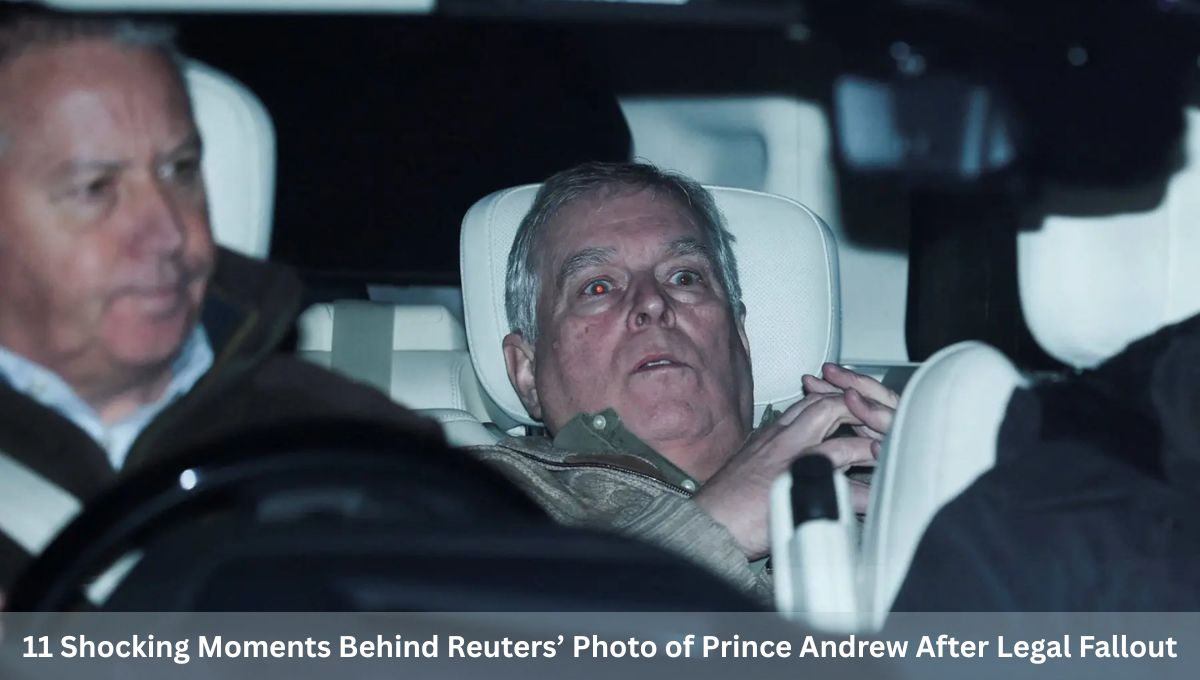
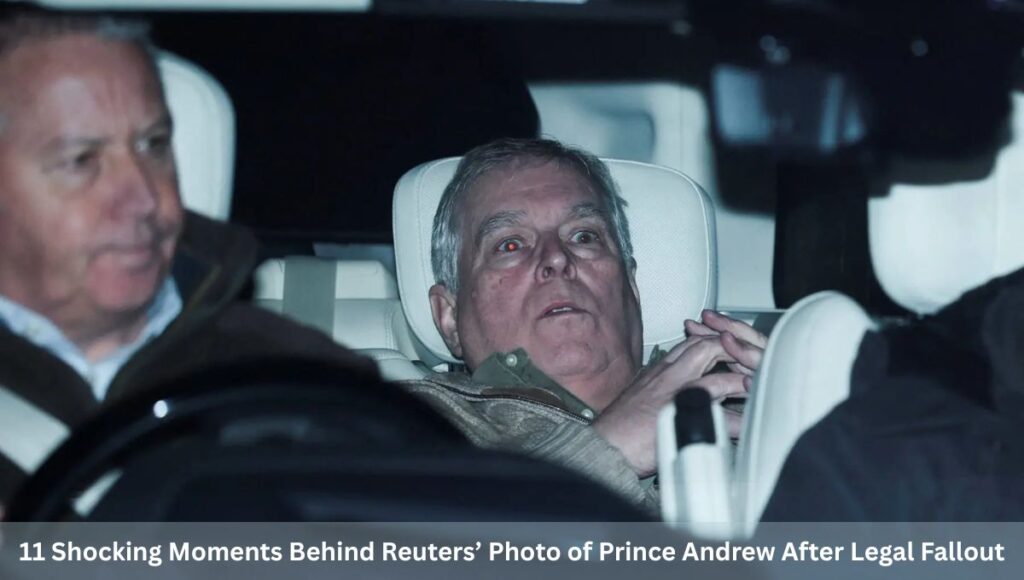
Slumped low in the back seat of a dark Range Rover, eyes fixed forward, face drawn and stunned, Prince Andrew appeared no longer insulated by centuries of royal privilege.
Within minutes of publication, the image ricocheted across the world — splashed across front pages, social media feeds, and television broadcasts from London to Washington to New Delhi.
This is the story of how Reuters captured that photograph, why it resonated globally, and how it became a visual symbol of the most severe crisis to confront the British monarchy in decades.
11 Shocking Moments Behind Reuters’ Photo of Prince Andrew After Legal Fallout
1. The Photograph That Changed the Narrative
The image was taken outside Aylsham Police Station, a modest building in the historic market town of Aylsham, Norfolk. Nothing about the setting suggested history in the making.
Yet the photograph’s power lay in its ordinariness:
- No palace gates
- No ceremonial vehicles
- No deference
Just a former prince, released under investigation, leaving a police station after hours of questioning.
For many observers, the image shattered the long-held assumption that royal status provides permanent insulation from the law.
2. The Photographer Behind the Lens: Phil Noble
The man who captured the image was Phil Noble, a veteran Reuters photographer based in Manchester.
When news broke early Thursday that Andrew Mountbatten-Windsor had been arrested, Noble immediately began a six-hour drive south to Norfolk, acting on instinct rather than certainty.
“There was no guarantee we’d find him,” Noble later said. “But in breaking news, you move first and ask questions later.”
3. A Race Against Geography and Uncertainty
Norfolk is home to the Sandringham Estate, the private royal estate where Andrew had been living since his eviction from Royal Lodge in Windsor.
However, the investigation was being conducted by Thames Valley Police, which covers southeast England. That meant Andrew could have been held at 20 or more potential police stations.
The odds were poor.
4. The Tip That Changed Everything
After hours of waiting and dead ends, Noble received a tip pointing him to Aylsham, a town more than an hour from Andrew’s residence. At first, it looked like a mistake.
Only a handful of journalists were present, including Reuters video journalist Marissa Davison. Hours passed. Darkness fell. No movement. “It felt like we’d picked the wrong place,” Noble recalled.
5. The Moment Almost Missed
After six or seven uneventful hours, the Reuters team decided to pack up and head to a hotel. Then the phone rang.
Davison was on the line:
Andrew’s cars had just arrived.
Noble turned his car around and sped back. By the time he arrived, two vehicles were already pulling away — fast.
6. Six Frames, One Historic Image
The first car contained police officers. Noble instinctively swung his camera toward the second vehicle.
He fired six frames.
- Two showed police
- Two were blank
- One was out of focus
- One captured history
Andrew Mountbatten-Windsor, slumped, stunned, and unmistakably human, framed by darkness and glass.
“When you’re doing car shots,” Noble said, “it’s more luck than judgment.”
7. Why the Image Went Viral
The photograph’s impact was immediate and global.
It resonated because it represented:
- Accountability over privilege
- Transparency over deference
- The erosion of untouchability
For the first time in nearly 400 years, a senior British royal had been arrested and photographed in custody.
8. The Allegations Behind the Arrest
Andrew was arrested on suspicion of misconduct in public office, a charge linked to his tenure as Britain’s Special Representative for International Trade.
Police are investigating allegations that he:
- Shared confidential trade documents
- Sent official reports to Jeffrey Epstein
- Continued correspondence after Epstein’s 2008 conviction
Authorities have stressed the investigation is not related to sexual assault allegations.
9. The Epstein Files and Renewed Scrutiny
The arrest followed the release of millions of documents by the United States Department of Justice related to Epstein.
Emails appear to show:
- Epstein offering to arrange dates for Andrew
- Invitations to Buckingham Palace
- Trade reports from official visits to Southeast Asia
Andrew has consistently denied wrongdoing.
10. King Charles Breaks with Royal Tradition
The response from King Charles III was swift and unusually direct.
“The law must take its course.”
Notably:
- Charles did not refer to Andrew as his brother
- The statement was issued in his own name
- Full cooperation with police was pledged
Royal observers noted this marked a clear departure from the late Queen Elizabeth II’s more protective approach.
11. A Monarchy Under Unprecedented Pressure
Historians describe Andrew’s arrest as the most damaging royal scandal since:
- Edward VIII’s abdication
- The death of Princess Diana
Royal historian Kate Williams warned:
“The question will increasingly be asked — what did Charles know? What did William know?”
The Legal Reality: Arrest Without Privilege
Andrew was held for approximately 11 hours before being released under investigation.
Under UK law:
- Suspects may be held for 24 hours without charge
- Release under investigation means no charge — but no clearance
Police confirmed searches at properties in Norfolk and Berkshire.
Why This Case Matters Beyond Britain
Globally, the case has implications for:
- Public trust in institutions
- Perceptions of elite accountability
- The future legitimacy of constitutional monarchies
From India to the United States, commentators noted that no status now guarantees immunity.
The Image That Will Endure
Long after legal proceedings conclude, the Reuters photograph will remain.
Not because it shows guilt or innocence — but because it shows equality before the law, frozen in a single frame.
As Phil Noble put it:
“It was a proper old-school news day.” And in that moment, the monarchy’s centuries-old shield cracked — visibly, unmistakably, and permanently.
Also Read: 11 Explosive Revelations from the Epstein Files That Are Shaking Global Power
Also Read: How the Andrew-Epstein saga plunged Britain’s royals into a year long crisis
Related Posts:
- Donald Trump’s Lavish UK State Visit: From Kate…
- Sarah Mullally Appointed First Female Archbishop of…
- Prince Harry Reunites with King Charles After…
- 10 Shocking Details as UK Train Stabbing Leaves 10 Injured

- Elon Musk’s ‘Fight or Die’ Warning at Tommy…
- 5 Shocking Facts About the Racially Aggravated Rape…
