
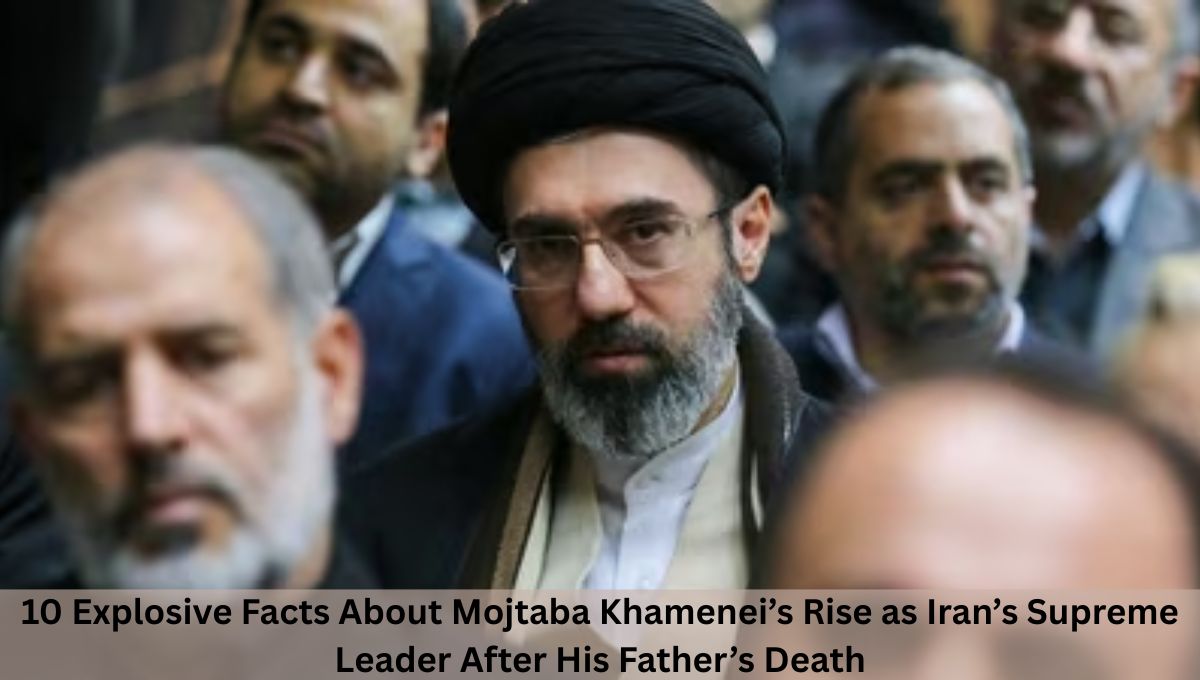
10 Explosive Facts About Mojtaba Khamenei’s Rise as Iran’s Supreme Leader After His Father’s Death amid fears of a more militarized, hardline Iran. Iran has entered one of the most turbulent periods in its modern political history following the death of longtime Supreme Leader Ali Khamenei in a joint United States–Israeli strike on Tehran in late February. Within days, Iran’s powerful clerical body, the Assembly of Experts, announced that the late leader’s son, Mojtaba Khamenei, would become the third Supreme Leader of the Islamic Republic. The decision stunned observers inside and outside Iran.
Reports from insiders suggest that the appointment did not emerge from a consensus among clerics or politicians. Instead, it appears to have been strongly influenced — and possibly engineered — by the powerful Islamic Revolutionary Guard Corps, better known as the IRGC.
The rise of Mojtaba Khamenei is controversial for several reasons. Not only did he lack the traditional religious credentials expected for the position, but reports suggest his own father had opposed the idea of him inheriting the post.
As Iran fights an escalating regional conflict and faces mounting international pressure, the leadership transition has sparked fears that the Islamic Republic could shift further toward military dominance and hardline governance.
Here are 10 explosive facts explaining how Mojtaba Khamenei rose to power and what it could mean for Iran and the world.
10 Explosive Facts About Mojtaba Khamenei’s Rise as Iran’s Supreme Leader After His Father’s Death
1. A Wartime Leadership Vacuum Triggered the Succession
The leadership transition began after the death of Ali Khamenei during a massive US-Israeli strike on Tehran on February 28.
The strikes, launched as part of escalating hostilities between Iran and Western powers, reportedly targeted Iran’s leadership and military command structure.
Khamenei, who ruled Iran for nearly four decades, had been one of the most influential figures in the Middle East since taking power in 1989 following the death of revolutionary leader Ruhollah Khomeini.
His sudden death created a political vacuum at the very top of the Islamic Republic.
Iran’s constitution mandates that the Assembly of Experts select a new supreme leader, but the wartime environment made the process unusually urgent.
Within days, the assembly announced Mojtaba Khamenei as the new leader.
2. Iran’s Assembly of Experts Formally Approved the Appointment
The selection of Iran’s supreme leader constitutionally belongs to the Assembly of Experts — an 88-member body made up of senior clerics.
After an emergency meeting, the assembly declared that Mojtaba Khamenei had been chosen as Iran’s new Supreme Leader.
However, the vote reportedly took place under extraordinary circumstances.
The building usually used by the assembly in the holy city of Qom had reportedly been damaged during strikes, forcing the meeting to occur at an undisclosed location.
Some members were unable to attend or were not informed of the vote. Even among those present, reports suggest the decision was far from unanimous.
3. Reports Suggest His Father Opposed the Succession
One of the most surprising claims to emerge after Mojtaba’s appointment is that Ali Khamenei himself did not want his son to succeed him.
According to reports citing opposition-linked sources, the late leader explicitly asked in his will that Mojtaba not be named as his successor.
Critics say Ali Khamenei believed his son lacked the political experience required to run the Islamic Republic.
Although the authenticity of the claim remains debated, it has fueled controversy about the legitimacy of the succession.
If true, it would mark a remarkable situation where a leader’s final wishes were overridden by powerful political actors.
4. The Revolutionary Guards Played a Decisive Role
Multiple insiders say the Islamic Revolutionary Guard Corps was the decisive force behind Mojtaba Khamenei’s rise.
The IRGC is one of the most powerful institutions in Iran, controlling vast military forces, intelligence networks, and economic interests.
According to sources, senior commanders strongly backed Mojtaba because they believed he would support their hardline agenda.
They also reportedly viewed him as a leader who would allow them greater influence over Iran’s political system.
Analysts say the Guards may have used their influence to pressure members of the Assembly of Experts to approve his appointment.
5. Critics Say Iran May Be Becoming a Military State
Some insiders fear Mojtaba Khamenei’s rise could accelerate the transformation of Iran into what one source described as a “military state with only a thin veneer of religious legitimacy.”
For decades, Ali Khamenei balanced several competing power centers:
- clerical elites
- elected political institutions
- the Revolutionary Guards
Despite the Guards’ growing power, the elder Khamenei managed to keep them in check. But analysts believe that balance may now be shifting.
With Mojtaba seen as heavily dependent on the IRGC, the military establishment may gain unprecedented influence over national decision-making.
6. Mojtaba Khamenei Built Influence Behind the Scenes
Unlike his father, Mojtaba Khamenei never held a formal political office.
Instead, he spent years working behind the scenes inside the supreme leader’s office, known as the beyt.
This office functions as a powerful parallel network that influences nearly every branch of Iran’s government.
During this time, Mojtaba reportedly built strong relationships with military commanders, intelligence officials, and influential clerics.
Diplomatic cables released by WikiLeaks in the late 2000s described him as “the power behind the robes.”
These connections helped him build a reputation as a skilled political operator long before his public rise.
7. His Ties to the IRGC Date Back Decades
Mojtaba Khamenei’s relationship with the Revolutionary Guards began early.
As a teenager, he joined the organization during the Iran-Iraq War, one of the defining conflicts in Iran’s modern history.
That war, fought between 1980 and 1988, deeply shaped Iran’s political culture and its distrust of the United States and Western powers.
Over the years, Mojtaba maintained close ties with IRGC commanders and reportedly built strong support among second-tier military leaders.
These relationships proved critical in his eventual rise to power.
8. His Appointment Raises Concerns About Dynastic Rule
The Islamic Republic was founded in 1979 after a revolution that overthrew Iran’s monarchy. One of the core principles of the new system was rejecting hereditary rule.
For that reason, Mojtaba Khamenei’s appointment as Supreme Leader — immediately after his father’s death — has sparked accusations that Iran is drifting toward a dynastic system.
Critics argue that the transition resembles a monarchy more than a revolutionary republic.
Supporters, however, say Mojtaba’s experience inside the system makes him a logical choice during a national crisis.
9. The New Leader May Be More Hardline Than His Father
Many analysts believe Mojtaba Khamenei could pursue an even tougher political and military stance than his father.
Experts say the circumstances of his rise — in the middle of a major war — are likely to shape his worldview.
His strong ties with the IRGC also suggest he may adopt a more confrontational approach toward Western powers.
Some insiders fear this could lead to:
- more aggressive foreign policy
- stronger internal repression
- expanded power for security forces
Such changes could reshape Iran’s domestic and international policies for years to come.
10. His Rise Has Alarmed the United States and Israel
The leadership transition has already triggered strong reactions from Iran’s main adversaries.
US President Donald Trump publicly criticized Mojtaba’s appointment, calling it unacceptable and warning that it could prolong the conflict.
Israeli officials also condemned the move, suggesting that any Iranian supreme leader tied to the country’s hardline policies would remain a strategic target.
For Washington and Jerusalem, Mojtaba Khamenei’s rise signals ideological continuity rather than reform.
Instead of moderating Iran’s policies, they fear it could deepen confrontation between Iran and its rivals.
A Silent Leader Amid War
Another unusual aspect of Mojtaba Khamenei’s rise is his complete absence from public view.
Since his appointment, he has reportedly made no public speeches, appearances, or televised addresses.
Iranian state television has described him as a “janbaz,” a term often used to describe a wounded war veteran.
This has fueled speculation that he may have been injured during the same strikes that killed his father.
However, independent confirmation of his condition remains unclear. Security concerns may also explain his disappearance from public life.
What Mojtaba Khamenei’s Leadership Means for Iran
The rise of Mojtaba Khamenei could mark a turning point in the evolution of the Islamic Republic.
His leadership comes at a moment when Iran faces multiple challenges:
- an ongoing regional war
- international isolation
- economic pressure
- domestic political divisions
If the Revolutionary Guards gain greater influence under his rule, Iran’s political system could shift toward a model where military power plays a dominant role.
That would represent a major departure from the balance maintained during his father’s long rule.
Conclusion
The appointment of Mojtaba Khamenei as Iran’s Supreme Leader marks one of the most controversial leadership transitions in the history of the Islamic Republic.
From reports that his own father opposed the succession to claims that the Revolutionary Guards engineered his rise, the new leader enters office under extraordinary circumstances.
His lack of formal political experience, combined with his strong ties to the IRGC, raises questions about how power will be exercised in Tehran going forward.
As Iran confronts war, geopolitical rivalry, and internal tensions, Mojtaba Khamenei’s leadership could shape not only the future of the Islamic Republic but also the broader balance of power in the Middle East.
The world is now watching closely to see whether Iran’s new leader will escalate confrontation — or eventually seek a path toward stability.
Also Read: 9 Explosive Signals as Netanyahu Says Israel Is Close to “Freeing Iran”
Also Read: Ayatollah Khamenei reportedly opposed son Mojtaba’s rise as Iran’s Supreme Leader
Related Posts:
- 10 Explosive Facts About Mojtaba Khamenei’s Rise as…
- 7 Explosive Shifts: Mojtaba Khamenei Named Iran’s…
- 10 Explosive Signals Trump Says Iran War Could End…
- 7 Explosive Hours That Shook Iran: Tehran Hit as…
- 10 Explosive Warnings as Donald Trump Calls Iran…
- 11 Explosive Warnings as Trump Vows to ‘Knock the…
