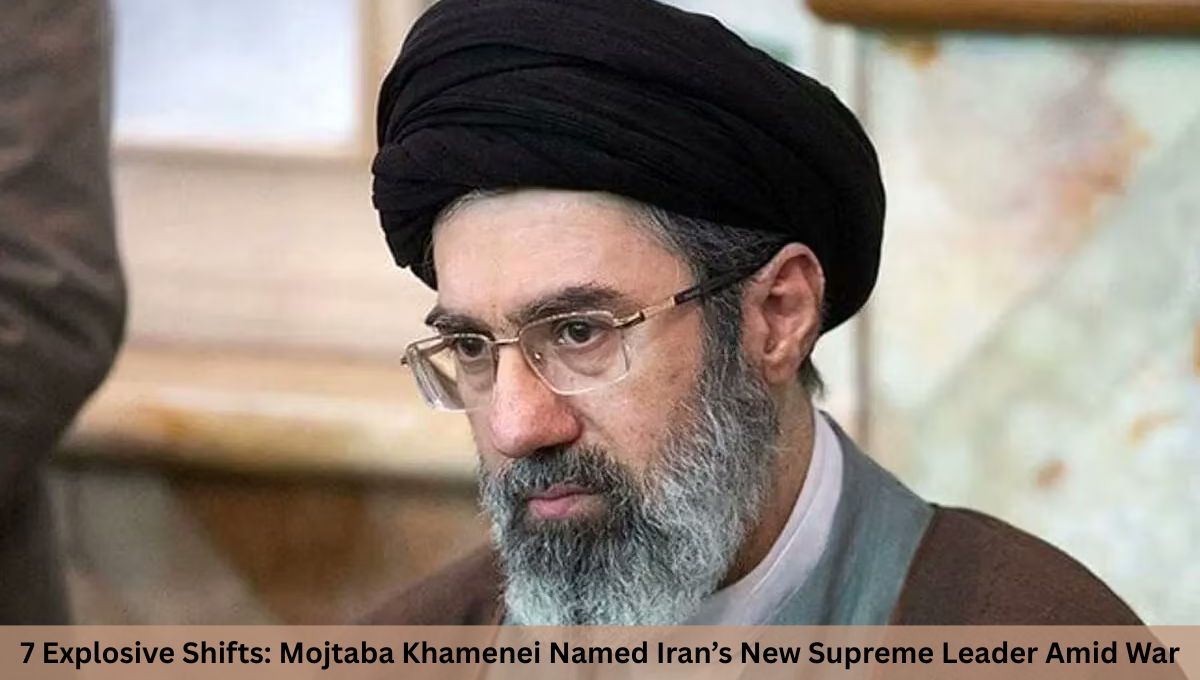
7 Explosive Shifts: Mojtaba Khamenei Named Iran’s New Supreme Leader Amid War, provoking debate over hereditary rule. Iran has entered one of the most consequential and dangerous moments in its modern history. Just days after the killing of long-time Supreme Leader Ayatollah Ali Khamenei in joint US-Israeli airstrikes, Iranian media outlets and international reports claim that his son, Mojtaba Hosseini Khamenei, has been elected as the country’s new Supreme Leader.
The reported decision by Iran’s powerful Assembly of Experts comes amid an all-out regional conflict involving the United States, Israel, Iran, Hezbollah, and Gulf states — a war that has already killed hundreds and shaken global energy markets.
If confirmed, Mojtaba Khamenei’s elevation would mark the first father-to-son succession in the Islamic Republic’s history, challenging one of the regime’s foundational claims:
that it rejects hereditary rule.
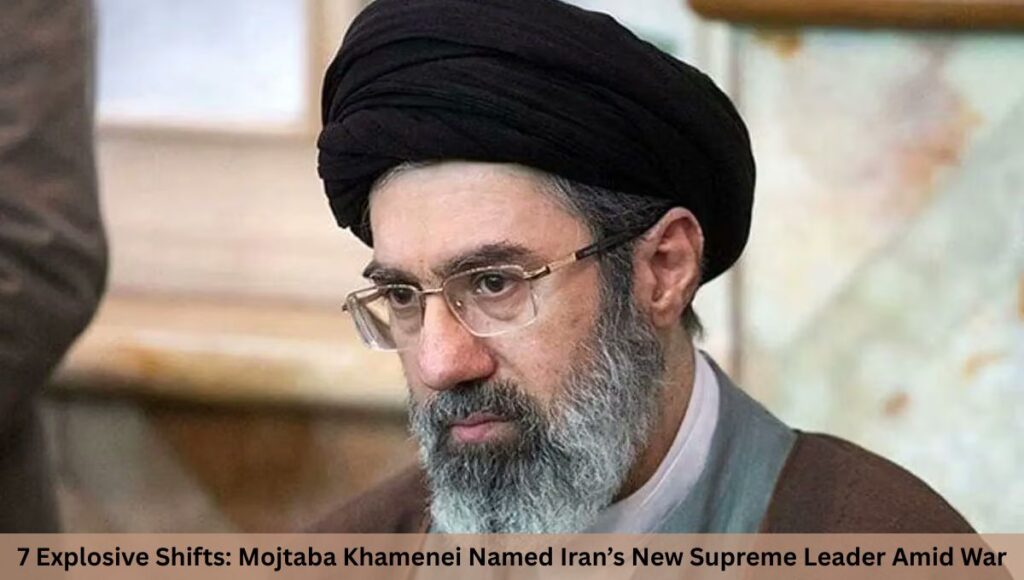
7 Explosive Shifts: Mojtaba Khamenei Named Iran’s New Supreme Leader Amid War
A Wartime Succession Like No Other
Iran’s constitution grants the Assembly of Experts — an 88-member body of senior clerics — the sole authority to appoint the Supreme Leader.
Historically opaque and tightly controlled, the body convenes rarely and under extreme secrecy.
This time, it did so under unprecedented conditions:
- Tehran and other Iranian cities under bombardment
- Senior political and military leaders killed
- Communications disrupted
- Intelligence penetration by Israel laid bare
Israeli and Iranian media outlets reported that Mojtaba Khamenei was selected as successor after intense internal deliberations, allegedly under pressure from the Islamic Revolutionary Guard Corps (IRGC).
Iran International reported that the Guard “heavily pressured” clerics to rally behind Mojtaba, viewing him as the safest option to preserve regime continuity during war.
The Death of Ali Khamenei and the Shock to the System
Ali Khamenei ruled Iran for nearly 36 years, shaping every aspect of the country’s political, military, and ideological life.
His killing in a joint US-Israeli strike on February 28 marked a historic rupture. According to Iranian sources, Khamenei was inside his fortified compound when it was struck.
Several family members were killed alongside him, including:
- His wife, Mansoureh Khojasteh Bagherzadeh
- His daughter
- His son-in-law
- His granddaughter
The scale of the loss — both personal and institutional — left Iran without a designated successor and forced the activation of an emergency constitutional mechanism.
Iran’s Interim Leadership Council Explained
Until a new Supreme Leader could be selected, power temporarily passed to a three-member interim council comprising:
- Masoud Pezeshkian, President
- Gholamhossein Mohseni Ejei, Chief Justice
- Alireza Arafi, senior cleric and Guardian Council member
This mechanism has only been used once before — in 1989, after the death of Ruhollah Khomeini — but that transition occurred in peacetime.
This time, Iran is at war.
Who Is Mojtaba Khamenei?
Early Life and Background
Born in 1969 in Mashhad, Mojtaba is the second-eldest son of Ali Khamenei. He grew up during the Islamic Revolution and came of age as his father consolidated power after 1989.
He attended Alavi High School in Tehran, an elite institution known for educating regime insiders, before pursuing religious studies in Qom, Iran’s clerical heartland.
Despite decades in seminary circles, Mojtaba has never attained the rank of ayatollah — a fact that has long fueled debate over his eligibility.
Military Experience and IRGC Ties
During the Iran-Iraq War, Mojtaba served in the Habib Battalion, forging early relationships with figures who later rose within Iran’s security establishment.
Analysts widely believe his real power stems from deep, long-standing ties with the IRGC, which has expanded its influence across:
- Politics
- The economy
- Intelligence
- Foreign military operations
Behind-the-Scenes Power Broker
Mojtaba has never held elected office or a formal government post. Yet insiders describe him as a gatekeeper within the Office of the Supreme Leader — a role similar to that played by Ahmad Khomeini, son of Ruhollah Khomeini.
In 2019, the US Treasury sanctioned Mojtaba, alleging that Ali Khamenei had delegated significant authority to him, allowing him to act in an official capacity without public accountability.
Why His Selection Is Politically Explosive
The Islamic Republic was founded on the rejection of monarchy after the overthrow of Shah Mohammad Reza Pahlavi. A father-to-son succession strikes at the heart of that narrative.
Even Ali Khamenei reportedly excluded Mojtaba from a list of potential successors he prepared last year, favoring senior clerics instead.
Within Iran’s Shiite establishment, hereditary succession is viewed with deep suspicion — but wartime realities may have overridden theological reservations.
The Assembly of Experts Under Fire — Literally
In one of the most dramatic episodes of the war, Israeli sources claimed the IDF struck a building where the Assembly of Experts was meeting to deliberate on Khamenei’s successor.
Iranian media reported the structure was “flattened,” though officials later said no members were killed and that key deliberations may have been held elsewhere.
The strike underscored the depth of Israeli intelligence penetration inside Iran and highlighted the fragility of Tehran’s command structure.
Operation Epic Fury and the Wider War
The succession drama is unfolding against the backdrop of Operation Epic Fury, the joint US-Israeli military campaign targeting Iran’s nuclear, missile, and leadership infrastructure.
US President Donald Trump has claimed Iran’s navy, air force, air defenses, and radar systems have been “knocked out,” while warning of additional waves of strikes.
Iran, meanwhile, has retaliated with missile and drone attacks across the Gulf, including:
- Dubai
- Abu Dhabi
- Bahrain
- Qatar
Oil facilities and diplomatic missions have been hit, driving up energy prices and rattling global markets.
Regional Escalation: Hezbollah and Beyond
Tehran-backed Hezbollah has entered the conflict, prompting Israeli forces to push deeper into southern Lebanon.
Israel says it is fighting a multi-front war aimed at neutralizing Iran’s regional network — a campaign that has dramatically widened the scope of the conflict.
Global Implications of Mojtaba’s Rise
If Mojtaba Khamenei consolidates power, several consequences are likely:
1. Stronger IRGC Influence
His close ties to the Guard suggest a more militarized, security-first leadership style.
2. Harder Line on the West
Diplomacy with Washington and Europe may become even more difficult, especially after Trump declared it was “too late” for talks.
3. Internal Legitimacy Questions
Hereditary succession could deepen public resentment inside Iran, particularly among reformists and younger Iranians.
4. Prolonged Regional Instability
A new, embattled Supreme Leader taking power during war increases the risk of miscalculation.
What Comes Next for Iran?
Much remains uncertain:
- Will clerical elites fully accept Mojtaba’s authority?
- Can Iran sustain a prolonged regional war under new leadership?
- Will economic pressure and military losses trigger internal unrest?
For now, Iran appears determined to project continuity and defiance — even as its leadership structure undergoes its most dramatic transformation since 1979.
Conclusion: A Defining Moment for the Islamic Republic
The reported elevation of Mojtaba Khamenei marks a defining moment not only for Iran but for the Middle East and global security.
A system built on revolutionary ideals now faces accusations of dynastic rule. A country already under fire must navigate leadership transition amid war.
And a region already on edge inches closer to a broader, more destructive conflict.
Whether Mojtaba Khamenei emerges as a stabilizing figure or a catalyst for deeper turmoil will shape Iran’s future — and the world’s — for years to come.
Also Read: Trump Signals Regime Change After Strikes on Iran’s Nuclear Sites
Also Read: Iran postpones Khamenei’s farewell as Israel threatens to kill successor
Related Posts:
- 7 Explosive Hours That Shook Iran: Tehran Hit as…
- Trump’s 20-Point Gaza Peace Plan Gains Urgent Global…

- 9 Explosive Warnings as Hezbollah Backs Iran Against…
- 11 Explosive Warnings as Trump Vows to ‘Knock the…

- 9 Explosive Claims: Trump Says Iran ‘Knocked Out’ as…
- 7 Explosive Turns: Israel Bombs Beirut as Hezbollah…