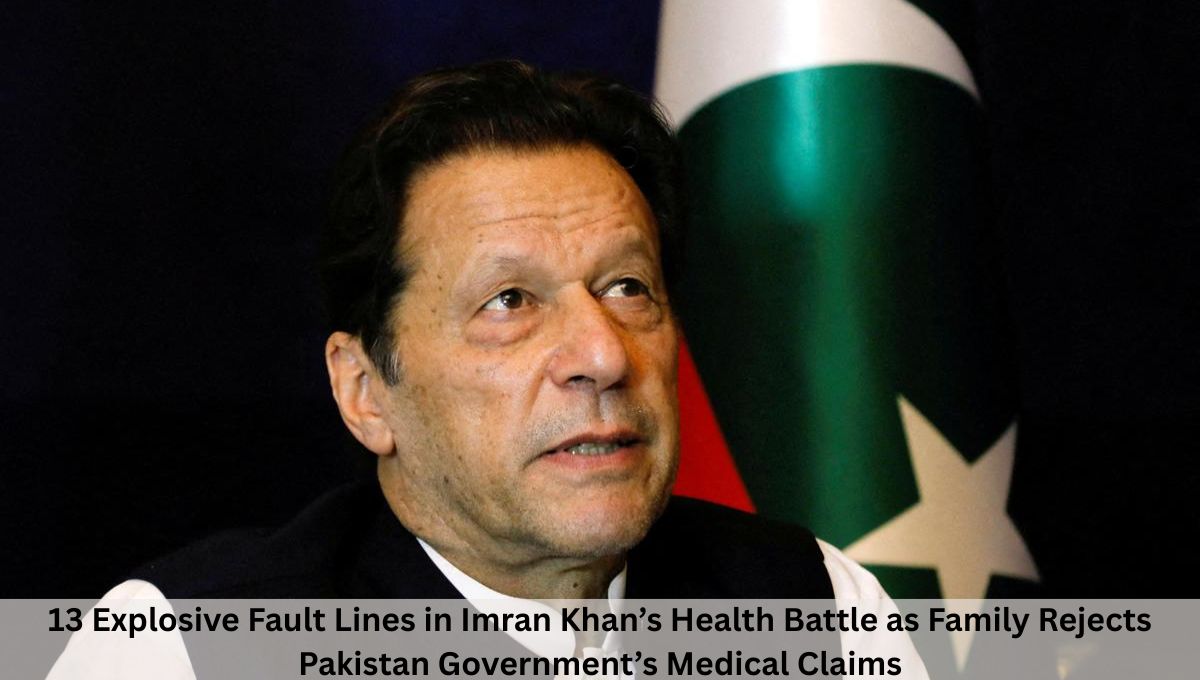
13 Explosive Fault Lines in Imran Khan’s Health Battle as Family Rejects Pakistan Government’s Medical Claims, fueling major political and global concern. The health of jailed former Pakistani Prime Minister Imran Khan has become the latest flashpoint in Pakistan’s intensifying political crisis, after his family categorically rejected claims by a government-appointed medical board that his eyesight has significantly improved.
The dispute is no longer a narrow medical disagreement. It has evolved into a high-stakes confrontation involving human rights, judicial oversight, political legitimacy, and international scrutiny, raising troubling questions about transparency inside Pakistan’s prison system and the treatment of its most prominent political detainee.
At the centre of the controversy is a stark contradiction:
while authorities claim Khan’s vision has recovered dramatically, his family, party, personal doctors, and legal representatives insist the assessment lacks credibility and was conducted without basic safeguards.
13 Explosive Fault Lines in Imran Khan’s Health Battle as Family Rejects Pakistan Government’s Medical Claims
1. The Government’s Claim: “Significant Improvement” in Vision
According to a medical report prepared by a government-appointed board, Khan’s eyesight in his right eye has improved from 6/36 to 6/9, while his left eye remains 6/6 with corrective glasses—a level considered clinically normal.
In ophthalmic terms, 6/6 vision means a person can see clearly at six metres what someone with standard eyesight should see at that distance. A 6/9 reading, while not perfect, represents substantial functional vision.
The assessment was carried out inside Adiala Jail, where Khan has been incarcerated since August 2023, by a two-member medical board that included senior ophthalmologists.
Pakistan’s Law Minister Azam Nazeer Tarar publicly defended the findings, stating that Khan had responded positively to treatment and that opposition leaders had been briefed.
2. Family Pushback: “We Have No Trust”
Khan’s sister, Aleema Khan, dismissed the government’s claims outright, describing the process as “extremely concerning and unacceptable.”
Her objection hinges on a critical point:
neither Khan’s personal physician nor a family representative was allowed to be physically present during the examination.
“Without the physical presence of both his personal doctor and a family representative, we categorically reject any claims made by the government regarding his examination, treatment or medical condition,” she said.
According to the family, this exclusion invalidates the report entirely and raises fears of deliberate obfuscation.
3. The Role of Khan’s Personal Doctor
Dr Aasim Yusuf, chief medical officer of Shaukat Khanum Memorial Hospital and one of Khan’s long-time personal physicians, confirmed that he had spoken to the examining doctors for about 40 minutes.
While Yusuf acknowledged that the visiting doctors claimed improvement, he struck a cautious tone.
“I would be extremely happy if I could confirm this. Unfortunately, because I have not examined him myself, I cannot confirm or deny the veracity of what we have been told.”
This statement has become central to the family’s argument: second-hand assurances are no substitute for direct medical access.
4. Supreme Court Intervention and a Disturbing Report
The controversy escalated after Pakistan’s Supreme Court appointed senior lawyer Salman Safdar as amicus curiae to assess Khan’s condition following mounting public concern.
Safdar’s seven-page report painted a deeply troubling picture.
He noted:
- Rapid and substantial vision loss over three months
- Persistent complaints of blurred and hazy vision
- No timely action by jail authorities, despite repeated requests
Safdar quoted Khan as saying only 15% vision remained in his right eye—directly contradicting the government’s later claims.
5. PTI’s Position: Improvement or Managed Narrative?
The leadership of Pakistan Tehreek-e-Insaf (PTI) has offered a nuanced response.
PTI General Secretary Salman Akram Raja told reporters that doctors claimed Khan could now see objects—such as the clock on the wall—that he previously could not.
Yet even within PTI, the insistence remains firm:
no report is acceptable without independent verification.
6. Why Shifa International Hospital Matters
The family’s demand is specific and consistent: transfer Khan to Shifa International Hospital in Islamabad.
Aleema Khan argues that authorities initially agreed—only to reverse course without explanation.
“We were told he would be taken there with his physician and a family member. Then suddenly, they changed the plan. How can we be denied like this?”
The refusal has fuelled suspicions that the government fears independent medical confirmation.
7. Allegations of Deliberate Obstruction
According to the family, the government rejected multiple proposed family representatives, including Khan’s sister Uzma Khan and cousin Nausherwan Burki, both medically qualified.
Aleema Khan posed a pointed question:
“Are they being rejected because they are highly qualified doctors?”
The repeated rejections have transformed a medical dispute into an accusation of systematic obstruction.
8. International Cricket Legends Step In
The controversy has now crossed borders. Fourteen former international cricket captains—including Sunil Gavaskar, Kapil Dev, Greg Chappell, and Steve Waugh—signed a joint appeal urging Pakistan to ensure immediate and dignified medical care.
The letter emphasised that concern transcended politics, calling the issue one of basic human decency.
9. Sons in Limbo: Visa Silence and Growing Fear
Khan’s sons, Kasim Khan and Suleman Khan, both UK nationals, say they have been unable to visit their father despite repeated visa applications.
They last saw him in November 2022, before he survived an assassination attempt.
“We don’t even get a rejection or approval. It’s just silence,” Suleman said.
Their absence has intensified criticism that Khan is being isolated deliberately.
10. United Nations Finding: Arbitrary Detention
In June 2024, a United Nations Working Group on Arbitrary Detention concluded that Khan’s imprisonment lacked legal basis and appeared aimed at disqualifying him from political office.
That finding now casts a long shadow over the medical dispute, strengthening claims that health care may be weaponised as a tool of pressure.
11. Government Response: “Complete Transparency”
Pakistan’s Minister for Parliamentary Affairs Tariq Fazal Chaudhry rejected negligence allegations, insisting that all procedures were conducted transparently and that PTI leadership was informed.
Yet critics note that transparency without independent access remains a contradiction.
12. A Political Prisoner or Lawful Inmate?
Since his ouster via a no-confidence vote in 2022, Khan has accused Pakistan’s military establishment—led by Asim Munir—of orchestrating his downfall.
Both the military and the United States have denied his claims. Still, his supporters increasingly frame his imprisonment as political persecution, not criminal accountability.
13. Why This Case Resonates Globally
This standoff is no longer just about eyesight.
It touches on:
- Rule of law in nuclear-armed Pakistan
- Treatment of political detainees
- Judicial independence
- International human rights norms
For global observers, the question is simple but profound:
can a state credibly claim transparency while denying independent verification?
Conclusion: A Test of Pakistan’s Democratic Credibility
Imran Khan’s health controversy has become a litmus test for Pakistan’s institutions. The government’s insistence on improvement clashes sharply with family testimony, judicial reports, and international concern.
Until Khan is examined in person by doctors of his choosing, in the presence of family, doubts will persist—and so will the protests, petitions, and global scrutiny.
What is unfolding is not merely a medical dispute, but a defining chapter in Pakistan’s political and human rights narrative—one the world is now watching closely.
Also Read: 7 Shocking Twists in Imran Khan Death Rumours and Jail Chaos
Related Posts:
- 17-Year Shock Verdict: Imran Khan Jailed as Protests Loom

- 7 Shocking Twists in Imran Khan Death Rumours and Jail Chaos

- 7 Urgent Revelations as Imran Khan’s Isolation…
- 11 Explosive Developments as Pakistan Moves to Try…

- Afghanistan–Pakistan War 2025: Inside the 48-Hour Ceasefire

- 5 Key Shifts in Bangladesh–Pakistan Relations as…
