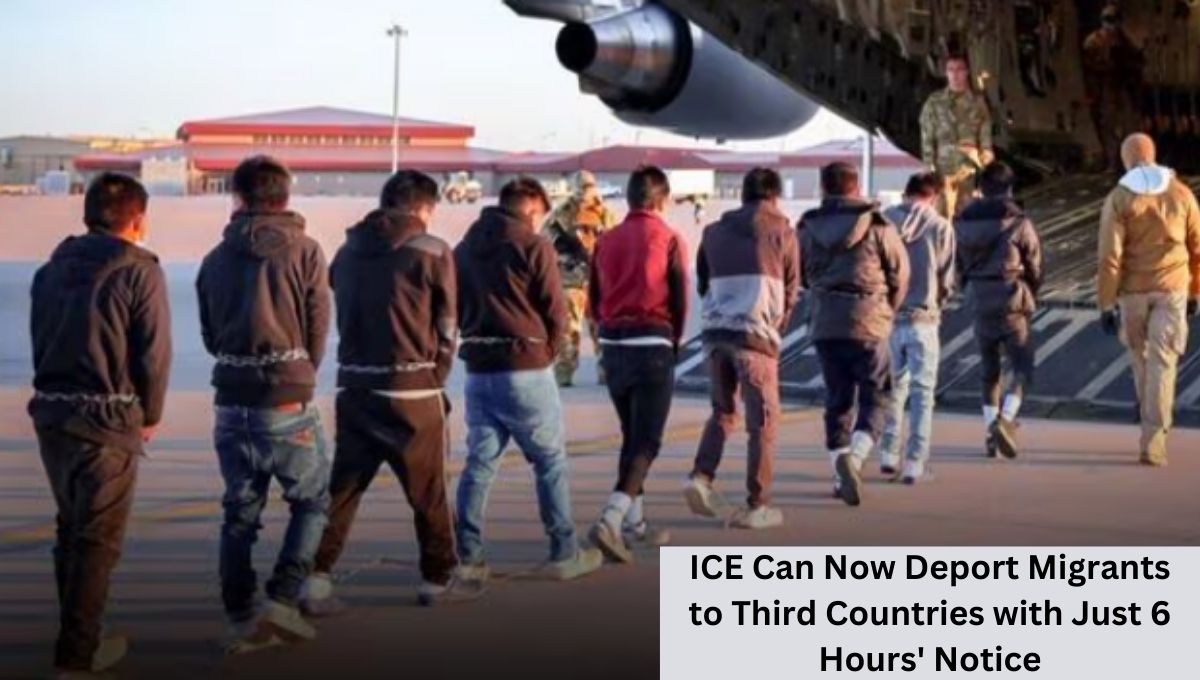
In a major policy shift under President Donald Trump, ICE Can Now Deport Migrants to Third Countries with Just 6 Hours’ Notice. This drastic change, confirmed by a memo dated July 9 from acting ICE director Todd Lyons, has triggered widespread concern from legal experts and immigrant rights advocates.
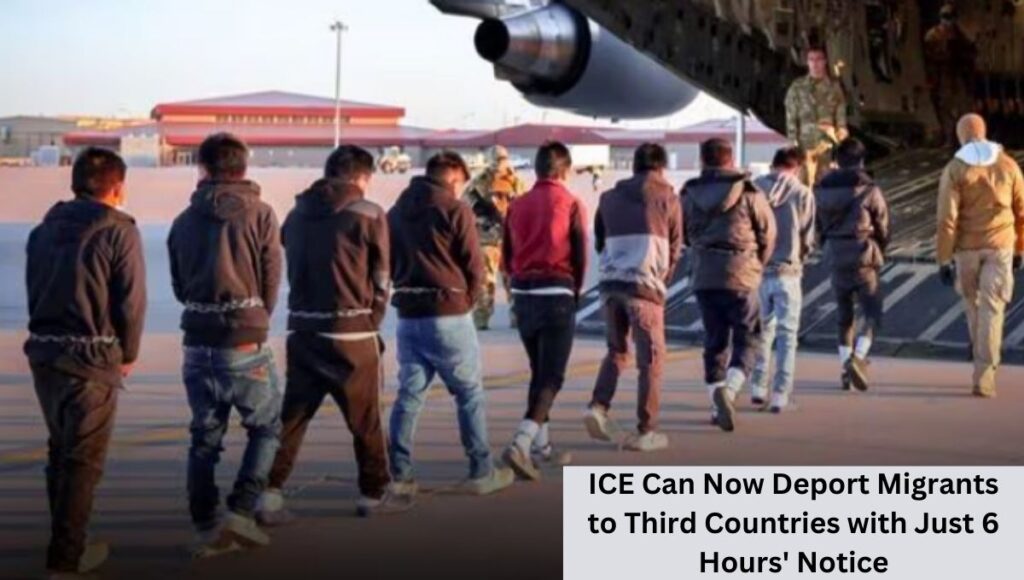
ICE Can Now Deport Migrants to Third Countries with Just 6 Hours’ Notice
What the ICE Memo Says
According to the new policy memo, ICE can now carry out “expedited removals” to countries other than the migrant’s home nation.
Under previous guidelines, ICE typically waited at least 24 hours before executing such deportations. Now, in what the memo calls “exigent circumstances,” the agency can act in just six hours.
These “third-country” deportations are justified by assurances from the receiving countries that migrants will not face persecution or torture.
No additional legal hearings or protections are required, significantly reducing due process for the affected individuals.
Supreme Court Clears the Way
This policy was made possible after a June Supreme Court ruling, which overturned a lower court’s restriction on third-country deportations.
The court’s conservative majority allowed ICE to resume these removals without the need to verify whether migrants feared harm in the third country.
Following that decision, ICE deported eight migrants from Cuba, Laos, Mexico, Myanmar, Sudan, and Vietnam to South Sudan, a country known for instability and human rights concerns.
“Six-Hour Notice, No Safety Assurance”
Immigrant advocacy groups are raising the alarm, stating that the policy jeopardizes thousands of lives.
Legal experts say it could lead to individuals being sent to countries where they have no ties, no language fluency, and potentially face serious danger.
“It puts thousands of lives at risk of persecution and torture,” said Trina Realmuto, executive director of the National Immigration Litigation Alliance.
Realmuto’s organization has already filed lawsuits challenging the legality of such deportations, claiming they violate federal due process protections.
Legal Pushback and Ongoing Lawsuits
Several lawsuits have been launched against the Trump administration for violating statutory and constitutional rights.
One key case involved a Guatemalan man who was deported to Mexico, where he had previously been kidnapped and raped.
In March, U.S. District Judge Brian Murphy issued a ruling requiring ICE to give migrants at least 10 days’ written notice before third-country deportations.
However, that order was paused by the Supreme Court in June, clearing the path for ICE’s new rapid removal policy.
No Guarantee of Safety
The memo allows deportations based solely on assurances accepted by the U.S. State Department. Migrants do not need to be asked if they fear going to the third country.
If they do express fear, they will be screened for protection under the Convention Against Torture and federal immigration law.
However, these screenings must be completed within 24 hours, leaving little time for a thorough review.
Impact on Vulnerable Populations
The policy disproportionately affects migrants from nations like Cuba, China, and Venezuela, where diplomatic relations with the U.S. are poor.
These countries often refuse to accept deportees, prompting ICE to send migrants to third countries with no cultural, linguistic, or familial connections.
“This is a category of people who understood themselves to be out of the woods,” said attorney Simon Sandoval-Moshenberg. “It is definitely going to affect thousands upon thousands of people.”
Trump Administration’s Justification
The Trump administration argues that the new policy is a necessary enforcement tool to remove individuals who are in the U.S. unlawfully, especially those with criminal records.
Officials say the move is meant to prevent migrants from gaming the system and delaying deportation through legal appeals.
In addition to South Sudan, ICE has reportedly urged five African nations Liberia, Senegal, Guinea-Bissau, Mauritania, and Gabon to accept deportees from various countries.
Historical Context and Biden’s Approach
Third-country deportations are not entirely new. During Trump’s first term, the administration deported small numbers of Salvadorans and Hondurans to Guatemala.
In contrast, the Biden administration had arranged deals with Mexico to accept migrants from Cuba, Haiti, Nicaragua, and Venezuela when direct repatriation was not feasible.
The new Trump policy significantly expands the scope and speed of these deportations, aiming for record-level removals.
ICE Internal Policy: Six Hours or Less
ICE Director Todd Lyons emphasized in the memo that officials can remove individuals in as little as six hours, particularly in situations deemed urgent.
These may include national security threats, public safety concerns, or logistical issues like flight availability.
The memo also states that deportees must be given the opportunity to consult with an attorney, though legal advocates argue that six hours is insufficient to secure meaningful representation.
Human Rights Concerns and Global Reaction
Human rights organizations have called the policy cruel, dangerous, and reckless.
They warn that deporting people without proper screenings could lead to serious human rights violations, especially in volatile regions.
Justice Sonia Sotomayor, dissenting from the Supreme Court’s ruling, wrote:
“In matters of life and death, it is best to proceed with caution. The Government took the opposite approach.”
The Case of Kilmar Abrego Garcia
The ICE memo was made public after being filed as evidence in a legal case involving Kilmar Abrego Garcia, a Maryland resident who was wrongfully deported to El Salvador.
His case has become a focal point in the legal battle against third-country removals and is expected to influence upcoming court decisions.
What Comes Next
Legal battles are expected to continue as the Trump administration aggressively expands deportations under the new policy. Advocacy groups plan to seek injunctions and legislative intervention, while ICE continues to ramp up coordination with foreign governments.
With the presidential election looming, immigration is likely to remain a hot-button issue, and this policy could play a significant role in shaping the national conversation.
Related Posts:
- 11 Powerful Shifts in New US Dietary Guidelines That…

- 7 Alarming Impacts of Trump’s Plan to Expand the US…

- 7 Explosive Shifts in Trump’s New Immigration…

- 7 Critical Impacts of the US Immigration Pause on…

- Worried Migrants Head Home from India as Nepal’s Gen…

- 75-Nation Visa Shock: Trump’s Explosive Immigration…