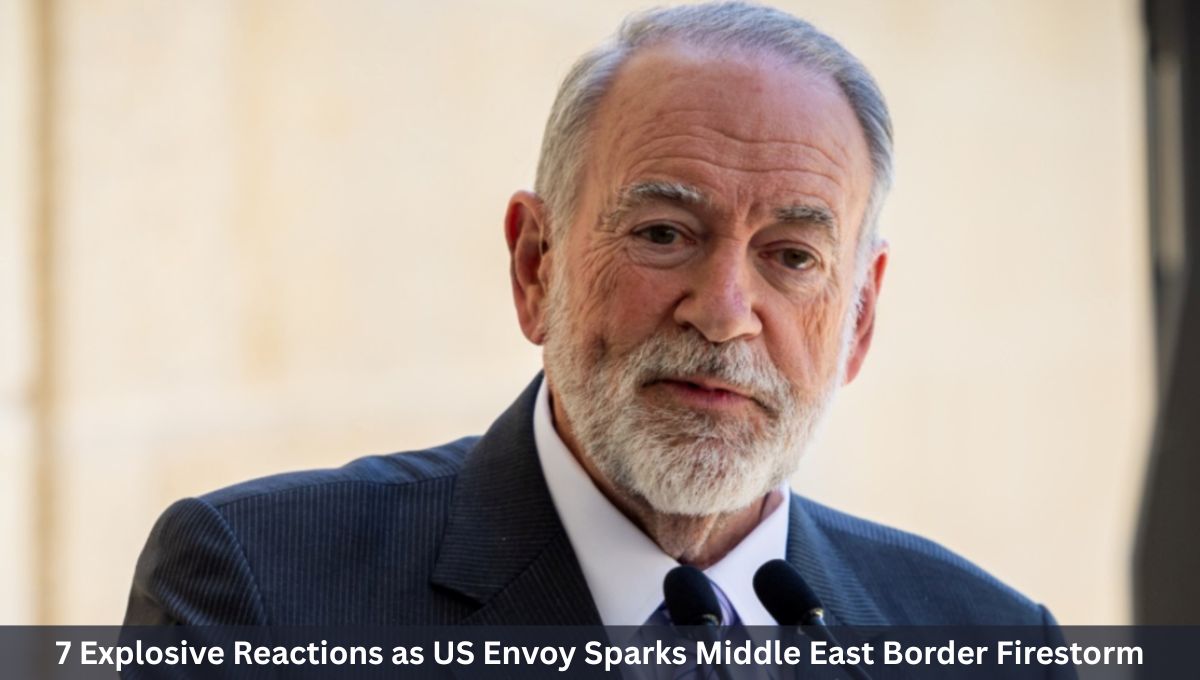
7 Explosive Reactions as US Envoy Sparks Middle East Border Firestorm by claiming Israel has right to much of region. The United States has been plunged into a diplomatic storm after Mike Huckabee, Washington’s ambassador to Israel, suggested it would be “fine” if Israel took control of much of the Middle East — remarks that detonated outrage across Arab and Muslim capitals and reignited one of the most volatile debates in global politics.
The comments, made during an interview with Tucker Carlson, were widely condemned as reckless, extremist, and diplomatically irresponsible, with critics warning they risk inflaming an already combustible region amid war in Gaza, rising West Bank violence, and fragile regional ceasefires.
While Huckabee later attempted to walk back the remarks as “hyperbolic,” the damage was already done. From Cairo to Riyadh, Amman to Jakarta, the response was swift — and severe.
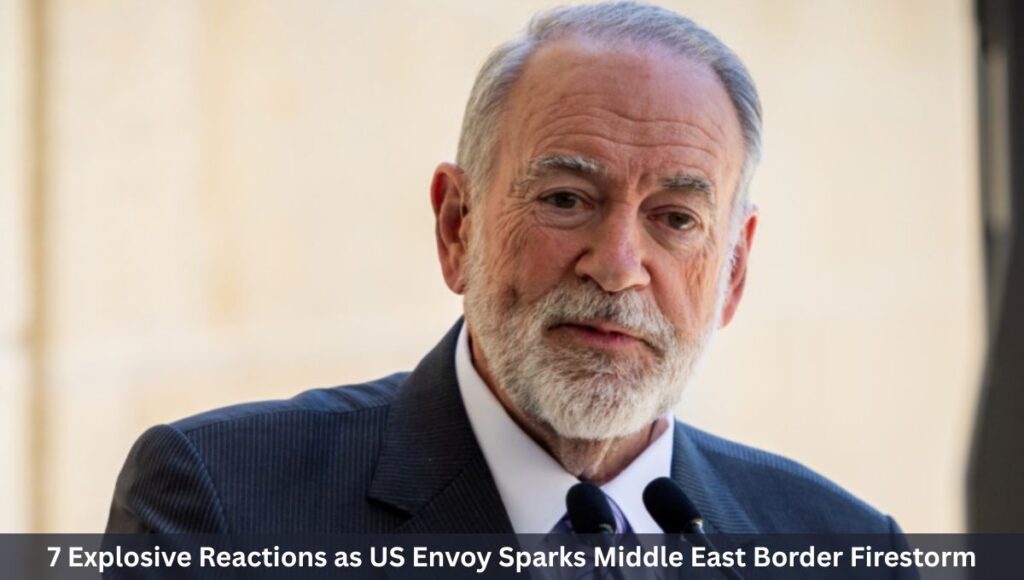
7 Explosive Reactions as US Envoy Sparks Middle East Border Firestorm
1. What Exactly Did Mike Huckabee Say?
During the interview, Carlson pressed Huckabee on a biblical passage from Genesis often cited by Christian Zionists, which describes land promised to the descendants of Abraham stretching from the Nile River to the Euphrates River.
Mapped onto the modern world, that territory would include:
- Israel and the occupied Palestinian territories
- Jordan
- Lebanon
- Syria
- Large parts of Saudi Arabia and Iraq
When asked whether Israel had a right to that land, Huckabee replied:
“It would be fine if they took it all.”
Though he later added that Israel was not actively seeking such expansion and had a right to security in the land it “legitimately holds,” the statement was immediately interpreted as endorsing maximalist territorial claims that directly contradict international law and longstanding US policy.
2. Arab and Muslim World Reacts With Fury
The backlash was immediate and nearly universal across the Arab and Muslim worlds.
Egypt: “A Blatant Violation of International Law”
Egypt’s Ministry of Foreign Affairs condemned Huckabee’s remarks as:
“A blatant violation of international law… Israel has no sovereignty over the occupied Palestinian territory or any other Arab lands.”
Egypt warned that such rhetoric undermines regional stability and the foundations of diplomacy.
Jordan: “Absurd and Provocative”
Jordan’s foreign ministry described the comments as:
“Absurd, provocative, and an infringement on the sovereignty of states in the region.”
Amman stressed that such statements violate diplomatic norms and inflame nationalist and religious tensions.
Saudi Arabia: “Extremist and Unacceptable”
Saudi Arabia’s Ministry of Foreign Affairs issued one of the strongest rebukes, calling the remarks:
“Extremist rhetoric… unacceptable and reckless.”
Riyadh formally demanded clarification from the US State Department, warning that such views threaten global peace and security.
3. Unified Condemnation From Arab and Islamic Institutions
Beyond individual states, major regional and international bodies weighed in.
Organisation of Islamic Cooperation (OIC)
The Organisation of Islamic Cooperation denounced Huckabee’s remarks as dangerous and inconsistent with international norms, warning they could incite conflict across the region.
League of Arab States
The League of Arab States issued a scathing statement, saying:
“Statements of this nature — extremist and lacking any sound basis — serve only to inflame religious and national emotions.”
The Arab League emphasized that such rhetoric contradicts international law and threatens prospects for peace.
4. A Sharp Break From Official US Policy
Huckabee’s comments stand in stark contrast to official US positions — including statements from Donald Trump himself.
Despite Trump’s strong pro-Israel record, he has explicitly stated:
“I will not allow Israel to annex the West Bank. It’s not going to happen.”
That position aligns with decades of bipartisan US policy opposing unilateral territorial expansion and supporting — at least rhetorically — a negotiated settlement.
Huckabee’s remarks therefore raised uncomfortable questions:
- Is the ambassador freelancing on theology?
- Or revealing deeper ideological currents within parts of the US political establishment?
5. International Law vs Biblical Claims
At the heart of the controversy lies a fundamental clash between religious-nationalist interpretations and international law.
The Legal Reality
- In 2024, the International Court of Justice ruled that Israel’s occupation of Palestinian territory is illegal and must end.
- The acquisition of territory by force is prohibited under the UN Charter.
- Israel’s annexation of the Golan Heights in 1981 is not recognized by the international community — except by the US since 2019.
The Political Reality
Israel does not have formally defined borders in its domestic law. Its frontiers have shifted repeatedly since 1948 due to wars, ceasefires, occupations, and annexations.
Some Israeli politicians — including Benjamin Netanyahu — have openly entertained the idea of a “Greater Israel,” further complicating regional dynamics.
6. Christian Zionism and US Foreign Policy
Huckabee’s remarks cannot be separated from his ideological background.
A self-described Christian Zionist, Huckabee has long argued that Israel’s legitimacy is rooted not only in modern history but in biblical covenant.
Past statements include:
- Rejecting the two-state solution
- Denying the existence of an illegal occupation of the West Bank
- Questioning Palestinian national identity
These views resonate with segments of the US evangelical movement but clash sharply with international consensus and the lived realities of millions in the region.
Critics argue that blending theology with diplomacy is a recipe for perpetual conflict, especially when voiced by a sitting ambassador.
7. Regional Consequences at a Dangerous Moment
Huckabee’s comments come at an exceptionally volatile time.
- Israel remains deeply engaged in Gaza following war with Hamas
- Israeli forces maintain expanded control across large parts of the territory
- Military outposts remain inside southern Lebanon following clashes with Hezbollah
- Tensions persist along Israel’s border with Syria
Against this backdrop, statements suggesting Israel has a right to dominate the region are seen as pouring fuel on an open fire.
Even US allies fear such rhetoric could:
- Undermine fragile ceasefires
- Radicalize public opinion
- Weaken US credibility as a mediator
Global Fallout Beyond the Middle East
Condemnation was not limited to the region.
Muslim-majority nations outside the Middle East — including Turkey, Indonesia, and Pakistan — echoed concerns, warning that the remarks threaten international stability and erode respect for sovereignty.
The Palestinian Authority said Huckabee’s comments:
“Contradict international law, religious facts, and even the stated position of the US president.”
What Happens Next?
So far:
- No formal apology has been issued
- The US State Department has not publicly endorsed Huckabee’s remarks
- Israel has remained officially silent
But the episode leaves lasting questions:
- Will Washington rein in its ambassador?
- Will this deepen mistrust between the US and Arab states?
- And does this signal a growing ideological fracture within US foreign policy circles?
Final Takeaway
Mike Huckabee’s comments were more than a diplomatic gaffe — they struck at the raw nerve of territory, faith, identity, and power in one of the world’s most contested regions.
In a Middle East already on edge, words matter.
And these words, many fear, may echo far longer than intended.
Also Read: Trump and Netanyahu Meet: Gaza Peace Plan, Netanyahu’s Transformation & Middle East Gamble
Also Read: ‘Absurd and provocative’: Huckabee faces firestorm for Israel border stance