21 Shocking Secrets: How AI, Cameras & Phone Networks Led to Khamenei’s Death — A years-long intelligence campaign. The assassination of Ayatollah Ali Khamenei, Iran’s Supreme Leader for nearly four decades, was not the result of a single intelligence breakthrough or last-minute opportunity.
It was the culmination of a years-long, multi-layered intelligence campaign that fused traditional espionage with cutting-edge technology — from hacked traffic cameras and mobile phone networks to artificial intelligence, cyber warfare, and human sources deep inside Iran’s power structure.
According to detailed reporting by the Financial Times, Israel and the United States slowly constructed a complete operational picture of Tehran’s most sensitive leadership compound, ultimately identifying the precise moment when Khamenei would be most vulnerable.
21 Shocking Secrets: How AI, Cameras & Phone Networks Led to Khamenei’s Death
The Long Surveillance of Tehran’s Invisible Grid
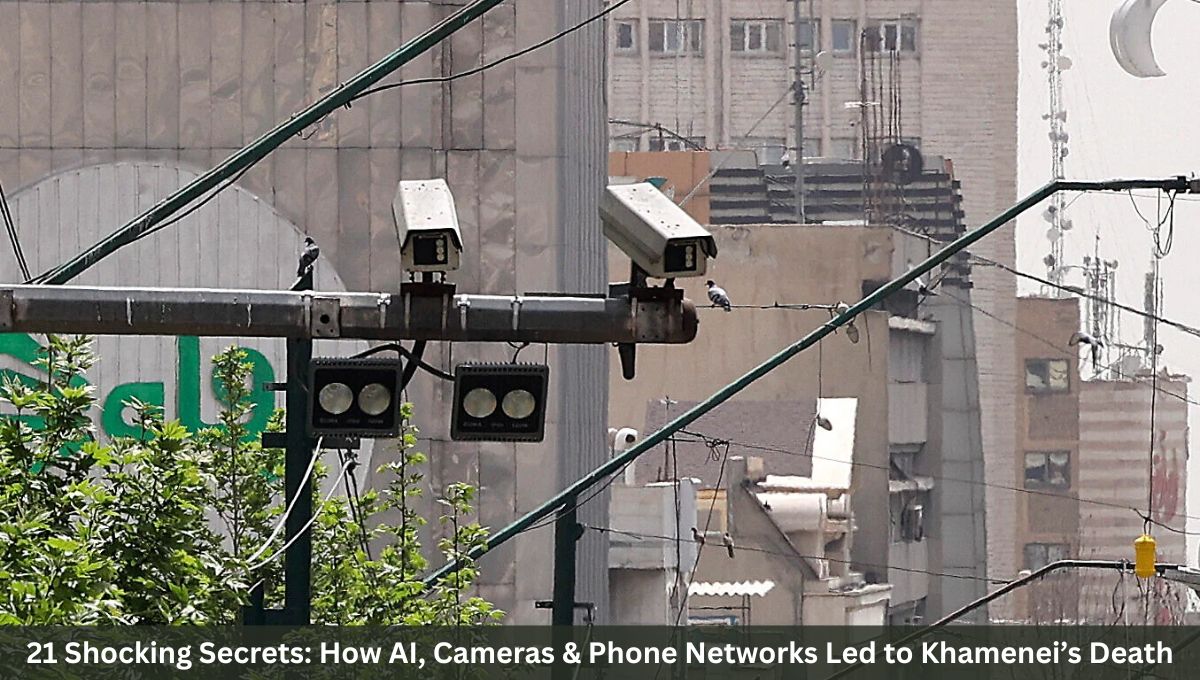
For years, nearly all traffic cameras in Tehran were quietly compromised. These were not dramatic Hollywood-style hacks but methodical, sustained intrusions into Iran’s civilian infrastructure.
One specific camera near Pasteur Street — home to Iran’s most guarded political offices — proved invaluable.
It offered Israeli intelligence a rare glimpse into a compound normally hidden from satellites and foreign observers.
This footage revealed:
- Where security personnel parked
- Shift changes and duty rotations
- Vehicle movement patterns
- Arrival and departure routines of senior officials
Over time, intelligence analysts assembled what they call a “pattern of life” — a behavioral map so detailed that deviations immediately raised alarms.
Algorithms, AI, and the Mathematics of Power
Raw surveillance alone was not enough. Israel deployed advanced AI algorithms to process billions of data points.
Using a mathematical method known as social network analysis, intelligence agencies mapped:
- Who protected whom
- Which officials traveled together
- Who attended which meetings
- How frequently certain individuals appeared near Khamenei
This analytical backbone transformed mundane data into predictive intelligence.
At the heart of this effort was Israel’s elite signals intelligence unit, Unit 8200, working alongside the foreign intelligence service Mossad.
Mobile Networks Turned Into Weapons
Perhaps the most decisive technological edge came from deep penetration of Iran’s mobile phone infrastructure.
Israeli intelligence learned how to:
- Disrupt individual components of mobile phone towers
- Make phones appear “busy” when called
- Prevent real-time warnings from reaching security teams
On the day of the strike, Khamenei’s protection detail was effectively digitally blinded. Phones rang unanswered. Alerts never arrived.
In modern warfare, silence can be deadlier than explosions.
The CIA’s Human Source: The Final Confirmation
While Israel dominated the technical surveillance, the Central Intelligence Agency delivered the final piece: a human source.
This source confirmed something technology alone could not guarantee — that Khamenei himself would be present at a leadership meeting on Saturday morning inside the Tehran compound.
That confirmation triggered a rapid operational shift. Plans for a night strike were scrapped in favor of a daylight attack, exploiting surprise rather than darkness.
Why the Strike Was Moved Forward
Israeli intelligence detected an unusual convergence of senior officials at the compound. According to Reuters, analysts concluded that once open war began, Iran’s leadership would disappear underground into hardened bunkers.
This meeting represented a fleeting window:
- Multiple senior leaders in one location
- Above ground
- On a predictable schedule
Miss it, and the opportunity might never return.
Precision From 1,000 Kilometers Away
Israeli pilots used Sparrow missile variants, capable of striking targets as small as a dining table from over 1,000 kilometers away — far beyond Iran’s effective air defense envelope.
Within seconds:
- Multiple buildings were hit
- Command centers collapsed
- Leadership was decapitated
Iranian officials were reportedly having breakfast when the missiles struck.
A Political Decision, Not Just a Military One
Killing Khamenei was not merely a technological achievement. It was a strategic political decision.
As the second Supreme Leader after Ayatollah Ruhollah Khomeini, Khamenei embodied the continuity of Iran’s clerical rule.
Removing him was intended to:
- Disrupt succession planning
- Shake elite cohesion
- Accelerate internal instability
This was regime decapitation, not retaliation.
Why Khamenei Didn’t Hide
Unlike Hezbollah leader Hassan Nasrallah, who lived for years in underground bunkers, Khamenei remained largely above ground.
His image dominated billboards. His movements followed routine. He even publicly mused about his own death, dismissing it as insignificant compared to the Islamic Republic.
That predictability became fatal.
The Shadow of October 7 and the Collapse of Iran’s Proxy Shield
The roots of Khamenei’s vulnerability trace back to October 7, 2023, when Hamas launched its attack on Israel under the leadership of Yahya Sinwar.
Instead of triggering a unified proxy assault, the attack exposed deep fractures:
- Hamas was dismantled
- Hezbollah hesitated
- Iran’s deterrent shield collapsed
Israel systematically eliminated Iran’s regional buffers — including senior Hezbollah leadership — leaving Tehran increasingly exposed.
Hezbollah’s Silence and Iran’s Isolation
When Israel struck Iran directly, Hezbollah did not respond meaningfully. The organization, once Iran’s most powerful deterrent, had been hollowed out.
That silence spoke volumes.
Trump, Netanyahu, and the Green Light
Former U.S. President Donald Trump confirmed the strike shortly after midnight in Washington.
Israeli Prime Minister Benjamin Netanyahu authorized what became the largest air operation in Israeli Air Force history.
Roughly 200 fighter jets struck 500 targets.
The U.S. military simultaneously launched cyber operations to blind Iran’s command and control systems.
Iran Confirms the Unthinkable
Iranian state television confirmed Khamenei’s death early Sunday morning, airing archival footage with a black mourning banner.
The Islamic Republic declared:
- 40 days of national mourning
- A week-long public holiday
Behind the symbolism lay chaos.
Family Members Lost in the Strike
Reports indicate that the strike killed not only Khamenei but also:
- A daughter
- A grandchild
- A son-in-law
His wife later died from injuries sustained in the attack.
For a regime built on ideological symbolism, the personal loss amplified the shock.
DHS Warning: Retaliation Is Coming
A U.S. Department of Homeland Security assessment warned that Iran and its proxies would likely escalate:
- Cyber attacks
- Targeted overseas actions
- Regional strikes
Large-scale attacks on U.S. soil were deemed unlikely — but not impossible.
A Region on the Brink
Since Khamenei’s killing:
- The Gulf has plunged deeper into conflict
- Shipping through the Strait of Hormuz has been disrupted
- Energy prices have surged
- Global aviation routes have been rerouted
The assassination was not an endpoint. It was an inflection point.
What Comes Next for Iran?
With no clear successor and the regime’s power centers fractured, Iran faces:
- A leadership vacuum
- Internal unrest
- External pressure
- A collapsing proxy network
Whether the Islamic Republic survives in its current form is now an open question.
Conclusion: When Surveillance Becomes Destiny
From hacked traffic cameras to AI-driven intelligence, from mobile phone disruption to human espionage, the operation that killed Ayatollah Ali Khamenei represents the future of warfare.
No mass armies. No invasions. Just data, patience, and precision.
History does not always turn slowly. Sometimes, it ends in a single morning.
Also Read: 7 Explosive Hours That Shook Iran: Tehran Hit as Khamenei Death Sparks Regional War
Also Read: How Mossad Spies, Traffic Cameras Sealed Khamenei’s Fate