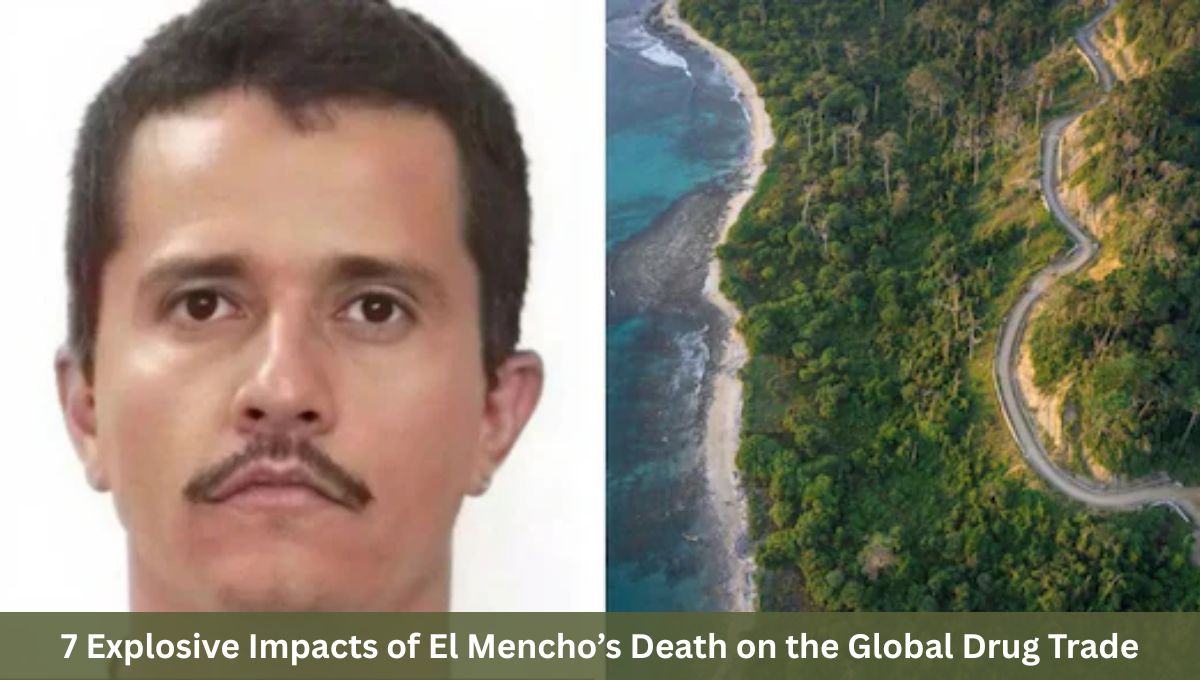
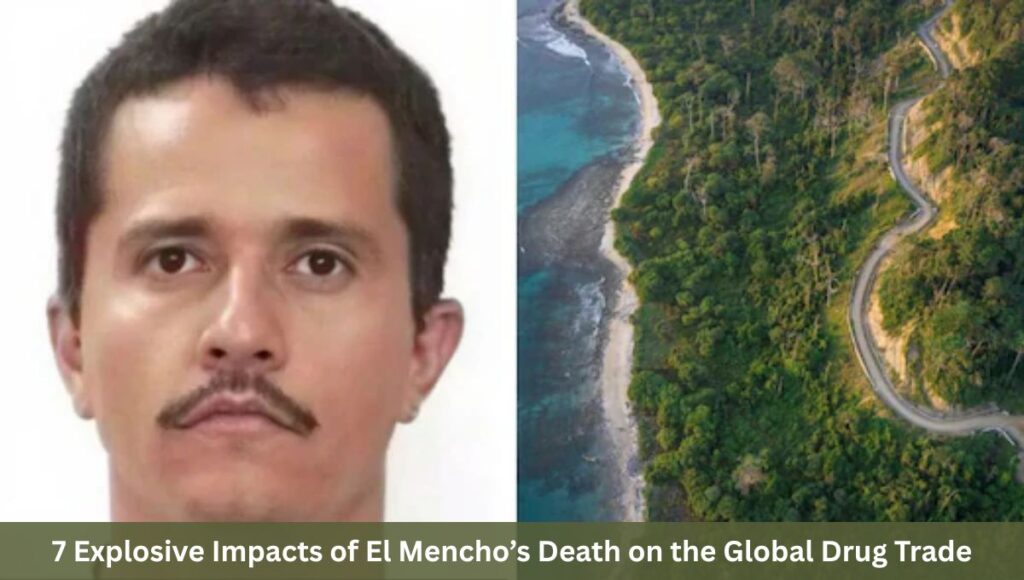
7 Explosive Impacts of El Mencho’s Death on the Global Drug Trade — from Mexico to Indian waters. The killing of Nemesio Rubén Oseguera Cervantes, better known as El Mencho, has triggered far-reaching consequences well beyond Mexico’s borders.
While his death has plunged several Mexican states into chaos, it has simultaneously delivered a strategic reprieve to law-enforcement agencies across Asia — particularly India — where his cartel’s shadowy operations had quietly expanded over the past decade.
From airport shutdowns in Mexico to intelligence alerts in New Delhi, El Mencho’s elimination marks one of the most consequential turning points in the global narcotics trade in recent years.
7 Explosive Impacts of El Mencho’s Death on the Global Drug Trade
Who Was El Mencho — And Why His Death Matters Globally
El Mencho, a former police officer born in 1966, rose to become the most feared figure in Mexico’s underworld as the leader of the Jalisco New Generation Cartel (CJNG). Under his command, CJNG transformed from a regional outfit into a transnational criminal enterprise operating across the Americas, Asia-Pacific, and parts of Europe.
The cartel’s reach extended far beyond cocaine and fentanyl trafficking into the United States. Intelligence agencies increasingly linked CJNG to large-scale methamphetamine production and maritime smuggling routes, including those passing through the Indian Ocean and the Andaman Sea.
El Mencho’s death during a Mexican military operation in Jalisco — aided by U.S. intelligence — has therefore disrupted not just a cartel, but a multi-continent narcotics architecture.
Coordinated Violence Across Mexico After the Killing
Following confirmation of El Mencho’s death, cartel operatives unleashed coordinated violence across nearly a dozen Mexican states. Buses were torched, highways blocked, and businesses shut down.
Major transport hubs were affected:
- Flights were cancelled at Cancún International Airport
- Disruptions spread to Lic. Benito Juárez International Airport
- Tourist hotspots like Puerto Vallarta and Guadalajara saw panic at airports and hotels
Several countries, including India, the United States, and Canada, issued travel advisories urging citizens to shelter in place.
Why Indian Agencies Are Quietly Relieved
While Mexico grapples with violent aftershocks, Indian security agencies view El Mencho’s death as a strategic gain in their long-running war against narcotics trafficking.
The Andaman & Nicobar Drug Seizure That Changed Everything
On November 25, 2024, the Indian Coast Guard intercepted a fishing trawler near the Andaman and Nicobar Islands, seizing 6,000 kg of methamphetamine valued at approximately ₹6,000 crore.
This seizure was unprecedented — not just for its size, but for what it revealed.
For the first time, Indian agencies uncovered evidence that Mexican and Chinese cartels were jointly operating in Indian waters.
The Mexico–China Drug Nexus Explained
Investigators traced the seized consignment to CJNG, with logistical and financial backing from Chinese networks led by Tse Chi Lop, widely known as Chinese El Chapo.
How the Network Worked
- Production: High-grade methamphetamine manufactured using advanced chemical precursors
- Logistics: Maritime routes through the Andaman Sea
- Manpower: Operatives recruited from Myanmar
- Distribution: India as a transit corridor to Thailand and Southeast Asia
Officials say narcotics of such purity and scale are beyond the capability of local syndicates, confirming the involvement of top-tier international players.
India’s Existing Drug War — And Why This Was Dangerous
India has long battled narcotics networks linked to Dawood Ibrahim and Pakistan’s ISI. However, the entry of Mexican and Chinese cartels represented a dangerous escalation.
According to intelligence officials:
- CJNG drugs were significantly higher in purity
- Demand surged rapidly across Asia-Pacific markets
- Indian waters were increasingly exploited as a low-risk transit zone
“El Mencho’s cartel didn’t just smuggle drugs — it industrialized trafficking,” one officer said.
The Andaman Sea: A Strategic Smuggling Corridor
The Andaman Sea emerged as a preferred route due to:
- Sparse maritime patrol coverage
- Proximity to Southeast Asian markets
- Access to multiple transshipment points
Since 2019, Indian agencies have documented repeated attempts by CJNG-linked networks to move methamphetamine through these waters, often using foreign crews and disguised fishing vessels.
Why El Mencho’s Death Disrupts Asia-Pacific Operations
El Mencho was not merely a cartel leader — he was a central coordinator.
- He controlled supply chains
- Managed cartel alliances
- Resolved disputes between transnational partners
His death weakens the Mexico–China partnership that once controlled an estimated 70% of the Asia-Pacific narcotics market, according to intelligence assessments.
US Military’s Role in the Hunt
A newly formed U.S. military-led unit, the Joint Interagency Task Force–Counter Cartel, played a critical intelligence role in locating El Mencho.
While the raid itself was executed by Mexican forces, U.S. surveillance, target mapping, and intelligence sharing proved decisive — highlighting Washington’s escalating involvement in cartel warfare.
Sports, Tourism, and Civil Life Disrupted
The fallout extended beyond security circles:
- Mexican league football matches postponed
- ATP Mexican Open faced uncertainty
- Hundreds of tourists stranded amid flight cancellations
Mexico’s efforts to project stability ahead of global sporting events have suffered a significant setback.
Does Killing El Mencho End the Threat?
Not entirely.
Experts warn that cartel decapitation often leads to fragmentation, spawning rival factions and fresh violence.
Mexican President Claudia Sheinbaum herself has expressed skepticism about the long-term effectiveness of kingpin takedowns.
However, in the short term, intelligence agencies agree on one thing:
Global narcotics flows have been disrupted.
What This Means for India and the World
For India, El Mencho’s death offers:
- Temporary relief from foreign cartel pressure
- Breathing space to strengthen maritime surveillance
- Opportunity to dismantle residual networks
For the world, it underscores a sobering reality — drug cartels now operate like multinational corporations, exploiting global trade routes, weak maritime governance, and international loopholes.
Conclusion: A Global Shockwave With Local Gains
The death of El Mencho marks a rare moment where a single operation has produced ripple effects across continents — from Mexico’s burning highways to the quiet waters of the Andaman Sea.
While the war on drugs is far from over, Indian agencies, at least for now, can count this development as a significant strategic victory in an increasingly globalised battle.
Also Read: Insights from Pakistan Navy’s $1 Billion Arabian Sea Drug Seizure