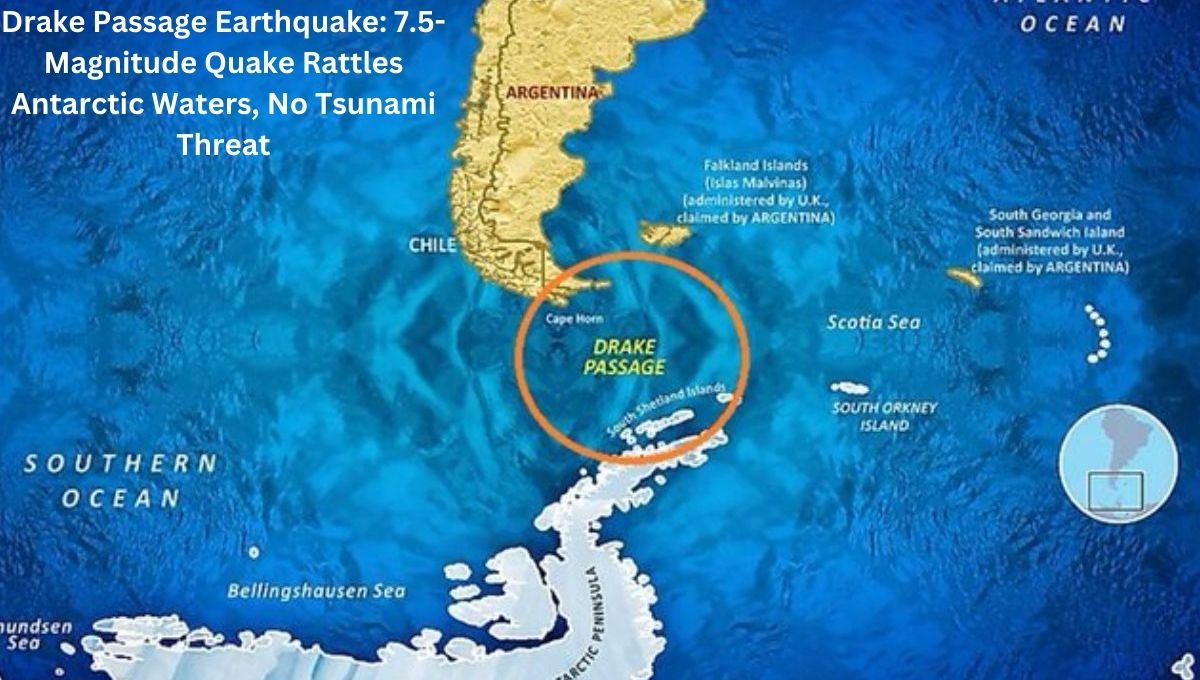
Powerful Drake Passage Earthquake: 7.5-Magnitude Quake Rattles Antarctic Waters, No Tsunami Threat. A 7.5-magnitude earthquake struck the Drake Passage, the turbulent stretch of water separating South America’s southern tip and Antarctica, late on Thursday. The United States Geological Survey (USGS) recorded the quake at a depth of about 10 kilometers (6.2 miles).
Although the earthquake triggered brief tsunami fears across the region, the US National Tsunami Warning Center (NTWC) confirmed that there was no active tsunami threat for the Puerto Rico and Virgin Islands region, nor for the South American mainland.
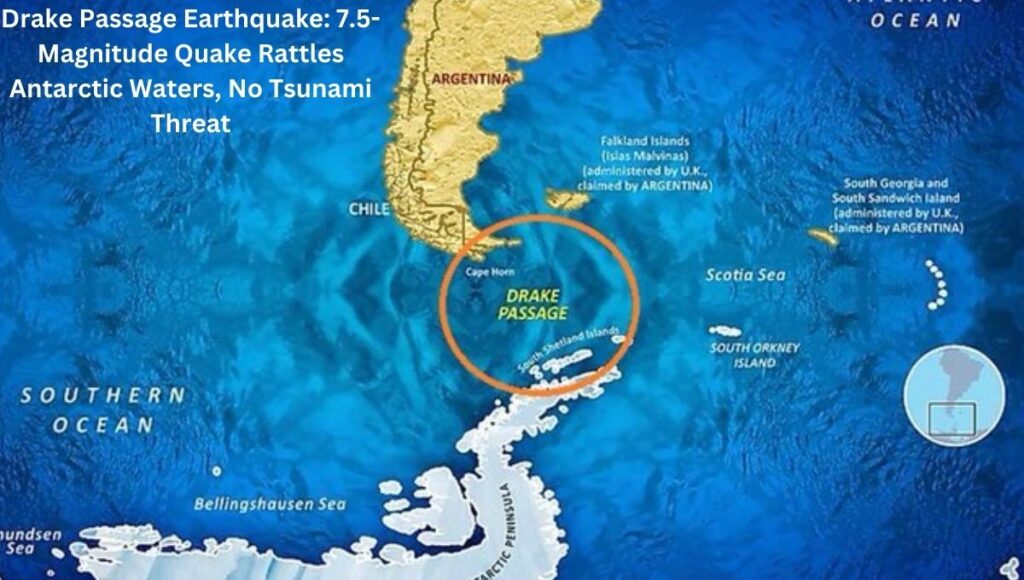
Drake Passage Earthquake: 7.5-Magnitude Quake Rattles Antarctic Waters, No Tsunami Threat
Where Did the Earthquake Strike?
The earthquake struck in the Drake Passage, a 500-mile-wide strait that connects the Atlantic and Pacific Oceans between Cape Horn in South America and the South Shetland Islands of Antarctica.
USGS initially reported the earthquake at magnitude 8.0 before revising it to 7.5 following further analysis.
The quake’s epicenter was more than 700 kilometers southeast of Ushuaia, Argentina, the southernmost city in the world.
No Tsunami Threat, Says NWS
After the quake, tsunami fears briefly spread across the Americas. However, the National Tsunami Warning Center quickly issued a statement confirming there was no tsunami threat to the Puerto Rico and Virgin Islands region, easing public concern.
The Pacific Tsunami Warning Center (PTWC) initially issued a precautionary alert for Chilean coastal areas and parts of the Antarctic territory, warning that hazardous waves could form.
Chile’s Navy Hydrographic and Oceanographic Service also released a precautionary bulletin. These alerts were lifted shortly after once assessments confirmed no significant risk.
Chilean and Regional Response
Chile’s national disaster response service (Senapred) described the quake as of “medium intensity”.
A precautionary alert was issued for Chile’s Antarctic bases, advising people to stay away from beaches and rocky shores until the all-clear was given.
A spokesperson for Chile’s Interior Ministry told AFP:
“There is no danger for the Magallanes region,” referring to the country’s southernmost inhabited area.
The quake occurred close to Chile’s Antarctic territory, prompting officials to remain cautious, especially given the region’s history of strong seismic activity.
A History of Earthquakes in the Region
The Drake Passage earthquake comes just months after a 7.4-magnitude quake struck southern Chile in May 2025, triggering widespread tsunami alerts and coastal evacuations in the Magallanes region.
At that time, President Gabriel Boric urged citizens to evacuate coastal areas and emphasized preparedness, saying:
“At this time, our duty is to be prepared and heed the authorities. Regional and national COGRID is underway. All state resources are available.”
These repeated earthquakes highlight the volatile seismic environment near the southern tip of South America, where the Nazca, Antarctic, and South American tectonic plates converge.
Puerto Rico and Virgin Islands Tsunami Concerns
The mention of Puerto Rico and the Virgin Islands in official tsunami bulletins caused concern among residents thousands of miles away from the quake’s epicenter.
Social media platforms quickly filled with questions about possible impacts.
The National Tsunami Warning Center reassured that the 7.5-magnitude earthquake in the Drake Passage posed no tsunami risk to these territories.
The Caribbean region, while prone to hurricanes, is less frequently affected by tsunamis, but authorities remain vigilant given the Atlantic’s complex tectonic activity.
“Drake Shake” vs. “Drake Lake” – The Passage’s Reputation
The Drake Passage has long been notorious among sailors and travelers for its rough seas, often described as the “Drake Shake.”
Storms and massive swells frequently batter ships navigating between Cape Horn and Antarctica.
In April 2025, a viral video showed a 40-foot wave crashing into a luxury cruise ship crossing the Drake Passage.
Passengers documented the ordeal online, describing the journey as a “48-hour rollercoaster.” Despite the intensity, the vessel and its passengers were unharmed.
Seafarers say the passage alternates between the calmer “Drake Lake” and the ferocious “Drake Shake.” The region’s reputation adds drama to natural events like Thursday’s earthquake.
International Monitoring and Reports
Global seismic monitoring agencies also registered the quake.
- German Research Center for Geosciences measured the magnitude at 7.1.
- National Center for Seismology (India) reported a 7.4-magnitude quake at a depth of 36 kilometers.
- USGS confirmed the final reading at 7.5 magnitude, depth 10 km.
This slight variation in reported magnitudes is common, as different agencies use separate monitoring networks and calculation methods.
Comparisons to Previous Quakes
The recent Drake Passage earthquake recalls earlier powerful quakes in the Pacific and Southern Oceans.
Just weeks earlier, in late July, an 8.8-magnitude quake struck Russia’s Far East, triggering tsunami waves that reached Japan and Alaska.
That event prompted warnings across the Pacific Ocean, with authorities in Hawaii, North America, and New Zealand urging coastal evacuations.
Unlike that disaster, however, Thursday’s quake produced no significant tsunami waves, sparing coastal communities from further distress.
Why the Drake Passage Is So Seismically Active
The Drake Passage’s geological position makes it one of the most seismically active waterways in the world.
It lies along the boundary of major tectonic plates, including the South American Plate, the Scotia Plate, and the Antarctic Plate.
Constant pressure and shifting beneath the seafloor trigger earthquakes, while the region’s fierce storms often amplify risks for ships and researchers operating in Antarctic waters.
Safety Protocols in Place
Authorities across South America and Antarctica regularly rehearse emergency protocols due to the unpredictable seismic activity.
Coastal evacuation routes, communication systems, and coordination with global tsunami warning centers remain critical in responding to potential disasters.
Experts emphasize that while Thursday’s quake did not cause major damage, it serves as another reminder of the constant risks posed by seismic events in the southern hemisphere.
Conclusion: Preparedness Over Panic
The 7.5-magnitude Drake Passage earthquake was powerful enough to rattle nerves across the Southern Hemisphere, but fortunately, it posed no tsunami threat to Puerto Rico, the Virgin Islands, or South America’s mainland coasts. Still, the quake underscores the importance of disaster preparedness in a region where seismic shocks are a recurring reality.
As the Drake Passage continues to earn its reputation as both the Drake Shake and Drake Lake, residents, travelers, and researchers remain watchful of the powerful forces at play beneath the ocean floor.
Also Read: Why the Kamchatka 8.8 Earthquake Didn’t Turn into a Global Tsunami Disaster
Also Read: Drake Passage earthquake: NWS addresses tsunami fears in Puerto Rico, Virgin Islands
Related Posts:
- Another Earthquake Strikes Afghanistan After 1,400…

- 6.3-Magnitude Earthquake Devastates Northern Afghanistan

- Afghanistan Earthquake 2025: Over 600 Killed, 1,500…

- Massive 8.8 Earthquake Hits Russia’s Kamchatka,…
- 600-Year Dormant Russian Volcano Erupts After…

- Why the Kamchatka 8.8 Earthquake Didn't Turn into a…