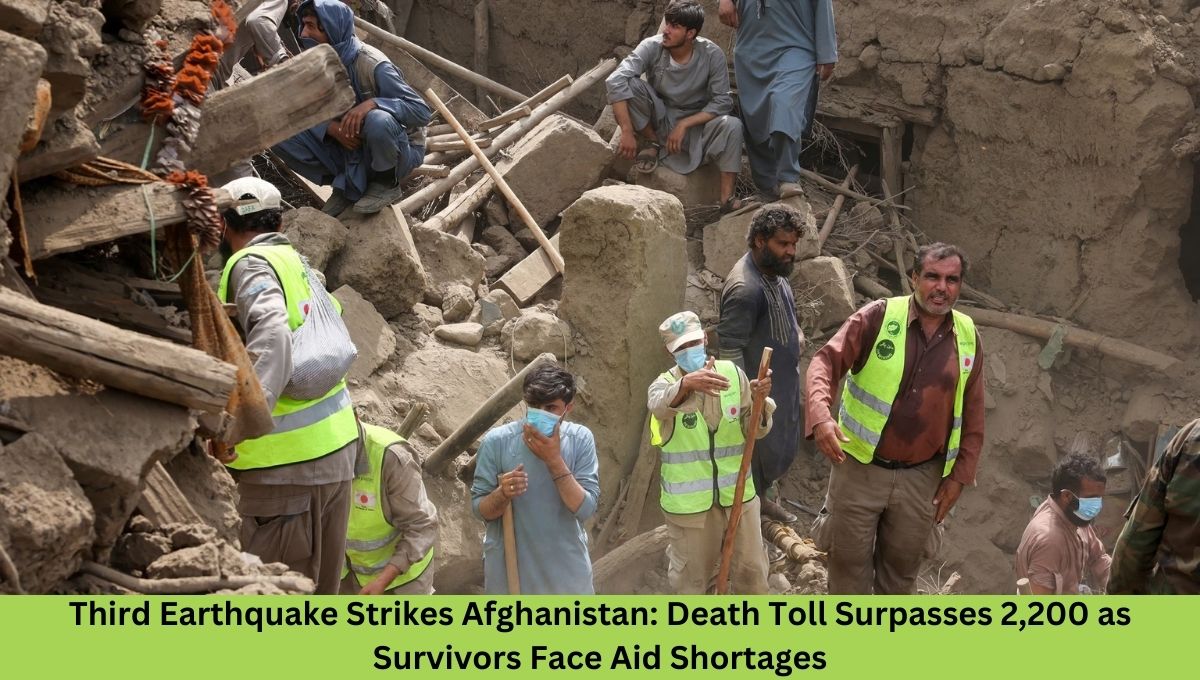
In succession, a Third Earthquake Strikes Afghanistan: Death Toll Surpasses 2,200 as Survivors Face Aid Shortages. Afghanistan is reeling after a third powerful earthquake struck its southeastern region, devastating already fragile communities and pushing the death toll past 2,200 people. Entire villages in Kunar and Nangarhar provinces have been flattened, leaving tens of thousands homeless as aid agencies warn of an escalating humanitarian catastrophe.
The magnitude 6.2 quake on Thursday evening, recorded by the German Research Centre for Geosciences (GFZ), struck at a shallow depth of 10 km. It followed two earlier tremors a 6.0-magnitude quake on Sunday and a 5.5-magnitude aftershock on Tuesday that had already caused widespread destruction.
Afghanistan, located on the collision point of the Indian and Eurasian tectonic plates, is no stranger to earthquakes. Yet the scale of devastation in recent days marks one of the deadliest disasters the country has faced in decades.
Third Earthquake Strikes Afghanistan: Death Toll Surpasses 2,200 as Survivors Face Aid Shortages
The Sequence of Quakes
Sunday’s Deadly Quake
On Sunday night, a 6.0-magnitude earthquake struck Kunar and Nangarhar provinces, toppling thousands of mud-brick homes while families slept. The Taliban administration reported at least 2,205 deaths and 3,640 injuries, with entire villages reduced to rubble.
Authorities estimate that over 6,700 homes were destroyed. According to Islamic Relief, as many as 98% of buildings in Kunar province were either destroyed or damaged, leaving communities exposed to the elements.
Tuesday’s Aftershock
Two days later, a 5.5-magnitude quake rattled the same mountainous region. Though smaller, it triggered landslides that blocked access to remote villages and temporarily halted rescue operations.
The aftershock compounded fears among survivors, many of whom refused to return to their damaged homes.
Thursday’s Magnitude 6.2 Quake
The latest tremor, measuring 6.2, struck near the remote Shiwa district of Nangarhar province at 20:56 local time. Strong shaking was felt across eastern Afghanistan and even across the border in Delhi NCR and Jammu & Kashmir in India, where residents reported trembling buildings but no casualties.
Initial reports suggest further damage in Barkashkot and surrounding areas, though details remain scarce as communications and transport links remain severely disrupted.
Rising Death Toll and Human Suffering
The Taliban government confirmed that the combined death toll from the series of earthquakes has risen to 2,205 people, with over 3,600 injured. In some villages, two-thirds of the population has either been killed or wounded.
Witness accounts paint a harrowing picture.
“Everything we had has been destroyed. The only remaining things are these clothes on our backs,” said Aalem Jan, a resident of Kunar province, whose house was flattened by the tremors.
Survivors can be seen digging graves with pickaxes, carrying bodies on woven stretchers, and sitting under trees with their remaining belongings. Entire families remain missing under collapsed structures.
The United Nations Office for the Coordination of Humanitarian Affairs (OCHA) warned that the true toll could rise further as many remain trapped beneath rubble.
Aid Shortages Amid Humanitarian Crisis
UN and International Aid Response
The United Nations has released emergency funds, while the UK pledged £1 million ($1.3m) in assistance. The World Health Organization (WHO) has appealed for $4 million to deliver emergency health interventions and deploy mobile clinics.
The World Food Programme (WFP), however, warned it only has stocks to support survivors for four more weeks. “The humanitarian needs are vast and growing rapidly,” said John Aylieff, WFP’s country head.
Struggle on the Ground
Rescue efforts are hampered by Afghanistan’s mountainous terrain and poor infrastructure. Helicopters have been the main lifeline, conducting over 150 flights in two days to evacuate injured survivors from remote districts. Commando forces were airdropped into areas inaccessible by road.
Still, aid is arriving too slowly for many. In Nurgal district, hundreds of villagers are stranded in the open air, surviving under makeshift tarps. In some areas, fights broke out over food distribution.
“Yesterday, some people brought food, everyone rushed at once. People are starving, we haven’t had anything to eat for a long time,” said Zahir Khan Safi, a 48-year-old survivor.
Healthcare Under Strain
Local hospitals are overwhelmed. The WHO emergency team warned that facilities face shortages of trauma supplies, medicines, and staff, with the situation described as “immense and rapidly deteriorating.”
“Every hour counts,” said Jamshed Tanoli, WHO’s emergency lead in Afghanistan. “Hospitals are struggling, families are grieving, and survivors have lost everything.”
Survivors Living in Fear
Thousands of people are now living outdoors, fearing further aftershocks. Makeshift camps with tarpaulin shelters dot quake-hit valleys, while families huddle together in fields under harsh weather conditions.
Villagers described the terror of continuous tremors.
“Everyone is afraid, and there are many aftershocks. We spend all day and night in the field without shelter,” said Awrangzeeb Noori, from Darai Nur in Nangarhar.
The destruction of mud-brick and timber homes common in Afghanistan’s rural areas has left survivors with nowhere safe to return. The unstable ground, further weakened by recent rains, increases the risk of landslides.
International Isolation and Aid Challenges
Afghanistan’s Taliban government, recognized internationally only by Russia, has appealed for more global support. But international aid remains limited due to strained relations and restrictions imposed by the Taliban, particularly on women aid workers.
The country is already suffering from endemic poverty, severe drought, and the return of millions of Afghan refugees expelled from Pakistan and Iran since the Taliban’s takeover in 2021.
The withdrawal of U.S. foreign aid in January 2025, coupled with donor fatigue, has worsened Afghanistan’s humanitarian isolation. Aid agencies describe the quake as a “crisis within a crisis.”
“The earthquake should serve as a stark reminder: Afghanistan cannot be left to face one crisis after another alone,” said Jacopo Caridi of the Norwegian Refugee Council.
Afghanistan’s Earthquake Vulnerability
Afghanistan lies in the Hindu Kush mountain range, one of the most seismically active zones in the world. The collision of tectonic plates makes the region prone to frequent earthquakes, often shallow and highly destructive.
The country’s poorly constructed housing made of stone, dry masonry, and timber makes communities especially vulnerable. Entire villages can collapse in seconds when struck by a strong tremor.
Recent Deadly Quakes in Afghanistan
- 2023: A series of 6.3-magnitude earthquakes in Herat killed more than 1,400 people and destroyed 63,000 homes.
- 2022: A 5.9-magnitude quake in eastern Afghanistan killed 1,000 people and injured another 3,000.
The latest series of tremors may prove to be the deadliest in decades, surpassing previous disasters in scale and human loss.
Global Calls for Action
As rescue efforts continue, aid agencies are urging donors not just to deliver emergency relief, but also to invest in long-term resilience.
“Afghanistan’s cycle of disaster and poverty must be broken. Beyond life-saving aid, survivors need a chance at recovery and rebuilding,” said a statement from Islamic Relief Worldwide.
The UNHCR chief, Filippo Grandi, noted that more than 500,000 people have been directly or indirectly affected by the recent quakes, describing the scale of displacement as “immense.”
For survivors in Kunar and Nangarhar, however, the focus remains on the immediate struggle for survival: finding food, water, and a safe place to sleep.
Also Read: Iran dispatches 100-ton humanitarian shipment to quake-stricken Afghanistan
Conclusion
The series of earthquakes striking Afghanistan over just six days has created one of the worst humanitarian disasters in recent history for the country. With over 2,200 dead, thousands injured, and tens of thousands homeless, the crisis is far from over.
Aid shortages, international isolation, and Afghanistan’s fragile infrastructure are combining to create a catastrophe within a catastrophe. For survivors, each aftershock brings new terror, while each day without aid brings deeper suffering. Unless the international community responds swiftly and generously, Afghanistan risks slipping further into despair.
Also Read: Afghan Women Left to Die After Earthquake as Taliban’s Sharia Ban Blocks Male Rescuers
Related Posts:
- Another Earthquake Strikes Afghanistan After 1,400…
- Afghanistan Earthquake 2025: Over 600 Killed, 1,500…
- Afghanistan Earthquake 2025: Over 800 Dead as…
- 6.3-Magnitude Earthquake Devastates Northern Afghanistan
- 6.1-Magnitude Earthquake Rocks Western Türkiye:…
- 6.1 Magnitude Earthquake Strikes Turkey’s Balikesir…