
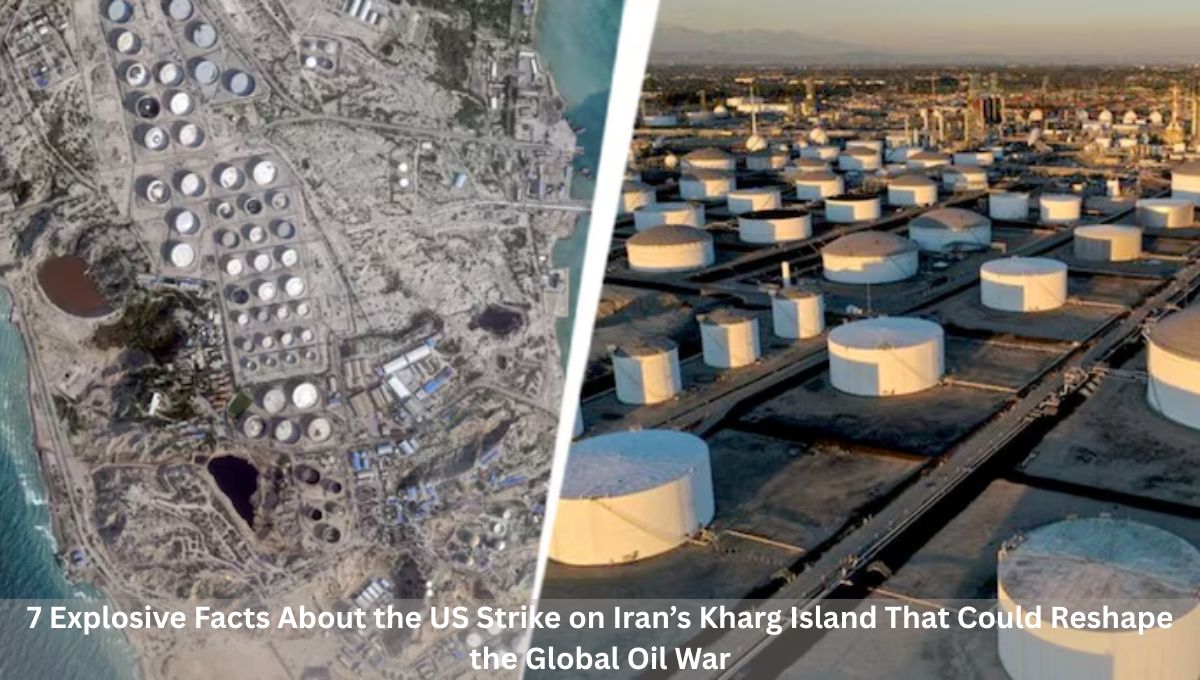
7 Explosive Facts About the US Strike on Iran’s Kharg Island That Could Reshape the Global Oil War and shake the global economy. Tensions in the Middle East have surged dramatically after the United States launched a powerful airstrike targeting military facilities on Iran’s Kharg Island, a strategic oil hub in the Persian Gulf. The operation, ordered by Donald Trump, marks one of the most significant escalations in the ongoing regional conflict involving Iran, Israel, and several Western allies.
Kharg Island is not just another military target—it is widely considered the backbone of Iran’s oil export system. Nearly 90 percent of the country’s crude oil exports flow through this small island, making it a crucial economic and strategic asset for Tehran.
While the United States claims the strike targeted only military infrastructure, the attack has raised fears that the war could shift toward energy infrastructure, which could dramatically impact the global oil market.
With oil prices already surging and the Strait of Hormuz facing disruptions, analysts warn that the attack could mark a turning point in the broader Middle East conflict.
This article breaks down what happened, why Kharg Island matters, how the strike unfolded, and what the potential global consequences might be.
7 Explosive Facts About the US Strike on Iran’s Kharg Island That Could Reshape the Global Oil War
What Happened During the US Strike on Kharg Island
The United States carried out a massive bombing operation on Kharg Island, targeting Iranian military sites located on the strategic island in the Persian Gulf.
According to statements from United States Central Command, the strikes focused on destroying military infrastructure including:
- Radar installations
- Missile launch systems
- Air defense batteries
- Command and control facilities
President Donald Trump described the operation as one of the “most powerful bombing raids in the history of the Middle East.”
In a public statement, he claimed the strikes “totally obliterated every military target” on the island.
However, the United States deliberately avoided hitting the island’s oil terminals and storage facilities. Trump said the decision was made “for reasons of decency.”
But he also issued a stark warning.
If Iran continues interfering with shipping in the Strait of Hormuz, the United States could reconsider and directly target the oil infrastructure.
That threat alone has already rattled energy markets worldwide.
Why Kharg Island Is So Important
The Heart of Iran’s Oil Economy
Though small in size, Kharg Island plays an outsized role in Iran’s economy.
The island handles roughly:
- 90% of Iran’s crude oil exports
- Nearly 950 million barrels of oil annually
- Up to 7 million barrels of loading capacity per day
Pipelines from Iran’s largest oil fields feed directly into the island’s massive storage tanks.
These fields include:
- Ahvaz
- Marun
- Gachsaran
Oil from offshore fields like Aboozar, Forouzan, and Dorood is also transported through subsea pipelines to the island.
From there, giant supertankers ship the crude primarily to Asian markets, including China and India.
The island’s deep-water port allows massive tankers to dock safely—something much of Iran’s shallow coastline cannot support.
Because of this infrastructure, Kharg Island functions as Iran’s primary gateway to global oil markets.
A Tiny Island With Massive Strategic Value
Despite covering just about 20 square kilometers, Kharg Island holds immense strategic significance.
Located roughly 28 kilometers off the Iranian mainland, the island lies near critical shipping routes in the Persian Gulf.
Its proximity to the Strait of Hormuz—the world’s most important oil transit chokepoint—makes it even more critical.
Around 20 percent of the world’s oil supply passes through this narrow waterway. Any disruption to shipping there can instantly send global energy markets into turmoil.
Iran has previously threatened to close the strait during conflicts, using it as leverage against Western powers.
If Kharg Island’s facilities were destroyed, analysts say Iran’s ability to export oil would collapse almost overnight.
That would not only cripple Tehran’s economy but also reshape the global oil market.
A Conflict That Has Rapidly Escalated
The strike on Kharg Island came amid an already intensifying regional conflict involving Iran and Israel.
Since the war began on February 28, thousands of targets have reportedly been struck across Iran.
According to U.S. officials, more than 15,000 military targets have been attacked in the country since the start of the campaign.
Meanwhile, Iranian missile and drone attacks have targeted Israel and multiple Gulf states.
Countries affected include:
- Israel
- Bahrain
- United Arab Emirates
- Oman
Iran has also threatened attacks on energy facilities belonging to companies cooperating with the United States.
The conflict has already killed thousands across the region, with civilians in several countries caught in the crossfire.
The Strait of Hormuz Crisis
At the center of the geopolitical standoff lies the Strait of Hormuz.
This narrow maritime corridor connects the Persian Gulf to the global ocean and serves as a key artery for global energy supply.
Roughly one-fifth of the world’s traded oil passes through the strait every day.
During the conflict, Iran has effectively restricted shipping traffic in the area. Several incidents involving attacks on commercial vessels have been reported.
In response, the United States has announced plans to deploy naval escorts for tankers moving through the strait.
This move aims to protect shipping lanes and stabilize global oil supplies. However, it also increases the risk of direct confrontation between Iranian and U.S. naval forces.
Could the US Invade Kharg Island?
Military analysts say the bombing of Kharg Island may be only the beginning.
Some experts believe the United States could attempt a ground operation to seize control of the island.
Because Kharg is small and located offshore, it could be easier to capture than mainland Iranian territory.
Such an operation would likely involve:
Phase 1: Air Defence Suppression
U.S. forces would first destroy Iranian radar systems and missile batteries.
This step would ensure safe entry for aircraft and ships.
Phase 2: Special Forces Landing
Elite units such as Navy SEALs and Army Rangers could conduct a rapid assault to secure the island’s airstrip.
Phase 3: Reinforcements Arrive
Transport aircraft like the C-130 Super Hercules and helicopters such as the Boeing CH‑47 Chinook would bring additional troops.
Phase 4: Control of Oil Infrastructure
Once secured, troops would protect oil terminals and establish a defensive perimeter. However, such a move would carry significant risks.
Iran could launch missile attacks from the mainland or deploy drone swarms against occupying forces.
Global Oil Markets React
The attack has already had immediate consequences for global energy markets. Oil prices surged toward $100 per barrel following the escalation.
Energy analysts warn that targeting Kharg Island could create severe disruptions in global oil supply.
Iran is among the largest producers in Organization of the Petroleum Exporting Countries. Any prolonged shutdown of its exports could tighten global energy supplies significantly.
At the same time, retaliation by Iran could target energy infrastructure across the Gulf region.
That includes oil facilities in countries such as:
- Saudi Arabia
- Kuwait
- United Arab Emirates
Such attacks could spark a full-scale energy crisis.
Iran’s Response and Threats
Iran has responded to the strike with strong warnings. Military leaders have said any attack on Iranian energy infrastructure will trigger retaliation against oil installations linked to U.S. allies.
Officials in Tehran also warned that the country could escalate its actions in the Strait of Hormuz. Closing the strait would disrupt global energy trade on an unprecedented scale.
Iran has also expanded cyber operations and reportedly targeted technology infrastructure linked to Western companies.
Analysts say the conflict is rapidly evolving into a multi-domain war involving:
- Military strikes
- Cyber warfare
- Economic disruption
- Maritime conflict
A War That Could Reshape the Middle East
The strike on Kharg Island represents a major turning point in the regional conflict.
If the island’s oil infrastructure becomes a target, it could devastate Iran’s economy. At the same time, it could push the Middle East toward a much broader war.
Several key questions remain unanswered:
- Will the United States escalate toward a ground invasion?
- Will Iran retaliate against global oil infrastructure?
- Can shipping remain open in the Strait of Hormuz?
The answers to these questions could determine not only the future of the conflict—but also the stability of the global economy.
Conclusion
The U.S. bombing of Kharg Island has dramatically raised the stakes in the ongoing Middle East conflict.
While the initial strike targeted military infrastructure, the island’s role as Iran’s primary oil export hub makes it one of the most sensitive strategic locations in the region.
For now, the oil facilities remain intact.
But the warnings from both sides suggest the conflict could soon expand into a battle over energy infrastructure.
If that happens, the consequences will extend far beyond the Middle East—potentially reshaping global energy markets, international diplomacy, and geopolitical power balances for years to come.
Also Read: 7 Critical Impacts of the Strait of Hormuz Crisis as U.S.–Iran War Disrupts Global Oil Markets
Also Read: US attacks military sites on Iran’s Kharg island, home to vast oil facility
Related Posts:
- 7 Critical Reasons Kharg Island Is Iran’s Oil “Crown…

- 3 Explosive Conditions Iran Sets to End War with US…

- 10 Explosive Warnings as Donald Trump Calls Iran…
- 10 Powerful Revelations from the Trump–Putin Call on…

- 10 Explosive Signals Trump Says Iran War Could End…
- 10 Explosive Strikes: Israel Bombs Tehran Oil Depots…
