12 Explosive Updates from Day 12 of the US-Israel War with Iran amid a worsening humanitarian crisis. The war between the United States, Israel, and Iran has entered its 12th day, and the conflict has already reshaped geopolitics across the Middle East. What began with a wave of coordinated strikes against Iranian leadership and military infrastructure has escalated into one of the most volatile regional confrontations in decades.
Over the past two weeks, the conflict has expanded beyond Iran and Israel to involve Lebanon, Iraq, the Gulf states, and critical global shipping routes. Missiles and drones have struck cities, military bases, and energy infrastructure across the region, while international markets have reacted sharply to the threat of disruptions to global oil supplies.
Day 12 of the conflict has proven especially dramatic. Overnight strikes targeted Tehran and northern Iran, while Iranian forces launched what they described as their “most intense operation” of the war. Gulf nations scrambled to intercept missiles and drones, and a humanitarian crisis deepened as thousands more civilians were displaced.
From escalating military operations to economic shockwaves and mounting civilian casualties, here are the key developments shaping the war on its twelfth day.
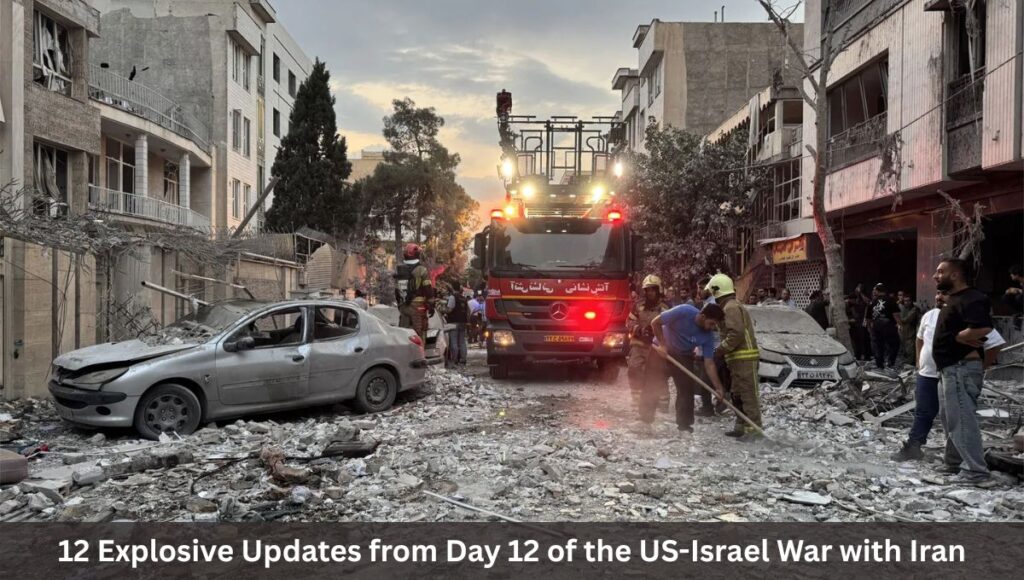
12 Explosive Updates from Day 12 of the US-Israel War with Iran
The Intensifying Air War
Israeli Strikes Hit Tehran and Northern Iran
Israel carried out another wave of airstrikes overnight, targeting locations across the Iranian capital Tehran and several northern regions of the country.
Iranian emergency authorities reported that at least one residential neighborhood in Tehran was struck, prompting rescue operations by the Iranian Red Crescent.
Witnesses described the bombardment as among the most intense attacks since the war began.
Residents in Tehran reported hearing multiple explosions across the city overnight. Several neighborhoods experienced power outages following strikes on nearby infrastructure.
In northern Iran, journalists and local residents reported large-scale nighttime bombardments, suggesting that Israeli forces were expanding the scope of their operations beyond previously targeted military facilities.
These attacks come as Israel continues its strategy of targeting:
- Iranian missile systems
- military bases
- nuclear-related facilities
- command and intelligence centers
The strikes are designed to weaken Iran’s ability to coordinate retaliatory attacks and maintain control of its military network.
Beirut Also Targeted in Expanding War
Beyond Iran, Israeli airstrikes continued in Lebanon, where Israel is targeting the Iran-backed militant group Hezbollah.
Footage circulating online showed parts of a high-rise building in Beirut engulfed in flames, following a strike believed to be aimed at Hezbollah infrastructure.
In southern Lebanon, tragedy struck when an Israeli strike hit a Red Cross ambulance, killing a paramedic and injuring several others.
Lebanon has become a significant secondary front in the war. Hezbollah has launched numerous rocket attacks into northern Israel in support of Iran, prompting repeated Israeli airstrikes on Lebanese territory.
The violence has displaced hundreds of thousands of civilians and triggered one of the largest humanitarian crises in Lebanon in years.
Iran Launches Its “Most Intense Operation”
Massive Missile and Drone Attacks
Iran’s military announced that it launched its “most intense and heaviest operation” since the war began.
The attacks targeted:
- Israeli cities
- US military bases
- American diplomatic facilities
- allied targets across the Middle East
Iranian state media described the operation as a multi-layered strike using ballistic missiles, drones, and cruise missiles.
Sirens sounded across central Israel as missiles approached, forcing millions of residents to take shelter in bunkers and safe rooms.
Israeli air defense systems intercepted many of the incoming missiles, but authorities did not immediately confirm how many were successfully stopped.
Attacks Spread Across the Gulf Region
The conflict is increasingly spilling into Gulf nations, raising fears that the war could escalate into a region-wide confrontation.
Several Gulf states reported intercepting Iranian missiles and drones overnight.
Saudi Arabia
Saudi air defense systems intercepted six ballistic missiles and multiple drones targeting key military installations.
One of the missiles was reportedly heading toward Prince Sultan Air Base, which hosts US military forces.
United Arab Emirates
The UAE confirmed that its air defenses were actively intercepting Iranian drones and missiles. Authorities urged residents to remain indoors and avoid travel during the attacks.
Bahrain
Warning sirens sounded across Bahrain as missiles approached the country’s airspace. The government ordered residents to seek immediate shelter.
Kuwait
Kuwaiti authorities reported intercepting several drones that had entered the country’s airspace.
The widespread attacks highlight Iran’s ability to strike across the region despite ongoing bombardment of its military infrastructure.
Rising Threats to Global Energy Supplies
Strait of Hormuz Becomes Central Battleground
One of the most dangerous developments of the war involves the Strait of Hormuz, a narrow waterway that carries roughly 20 percent of the world’s oil supply.
Iran has repeatedly threatened to block the strait if US and Israeli attacks continue.
American officials said US forces recently destroyed 16 Iranian mine-laying vessels believed to be preparing to deploy naval mines in the waterway.
The US military said the operation was a preemptive strike to protect global shipping lanes.
Iran’s Revolutionary Guard Corps responded by declaring that it would prevent oil shipments from reaching US allies if attacks against Iran continued.
Ships Damaged in Suspicious Attacks
Two commercial vessels were reportedly damaged in separate incidents linked to the conflict.
- A cargo ship in the Strait of Hormuz caught fire after being struck by an unknown projectile.
- Another vessel near the coast of the United Arab Emirates suffered damage from a suspected missile or drone strike.
These incidents highlight the growing danger to global maritime trade routes.
Any disruption to the Strait of Hormuz could send shockwaves through the global economy, causing major spikes in oil prices and energy shortages worldwide.
Toxic “Black Rain” Raises Health Concerns
Another alarming development from the war is the emergence of toxic “black rain” in parts of Iran.
The World Health Organization has warned that heavy pollution from burning fuel depots and oil facilities could mix with rainfall, creating contaminated precipitation.
This phenomenon occurs when soot and toxic chemicals from large fires combine with moisture in the atmosphere and fall as dark, polluted rain.
Health experts warn that exposure to such rainfall could cause:
- respiratory illness
- skin irritation
- long-term environmental contamination
Large plumes of black smoke have been rising over Tehran since oil facilities were struck earlier in the conflict.
Mounting Humanitarian Crisis
Civilian Death Toll Surges
The human cost of the war continues to rise rapidly.
Iran’s ambassador to the United Nations reported that more than 1,300 Iranian civilians have been killed since the conflict began. Thousands more have been injured.
Iranian officials say that strikes have destroyed:
- nearly 8,000 homes
- more than 1,600 commercial facilities
- dozens of hospitals, schools, and energy installations
Across the region, the death toll continues to climb.
In Lebanon, the United Nations says Israeli strikes have killed more than 10 children every day since the conflict began.
US Military Casualties
The United States has also suffered losses during the war.
According to the Pentagon:
- Seven US service members have been killed
- Around 140 troops have been wounded
Most of the injured soldiers have already returned to duty, but several remain hospitalized with serious injuries.
The casualties underscore the growing risks faced by American forces stationed across the Middle East.
Displacement Crisis in Lebanon
Lebanon has emerged as one of the hardest-hit countries in the expanding conflict. According to UN estimates, more than 667,000 people have been displaced by the fighting.
Many displaced families are now sheltering in:
- schools
- public buildings
- vehicles
- temporary camps
Large numbers of refugees have also crossed into neighboring Syria.
Humanitarian organizations warn that the displacement crisis could worsen dramatically if airstrikes continue.
Iran Cracks Down on Internal Dissent
Inside Iran, the government has moved to tighten security amid fears of domestic unrest.
Iranian authorities warned that anyone attempting to organize protests during the war would be treated as an enemy of the state.
Police chief Ahmadreza Radan said security forces had “their fingers on the trigger” to confront any demonstrations.
Authorities have also arrested dozens of individuals accused of spying for foreign governments.
The crackdown comes as some Iranian citizens have expressed anger at the government over the war and its economic consequences.
Political Stakes: War Without a Clear End
Trump’s Demands for “Unconditional Surrender”
The White House has outlined broad demands for what it calls Iran’s unconditional surrender.
US officials say the requirements include:
- dismantling Iran’s ballistic missile program
- ending support for regional militant groups
- abandoning nuclear ambitions
However, President Donald Trump has indicated that the final definition of surrender would ultimately be determined by him.
The lack of a clear diplomatic roadmap has raised concerns among international observers that the war could drag on longer than expected.
Iran Refuses to Back Down
Iran’s leadership has rejected calls for surrender. Senior Iranian officials say the country will continue fighting as long as necessary.
Iran’s parliament speaker said the country believes the aggressor must be “punched in the mouth” so it never attacks again.
These statements signal that neither side is currently prepared to de-escalate the conflict.
Global Economic Shockwaves
Oil Markets Swing Wildly
The war has already triggered major volatility in global energy markets.
Oil prices briefly surged to nearly $120 per barrel earlier in the conflict before falling back to around $90.
The dramatic swings reflect investor fears that the war could disrupt oil supplies from the Persian Gulf.
To stabilize markets, international energy authorities have discussed releasing large amounts of oil from strategic reserves.
International Flights and Trade Disruptions
The war has also disrupted travel and international trade.
Several airlines have suspended flights to parts of the Middle East due to security risks. Thousands of foreign nationals have evacuated the region.
The conflict has also slowed shipping activity in the Persian Gulf, increasing insurance costs for cargo vessels.
What Comes Next?
After twelve days of intense fighting, the war shows few signs of slowing down.
Both sides continue to escalate their military operations while issuing increasingly aggressive rhetoric.
Key questions remain unanswered:
- Will the conflict expand into a full regional war?
- Can global energy supplies remain stable?
- Will diplomatic efforts succeed in ending the fighting?
For now, millions of people across the Middle East remain caught in the middle of a conflict that is rapidly reshaping the region.
Also Read: 7 Shocking Reasons Trump Says Oil Spike Is “Worth It” to Stop Iran
Also Read: Could Iran be using China’s highly accurate BeiDou navigation system?
Related Posts:
- 10 Explosive Warnings as Donald Trump Calls Iran…
- 10 Explosive Strikes: Israel Bombs Tehran Oil Depots…

- 10 Explosive Signals: Trump Rates Iran War “15/10”…
- Trump’s 20-Point Gaza Peace Plan Gains Urgent Global…

- In 8 Moves, EU Targets China-Linked Refineries and…

- 7 Stunning Strikes: Iran Claims Destruction of US…