
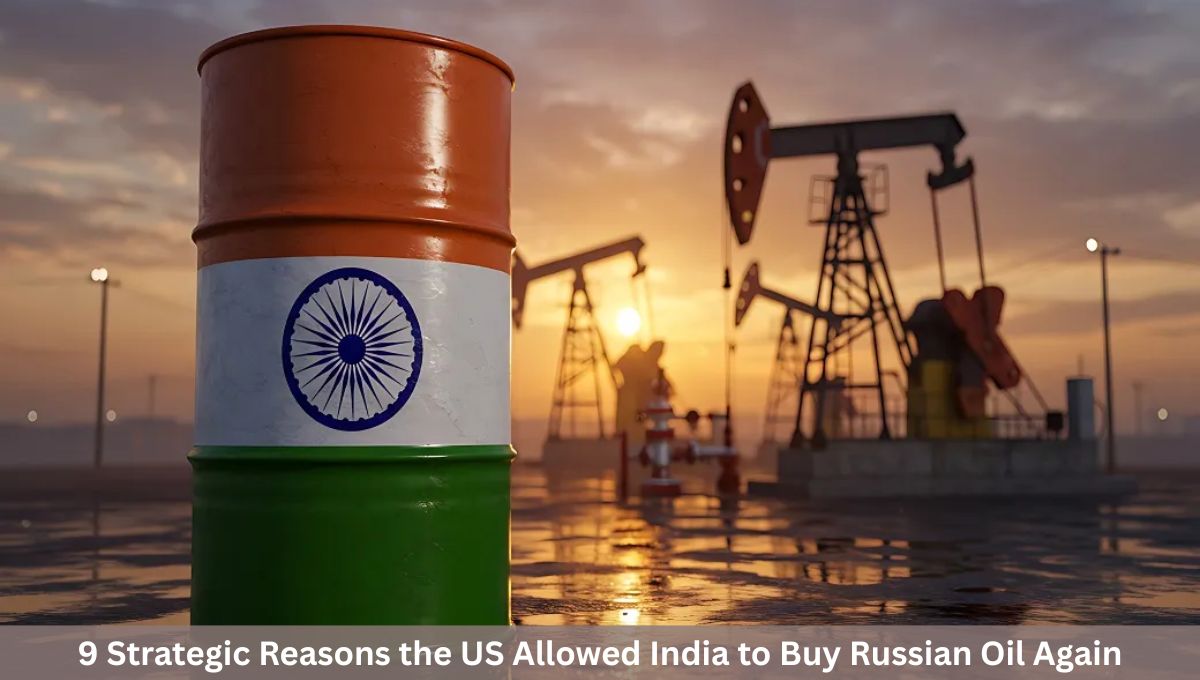
9 Strategic Reasons the US Allowed India to Buy Russian Oil Again amid rising global energy tensions. The United States has taken a surprising but calculated step in the global energy market by temporarily allowing India to purchase Russian crude oil again. The move comes amid rising tensions in West Asia, disruptions in oil shipping routes, and fears of a global energy supply shock triggered by the ongoing conflict involving Iran.
Washington has issued a 30-day waiver permitting Indian refiners to buy Russian oil that is already stranded at sea, a decision officials say is aimed at stabilizing global markets and preventing oil prices from spiraling further. The decision has drawn global attention because the US had previously pressured India to stop buying Russian crude following the Ukraine war and even imposed punitive tariffs on Indian imports.
Now, in a dramatic shift, American officials say the waiver is a temporary and practical measure designed to keep oil flowing into the global market. The development highlights the complex balancing act governments must perform during geopolitical crises, where economic stability, energy security, and diplomatic relationships intersect.
Below are the key reasons behind Washington’s decision to allow India to resume buying Russian oil — at least temporarily.
9 Strategic Reasons the US Allowed India to Buy Russian Oil Again
1. The Iran War Is Disrupting Global Oil Supply
The immediate trigger for the waiver is the escalating conflict involving the United States, Israel, and Iran.
Military strikes and retaliatory attacks have severely disrupted energy infrastructure across the Middle East.
Several oil fields, refineries, and export terminals in the region have been damaged or shut down due to security concerns.
More critically, Iran has threatened shipping through the Strait of Hormuz, one of the most important energy chokepoints in the world.
Roughly 20% of global oil supply normally passes through the Strait of Hormuz, connecting the Persian Gulf with the Arabian Sea.
When this route becomes unsafe, global oil markets immediately feel the pressure.
With tanker traffic reduced and insurance costs rising sharply, energy traders and governments have been scrambling to secure alternative supplies.
The temporary waiver allowing India to buy Russian oil is one of the steps Washington hopes will ease this pressure.
2. Large Volumes of Russian Oil Are Stranded at Sea
A key factor behind the decision is the large amount of Russian oil currently sitting in floating storage.
Hundreds of millions of barrels of crude oil have reportedly been loaded onto tankers but remain unsold because sanctions and geopolitical tensions disrupted normal trading patterns.
These cargoes are effectively stranded in international waters, particularly around South Asia and the Indian Ocean.
US Treasury officials say allowing these barrels to be sold temporarily could quickly inject additional supply into global markets.
Instead of sitting idle at sea, the oil can be processed by Indian refineries and converted into fuels that enter global supply chains.
Officials argue this approach is one of the fastest ways to ease market pressure during a crisis.
3. India Was Previously Asked to Stop Buying Russian Oil
The waiver comes after months of diplomatic negotiations between Washington and New Delhi.
After Russia invaded Ukraine, the United States urged countries around the world to reduce purchases of Russian energy.
India initially increased imports of discounted Russian crude after Western buyers withdrew from the market.
In response, the United States imposed a 25 percent punitive tariff on certain Indian imports, arguing that continued purchases were helping finance Russia’s war effort.
Eventually, the two countries reached a compromise. India agreed to reduce Russian oil imports and increase purchases of American energy instead.
According to US officials, India complied with this request, which helped build trust between the two governments.
That cooperation is one reason Washington was willing to grant the temporary waiver now.
4. Washington Views India as a Strategic Partner
American officials have repeatedly emphasized that India is a critical geopolitical partner.
US Treasury Secretary Scott Bessent described India as a “very good actor” that had respected earlier requests to limit Russian oil purchases.
He noted that India had been preparing to substitute Russian imports with American crude.
The temporary waiver therefore reflects both energy market concerns and broader diplomatic considerations.
Washington wants to maintain strong relations with India as part of its wider Indo-Pacific strategy.
India’s role as a major democracy, a large economy, and a key counterbalance to China makes the relationship particularly important.
Granting flexibility on energy purchases helps reinforce that partnership.
5. The Waiver Is Designed to Control Oil Prices
Another major objective behind the decision is to prevent a sharp spike in global oil prices. Energy markets reacted quickly to the Iran conflict.
Within days of the war’s escalation, international benchmark Brent crude prices surged nearly 20 percent.
Higher oil prices can quickly translate into rising fuel costs, inflation, and economic stress for governments worldwide. For the United States, keeping gasoline prices stable is also a domestic political priority.
Allowing additional Russian oil supplies into the market — even temporarily — helps increase availability and reduce price pressure.
US Energy Secretary Chris Wright described the waiver as a “practical way to get supply flowing and ease pressure.”
6. The Measure Applies Only to Oil Already at Sea
American officials have stressed that the waiver is limited in scope.
It only applies to Russian oil that had already been loaded onto ships before the announcement. No new purchases from Russian producers are authorized under the license.
This distinction is important because it allows Washington to stabilize energy markets without appearing to weaken sanctions against Russia.
According to US officials, the measure is carefully designed to avoid providing significant financial benefit to Moscow.
Instead, it focuses on clearing existing cargoes that would otherwise remain stranded. The waiver is scheduled to expire after 30 days, reinforcing its temporary nature.
7. China’s Changing Buying Patterns Played a Role
Another factor shaping the decision is China’s recent behavior in the oil market. Some shipments of Russian crude have reportedly remained unsold after Chinese buyers slowed their purchases.
Analysts say this created a backlog of floating oil storage around southern Asia. With Chinese demand fluctuating, the United States saw an opportunity to redirect those barrels to India.
By encouraging Indian refiners to process the oil, Washington hopes to bring the supply back into global circulation quickly.
This approach also prevents the buildup of excess storage that could destabilize market dynamics.
8. Russia Stands to Benefit From Higher Oil Prices
Although the waiver is designed to avoid significantly helping Russia, the broader market environment still benefits Moscow.
The Iran war has driven oil prices upward, increasing revenue for oil-exporting countries.
Russia’s crude exports now trade at a discount compared with global benchmarks, but even discounted barrels become more valuable when overall prices rise.
Oil and gas revenues represent 20–30 percent of Russia’s federal budget. Higher prices therefore strengthen Moscow’s financial position, particularly as it continues its war in Ukraine.
Kremlin officials have declined to disclose detailed data on Russian oil exports to India, saying such information could be misused by adversaries.
9. India’s Energy Needs Make It a Key Buyer
India’s energy demand is one of the fastest-growing in the world.
The country imports roughly 90 percent of the crude oil it consumes, making it highly dependent on international energy markets.
Currently, India imports around 5.5 to 5.6 million barrels of oil per day. Even small disruptions in global supply can have major implications for its economy.
Discounted Russian crude became particularly attractive after the Ukraine war, helping India manage fuel costs and inflation.
Before 2022, Russian oil accounted for less than 1 percent of India’s imports. Within two years, that share surged dramatically as refiners took advantage of price discounts.
The temporary US waiver allows India to maintain supply stability while global markets remain volatile.
Oil Markets React to the Policy Shift
Energy traders reacted cautiously to the announcement of the waiver. Oil prices fell slightly after reports that the United States might intervene to stabilize markets and release additional supply.
Brent crude dropped modestly after several days of sharp gains triggered by the Middle East conflict.
Analysts say the impact of the waiver itself may be limited. However, the psychological effect of increased supply availability could help calm markets.
Energy traders closely watch government interventions during crises, as policy signals can significantly influence expectations.
The Strategic Importance of the Strait of Hormuz
At the center of the current crisis lies the Strait of Hormuz.
This narrow waterway connects the Persian Gulf to the Arabian Sea and serves as the primary export route for oil from several major producers.
Countries including Saudi Arabia, Kuwait, Iraq, the United Arab Emirates, and Qatar rely heavily on this shipping route. Any disruption there can have immediate global consequences.
Recent attacks and security threats have forced many tankers to delay or reroute shipments, tightening global supply.
The United States has responded by increasing naval patrols and offering military escorts for commercial tankers passing through the region.
India’s Refining Capacity Makes It a Strategic Hub
One reason India plays such a key role in the global oil market is its massive refining capacity. Indian refineries process imported crude oil into gasoline, diesel, aviation fuel, and other petroleum products.
Much of this refined fuel is then exported to other countries. In effect, India acts as a critical processing hub within the global energy supply chain.
By allowing Indian refiners to access stranded Russian oil, Washington hopes to ensure that these refineries continue operating at full capacity. This helps maintain global supply of refined fuels.
Economic and Political Reactions in India
The US decision has sparked debate within India.
Some political leaders argue that the language used by American officials — describing the move as “allowing” India to buy Russian oil — raises concerns about national sovereignty.
Critics say India should make its own energy decisions without external approval. However, others view the waiver as a pragmatic step that benefits India’s economy during a volatile global crisis.
Indian officials have generally emphasized that the country’s energy policy is guided by national interests and supply security.
Russia’s Response to the Waiver
Russia has welcomed the increased demand for its oil but remains cautious in public statements.
Kremlin spokesperson Dmitry Peskov said Russia would not disclose detailed export data to India because there are “too many ill-wishers.”
Moscow maintains that it remains a reliable energy supplier and is ready to expand deliveries to major customers such as India and China.
Russian officials have also noted that both countries make energy decisions based on their own national interests.
A Complex Intersection of Energy and Geopolitics
The temporary waiver highlights how deeply energy markets are intertwined with geopolitics.
Conflicts in one region can rapidly reshape trade flows, diplomatic relationships, and economic strategies across the world.
The US decision reflects a broader recognition that strict sanctions policies sometimes need short-term adjustments during crises.
Maintaining stable energy supplies often requires pragmatic compromises.
What Happens After the 30-Day Waiver?
The future of the policy will depend largely on how the Middle East conflict evolves.
If tensions ease and shipping through the Strait of Hormuz returns to normal, the waiver may simply expire after its 30-day period.
However, if disruptions continue, governments may face difficult decisions about extending temporary measures.
Energy markets will also closely watch whether oil prices stabilize or continue rising. The outcome will shape not only global fuel costs but also the geopolitical balance among major powers.
A Defining Moment for Global Energy Politics
The US decision to allow India to purchase Russian oil again — even temporarily — illustrates the complexity of today’s geopolitical landscape.
Sanctions, alliances, wars, and economic pressures are constantly reshaping the global energy system. For policymakers, maintaining energy stability often requires navigating competing priorities.
For consumers and businesses around the world, the consequences of these decisions are felt directly through fuel prices and economic conditions.
As the Iran conflict continues to unfold, the global oil market remains on edge — and the policies adopted today may shape the energy landscape for years to come.
Also Read: 7 Powerful Shifts as India Slashes Russian Oil Buys Ahead of U.S. Sanctions
Related Posts:
- 7 Powerful Reasons the U.S. Is Letting Countries Buy…
- US Revokes Sanctions Waiver for Iran’s Chabahar…

- 7 Shocking Reasons Trump Says Oil Spike Is “Worth…

- 7 Powerful Shifts as India Slashes Russian Oil Buys…
- 10 Critical Risks if the Strait of Hormuz Closes…

- 7 Critical Reasons Kharg Island Is Iran’s Oil “Crown…
