10 Powerful Facts Behind the $10 Million US Bounty on Iran’s Top Leaders as the US-Israel air campaign against Tehran intensifies. The United States has dramatically intensified pressure on Iran’s leadership by announcing a reward of up to $10 million for information on some of the country’s most powerful figures.
The bounty targets senior officials linked to Iran’s Islamic Revolutionary Guard Corps (IRGC), including the country’s newly appointed Supreme Leader, Mojtaba Khamenei.
The announcement was made through the US State Department’s Rewards for Justice program, which offers financial incentives for intelligence that leads to the capture or prosecution of individuals accused of terrorism against the United States.
The move comes amid an escalating military confrontation involving the United States, Israel, and Iran. Since late February, the region has seen intense airstrikes, missile exchanges, and military deployments that have shaken global energy markets and heightened fears of a wider war.
Washington says the individuals listed in the bounty program direct key elements of Iran’s military and intelligence apparatus, particularly the powerful IRGC network that the United States accuses of coordinating militant operations around the world.
Here are 10 powerful facts about the US bounty on Iran’s leadership and why it represents a major escalation in the ongoing geopolitical crisis.
10 Powerful Facts Behind the $10 Million US Bounty on Iran’s Top Leaders
1. The United States Is Offering Up to $10 Million
The US State Department has announced a reward of up to $10 million (about ₹92.6 crore) for information about several Iranian leaders.
The offer is part of the Rewards for Justice initiative, a long-running intelligence program that has previously offered rewards for information on international militants and terror networks.
The program’s website states that individuals who provide credible intelligence could receive:
- Financial compensation
- Assistance relocating to another country
- Security protections
Officials say the goal is to encourage insiders or informants to provide information about Iran’s security leadership structure.
2. Iran’s New Supreme Leader Is the Main Target
The most prominent figure on the list is Mojtaba Khamenei, who recently succeeded his father, Ali Khamenei.
The elder Khamenei was reportedly killed in the opening phase of the US-Israeli air campaign against Iran on February 28.
Following his death, Mojtaba Khamenei assumed the role of Supreme Leader, placing him at the center of Iran’s political and military power structure.
The United States is specifically seeking information about his location and physical condition, following reports that he may have been wounded during the initial strikes.
Iranian officials have acknowledged that the younger Khamenei suffered injuries but insist they are not serious.
3. The Bounty Targets Iran’s “Inner Circle”
The US announcement focuses not only on military commanders but also on the core leadership network surrounding the Supreme Leader.
Intelligence sources say this inner circle plays a key role in directing Iran’s regional strategy and proxy warfare operations.
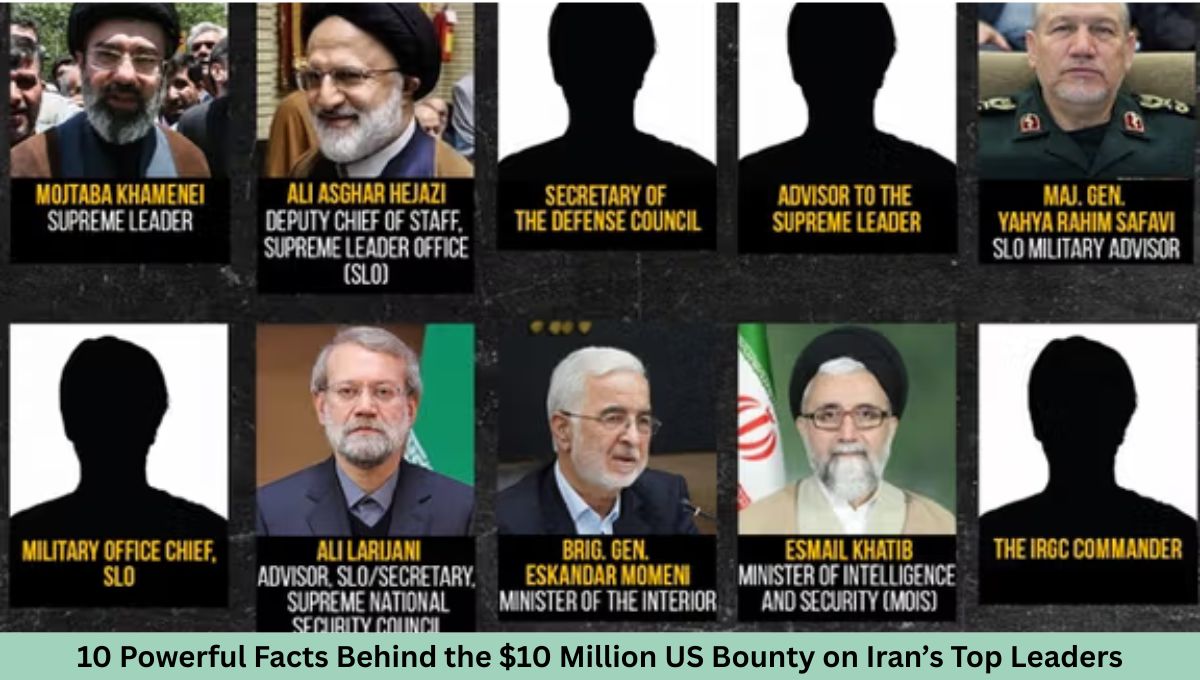
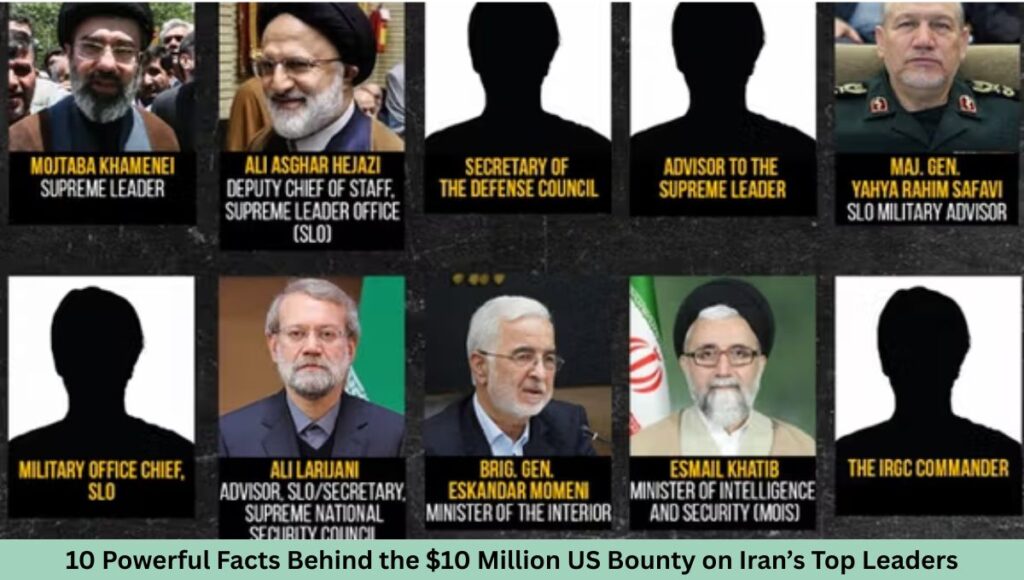
Among those named in the reward list are:
- Ali Asghar Hejazi
- Ali Larijani
- Yahya Rahim Safavi
- Eskandar Momeni
- Esmail Khatib
US officials believe these individuals collectively oversee the strategic planning and operational command of the IRGC.
4. The Reward Program Encourages Tips Through Encrypted Channels
To protect potential informants, the Rewards for Justice program has urged tipsters to submit information through secure communication platforms.
These include:
- Tor-based anonymous websites
- Encrypted messaging services such as Signal
According to the State Department, individuals providing credible information could qualify for both financial rewards and relocation assistance.
This approach is designed to encourage insiders within Iran’s security networks to provide intelligence without exposing themselves to immediate risk.
5. Four Iranian Leadership Positions Are Listed Without Names
In an unusual move, the United States also included four leadership positions without identifying the individuals currently holding them.
These include:
- Commander-in-Chief of the IRGC
- Secretary of the Supreme Defence Council
- Head of the Supreme Leader’s Military Office
- Special Adviser to the Supreme Leader
The State Department says it is offering rewards for information identifying who currently occupies these posts and where they are located.
The move suggests that recent military strikes may have disrupted Iran’s leadership structure, leaving some roles filled by individuals whose identities remain unclear to Western intelligence agencies.
6. The IRGC Is at the Center of the Dispute
The United States has long accused the IRGC of planning and supporting militant operations across the Middle East.
The organization was created after the 1979 Iranian Revolution and is tasked with protecting the country’s Islamic political system.
Washington has designated the IRGC as a foreign terrorist organization, accusing it of involvement in attacks against US personnel and allies.
Iran strongly denies these accusations, arguing that the IRGC is a legitimate branch of its national military.
7. The Announcement Comes Amid a Major Military Campaign
The reward announcement comes during one of the most intense military confrontations between the United States and Iran in decades.
US forces and their Israeli allies have conducted a large-scale air campaign targeting Iranian military infrastructure.
According to US Defence Secretary Pete Hegseth, the operation has struck more than 15,000 targets since it began.
The campaign has targeted:
- missile launch sites
- drone bases
- military depots
- command centers
US officials say the strikes have significantly weakened Iran’s ability to conduct missile and drone attacks.
8. The Conflict Began With a Massive Strike on Iran’s Leadership
The current war escalated dramatically after US and Israeli forces launched a major military operation that killed several senior Iranian officials.
Among those reportedly killed was former Supreme Leader Ali Khamenei. The strike marked one of the most significant leadership losses in Iran’s modern history.
It triggered widespread retaliation, including missile and drone attacks across the region.
9. The Strait of Hormuz Crisis Has Shaken Global Energy Markets
The conflict has also had major economic consequences.
Iran’s Revolutionary Guards have effectively disrupted shipping through the Strait of Hormuz, one of the world’s most important maritime routes.
About 20 percent of global oil shipments normally pass through this narrow waterway.
The disruption has already pushed oil prices above $100 per barrel and raised concerns about a prolonged global energy crisis.
Countries heavily dependent on imported oil are closely monitoring developments in the region.
10. Washington Says the Goal Is to Target Iran’s Decision-Making Network
According to US officials, the bounty program is designed to gather intelligence about the leadership system directing Iran’s regional operations.
Rather than focusing only on battlefield commanders, the reward targets the decision-making ecosystem surrounding the Supreme Leader’s office.
Officials say this network coordinates Iran’s relationships with proxy groups and oversees the country’s broader strategic policies.
By offering rewards for intelligence, Washington hopes to gain insights into how the leadership network functions and where key figures are located.
Trump Signals Even Stronger Military Action
The reward announcement came shortly after comments from US President Donald Trump, who suggested that the military campaign against Iran could intensify.
In an interview, Trump said American forces would hit Iranian targets “very hard” in the coming days.
“We’re going to be hitting them very hard over the next week,” he said.
Trump also suggested that Iran’s political leadership could eventually be overthrown by internal opposition.
Reports Claim Mojtaba Khamenei May Have Been Injured
Another factor fueling interest in the bounty announcement is the uncertainty surrounding the health of Iran’s new leader.
US officials say Mojtaba Khamenei may have been wounded during the initial strikes that killed his father.
According to Defense Secretary Hegseth, the younger Khamenei could even be “disfigured” as a result of the attack.
Iranian officials acknowledge that he was injured but insist that the wounds are minor and do not affect his ability to govern.
Since assuming power, Mojtaba Khamenei has not appeared publicly in video form, though he has issued written statements.
Iran Rejects US Accusations
Iranian authorities have strongly rejected the US allegations regarding the IRGC.
Officials argue that Washington uses terrorism accusations as a political tool to justify sanctions and military pressure.
Tehran insists that its security forces operate strictly in defense of national sovereignty and regional allies.
Iran has also accused the United States of conducting illegal attacks on its territory and destabilizing the region.
Rising Risks of a Wider Middle East War
Analysts warn that the escalating confrontation could expand beyond Iran.
Several regional actors have already become involved through missile strikes, drone attacks, and proxy warfare.
Military experts say the deployment of additional US forces to the region suggests that Washington is preparing for a prolonged conflict.
At the same time, Iran has threatened retaliation against US bases and allied infrastructure in the Gulf.
Information Warfare Is Also Intensifying
Alongside the military conflict, the crisis has sparked a fierce battle in the information space. Both sides are using media messaging and intelligence leaks to shape international opinion.
The bounty announcement itself may serve multiple purposes:
- encouraging defections
- gathering intelligence
- signaling pressure on Iran’s leadership
Such strategies have become common in modern geopolitical conflicts.
What the Bounty Means for Global Politics
The US decision to place a monetary reward on Iran’s top leadership figures is an unusually direct form of pressure.
While similar programs have targeted militant leaders in the past, applying them to senior state officials marks a significant escalation.
Experts say the move could further strain relations between Washington and Tehran while increasing tensions across the Middle East.
At the same time, it highlights the growing importance of intelligence gathering in modern warfare.
Conclusion: A New Phase in the US-Iran Confrontation
The $10 million bounty on Iran’s leadership represents one of the most dramatic political moves in the ongoing conflict.
By targeting figures at the very top of Iran’s power structure, Washington is signaling that it intends to challenge not only the country’s military capabilities but also its leadership network.
Whether the strategy will produce meaningful intelligence remains uncertain.
But one thing is clear:
the confrontation between the United States and Iran has entered a new and potentially more dangerous phase.
As military operations continue and geopolitical tensions rise, the stakes for regional stability — and for global security — remain extremely high.
Also Read: 27 Powerful Assassinations: How Israel’s Strikes Decimated Iran’s Top Leadership
Related Posts:
- 10 Explosive Facts About Mojtaba Khamenei’s Rise as…
- 10 Explosive Facts About Mojtaba Khamenei’s Rise as…
- 7 Explosive Shifts: Mojtaba Khamenei Named Iran’s…
- Trump Doubles Maduro Bounty to $50 Million Amid Drug…

- 10 Explosive Signals Trump Says Iran War Could End…
- 7 Explosive Hours That Shook Iran: Tehran Hit as…