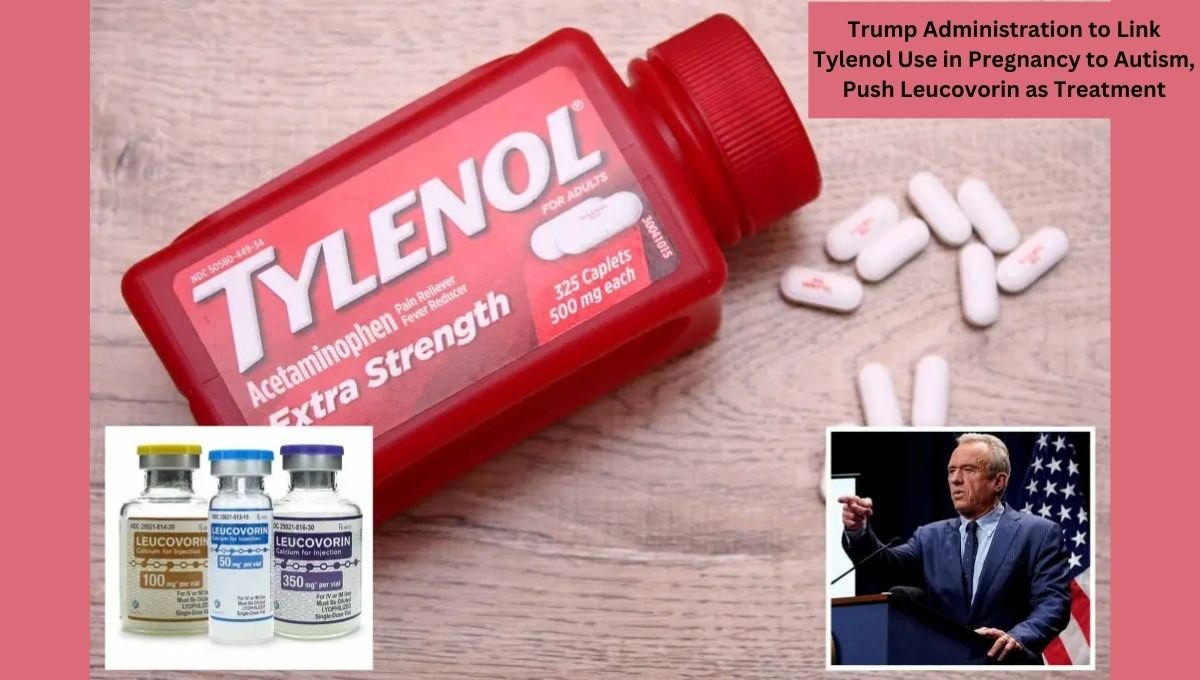
Despite medical groups calling the science inconclusive, Trump Administration to Link Tylenol Use in Pregnancy to Autism, Push Leucovorin as Treatment. The Trump administration is preparing to announce a controversial new health policy: linking the use of Tylenol (acetaminophen, also known globally as paracetamol) during pregnancy to a potential increased risk of autism in children.
According to reports from The Washington Post, Politico, and The Wall Street Journal, the administration is expected to warn pregnant women against using Tylenol unless treating a fever. At the same time, the White House will promote leucovorin — a drug normally used in cancer care — as a possible treatment for autism spectrum disorder (ASD).
The decision has sparked intense debate in the medical community. Major professional groups, including the American College of Obstetricians and Gynecologists (ACOG) and the Society for Maternal-Fetal Medicine (SMFM), continue to maintain that acetaminophen is safe during pregnancy when taken as directed.
Trump Administration to Link Tylenol Use in Pregnancy to Autism, Push Leucovorin as Treatment
Trump Previews “Most Important” Announcement
President Donald Trump teased the coming announcement during the September 21 memorial service for conservative activist Charlie Kirk in Glendale, Arizona.
“We think we found an answer to autism,” Trump said. “There’s obviously something really wrong, and we think we know what that is.”
He added that his administration would hold “one of the most important news conferences” of his presidency on Monday, September 22, alongside Health Secretary Robert F. Kennedy Jr. and CMS Administrator Dr. Mehmet Oz.
Trump framed the announcement as part of a historic effort to tackle America’s autism rates, declaring:
“We won’t let it happen anymore.”
What the Administration Plans to Announce
Warning Against Tylenol Use in Pregnancy
According to administration officials cited by Politico, pregnant women will be advised to avoid Tylenol unless they are treating high fevers.
- Tylenol is among the most widely used medications during pregnancy worldwide.
- Current medical guidelines — in the U.S. and internationally — say acetaminophen is safe when taken as directed.
- Ibuprofen and other pain relievers are already discouraged after 20 weeks of pregnancy, leaving Tylenol as the most common option.
The administration’s warning directly challenges decades of public health recommendations and could reshape pregnancy care.
Leucovorin as a Potential Treatment
In addition, the Trump administration plans to highlight leucovorin, a form of folinic acid.
- Traditionally, leucovorin is used in cancer treatment to reduce harmful drug side effects.
- Preliminary studies suggest it may help improve speech and comprehension in some autistic children.
- Advocates within the administration, including Robert F. Kennedy Jr., argue leucovorin may represent a breakthrough therapy.
However, experts caution the research is early-stage and far from conclusive.
Kenvue Pushes Back
Kenvue, the maker of Tylenol, issued a strong rebuttal on September 21, stressing that there is no credible evidence linking acetaminophen to autism.
“We strongly disagree with any suggestion otherwise and are deeply concerned with the health risk this poses for expecting mothers,” the company said.
Kenvue emphasized:
- More than a decade of rigorous research has confirmed acetaminophen’s safety in pregnancy.
- Studies endorsed by leading medical professionals and regulators worldwide have found no causal link to autism.
- Without acetaminophen, pregnant women may face dangerous alternatives — including untreated fever, which itself can threaten both mother and baby.
What the Courts Have Said
The courts have also weighed in.
- In 2023, U.S. District Judge Denise Cote rejected scientific evidence presented in 400 lawsuits claiming Tylenol caused autism when used during pregnancy.
- She found the plaintiffs relied on flawed science, concluding no credible causal link had been established.
Subsequent research has largely supported this position:
- A 2024 Swedish sibling study analyzing 2.5 million births found no increased autism risk associated with prenatal acetaminophen use.
- A 2024 JAMA study similarly found no elevated risk of autism, ADHD, or other neurodevelopmental disorders.
Still, an August 2024 meta-analysis in BMC Environmental Health reported “strong evidence of an association” — though researchers stressed that association does not prove causation.
Expert Reactions
Many health experts warn the administration’s planned announcement could cause unnecessary panic among pregnant women.
- Dr. Christopher Zahn, chief of clinical practice at ACOG:
“There is no clear evidence that proves a direct relationship between prudent acetaminophen use during pregnancy and fetal developmental issues.”
- SMFM President Sindhu K. Srinivas:
“At this time, the weight of scientific evidence that acetaminophen use during pregnancy causes an increased risk for autism or ADHD is simply inconclusive.”
- Dr. Peter Hotez, pediatrician at Texas Children’s Hospital:
“To focus an entire press conference just on Tylenol would be reckless without additional information.”
Hotez, who has a daughter with autism, warned against simplifying autism’s complex causes:
“It would be like saying only one thing causes cancer and now there’s a cure.”
RFK Jr. and the Autism Controversy
The role of Health Secretary Robert F. Kennedy Jr. is central to the unfolding debate.
- Kennedy has long promoted the debunked theory linking vaccines to autism.
- In April, he pledged that his agency would find answers about autism by September.
- In late August, he suggested his review had identified environmental interventions “almost certainly causing autism.”
Trump has backed him, telling Kennedy in a Cabinet meeting:
“There has to be something artificial causing this, meaning, a drug or something.”
The planned announcement is the culmination of those promises.
Autism in America: Rising Numbers, Rising Debate
Autism diagnoses have increased dramatically in the U.S.
- According to the CDC, 1 in 31 children were diagnosed with autism by age 8 in 2022.
- That is up from 1 in 36 in 2020, and five times higher than in 2000.
- Among boys, the rate is even higher — 1 in 20.
Experts attribute the rise primarily to:
- Broader diagnostic criteria since 2013.
- Better screening and earlier identification.
- Greater acceptance and willingness among families to seek diagnosis.
Also Read: Trump Issues Tylenol Warning: Autism Causes, Cuba Claim, and the Vaccine Debate
Charlie Kirk’s Autism Comments Resurface
Trump previewed his autism announcement at the Charlie Kirk memorial service. Kirk, assassinated earlier this month, had spoken compassionately about autism during a student Q&A.
- When a student mentioned being autistic, Kirk responded:
“Do not allow a diagnosis to become a label. Don’t look at what they call autism to be only a negative, it can also be a superpower.”
- He praised autistic individuals within Turning Point USA as “some of the most successful and best team members.”
Kirk’s words have resurfaced on social media, offering a sharp contrast to the administration’s policy-driven framing.
The NIH and “Gold Standard Science”
Amid political controversy, the National Institutes of Health (NIH) is moving forward with its own autism research initiative.
- On September 22, NIH will announce grants for 13 research teams to study autism causes and treatments.
- NIH officials have stressed the process is being led by career scientists, not political appointees.
- The initiative aims to deepen understanding of autism’s genetic and environmental factors.
The White House says this reflects Trump’s promise to tackle autism with “Gold Standard Science.”
Balancing Risks: Pain, Fever, and Pregnancy
Health experts warn that discouraging acetaminophen could have serious unintended consequences.
- Untreated fever during pregnancy can increase risks of miscarriage, birth defects, and high blood pressure.
- Alternatives like NSAIDs (ibuprofen, naproxen) are riskier later in pregnancy.
- Many doctors still consider acetaminophen the safest option available.
Without clear evidence of harm, experts say a broad warning risks leaving pregnant women without safe pain relief.
Conclusion: A Defining Health Debate
The Trump administration’s plan to link Tylenol to autism represents one of the most sweeping public health shifts in decades — if announced as expected.
Supporters believe it shows Trump and RFK Jr. are finally addressing America’s “autism epidemic.” Critics warn it risks politicizing science, undermining trust in medicine, and frightening pregnant women without solid evidence.
As the nation awaits Trump’s September 22 press conference, one thing is clear: this announcement could reshape the conversation around autism, pregnancy care, and public trust in science for years to come.
Related Posts:
- Donald Trump Urges Pregnant Women to Avoid Tylenol…

- Trump Issues Tylenol Warning: Autism Causes, Cuba…
- Joe Biden’s Aggressive Prostate Cancer Diagnosis…

- Donald Trump, Barack Obama React as Joe Biden…

- 9 Explosive Revelations as Trump Declares His Health…

- Murdoch vs. Trump: A Media Feud with Press Freedom…
