
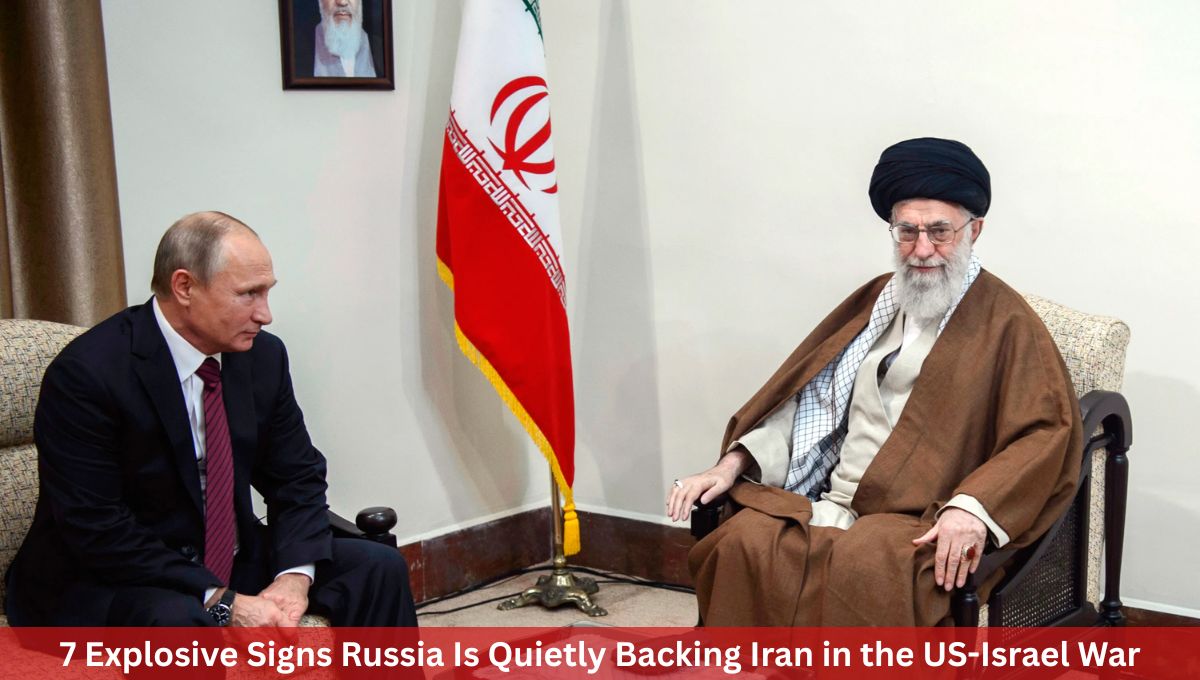
7 Explosive Signs Russia Is Quietly Backing Iran in the US-Israel War — reshaping global power alignments. The war involving the United States, Israel, and Iran is rapidly evolving into one of the most consequential geopolitical crises of the decade. What began as a regional military confrontation is increasingly drawing in global powers, raising fears that the conflict could transform into a wider international standoff.
Recent intelligence reports suggest that Russia may already be playing a role behind the scenes. According to multiple Western media outlets citing US intelligence sources, Moscow has been sharing sensitive information with Tehran that could help Iranian forces identify and target American military assets across the Middle East.
While US officials have publicly downplayed the significance of the reports, analysts warn that even indirect involvement from a major power like Russia could dramatically alter the strategic dynamics of the war.
The alleged intelligence cooperation highlights deepening geopolitical alignments between Russia and Iran — alliances forged during the Ukraine war but now extending into the volatile Middle East battlefield.
Below are seven major developments indicating how Russia may be quietly backing Iran in its confrontation with the US-Israel alliance.
7 Explosive Signs Russia Is Quietly Backing Iran in the US-Israel War
The most significant revelation comes from reports citing US intelligence officials who say Russia has provided Iran with information about American military assets in the region.
According to these officials, Moscow may have supplied data identifying the locations and movements of US warships, aircraft, and military bases across the Persian Gulf and surrounding areas.
The intelligence reportedly includes satellite imagery and surveillance data generated from Russia’s sophisticated network of military satellites.
Such information could allow Iranian commanders to more accurately target American assets during retaliatory attacks.
US officials say there is currently no evidence that Russia is directing Iranian strikes or coordinating military operations.
However, simply sharing targeting intelligence could significantly enhance Iran’s battlefield awareness.
For Iran, which has limited space-based reconnaissance capabilities of its own, access to Russian intelligence could be a strategic game-changer.
2. Iran’s Precision Strikes Raise Questions About External Support
Analysts began questioning whether Iran was receiving external assistance after a series of unusually precise attacks against Western military infrastructure.
According to defense experts, recent Iranian drone and missile strikes have targeted early-warning radar systems, command centers, and critical military installations with surprising accuracy.
Military analyst Dara Massicot noted that these attacks appeared highly coordinated. Iranian forces, she said, were striking key nodes in the military command network rather than randomly launching missiles.
Iran does possess ballistic missiles and drone technology, but its ability to detect and track moving targets like warships or aircraft carriers has historically been limited.
That gap may now be filled by intelligence from external partners. If Russian satellite reconnaissance is being shared with Tehran, it could explain the sudden increase in the precision of Iranian strikes.
3. A Deadly Drone Attack on US Forces Raises Alarm
The risks of such intelligence cooperation became evident after a deadly drone strike targeting American forces in Kuwait.
According to reports, an Iranian drone successfully struck a command facility at Port Shuaiba, killing six US service members and injuring 18 others.
The attack managed to bypass regional air defense systems before hitting the base.
While investigators have not publicly linked the strike to Russian intelligence assistance, the incident has intensified concerns within the Pentagon.
If Iran is gaining improved targeting information through Russian sources, attacks against US forces in the region could become more frequent and more lethal.
Such developments could push Washington toward escalating military responses, potentially widening the conflict.
4. Washington Downplays Russia’s Role
Despite the seriousness of the reports, the US government has attempted to publicly downplay Russia’s alleged involvement.
White House officials have insisted that any intelligence sharing between Moscow and Tehran has not significantly affected US military operations.
Officials claim American forces are still achieving their strategic objectives in the campaign against Iran.
According to White House statements, the United States has already inflicted major damage on Iran’s naval fleet, missile capabilities, and military infrastructure.
US Defense Secretary Pete Hegseth has also suggested that Russia and China are “not really a factor” in the war.
American officials say the US military is closely monitoring communications between Russia and Iran and adjusting operational plans accordingly.
However, analysts say such public reassurances may partly be aimed at preventing panic or speculation about the conflict expanding into a global confrontation.
5. Russia and Iran’s Strategic Partnership Has Deepened
Even before the current war, Russia and Iran had been steadily strengthening their military partnership.
The two countries developed closer ties during the Ukraine war, where Iran provided Russia with drones and missile technology.
Iran’s Shahed drones have played a major role in Russia’s battlefield strategy against Ukraine, particularly in attacks on Ukrainian infrastructure.
In return, Tehran has reportedly sought Russian assistance in areas including missile development, air defense systems, and nuclear technology.
This evolving partnership has effectively created a new geopolitical axis linking Moscow and Tehran. Now, the Middle East conflict may be further solidifying that alliance.
If Russia is indeed providing intelligence to Iran, it would represent a continuation of the reciprocal military support both nations have provided each other over recent years.
6. China May Be Considering Financial Support for Iran
While Russia appears to be offering intelligence support, China’s role in the conflict remains more cautious.
According to US intelligence cited in media reports, Beijing may be considering providing financial assistance to Iran, along with spare parts and missile components.
China relies heavily on Middle Eastern energy supplies, particularly oil from Iran. A prolonged war in the region could disrupt global oil flows and threaten Chinese economic stability.
For this reason, Chinese officials have publicly called for an immediate ceasefire and diplomatic resolution.
However, analysts say China may still quietly support Iran in limited ways if doing so helps stabilize energy supplies or counterbalance US influence in the region.
China’s involvement, even if indirect, would further complicate the geopolitical dynamics of the war.
7. The War Is Rapidly Becoming a Global Power Contest
The US-Israel-Iran war is increasingly reflecting broader geopolitical rivalries.
The United States and its allies are confronting a network of states that includes Iran, Russia, and potentially China.
Although these countries are not formally allied in a military bloc, their strategic interests often align against Western influence.
The current conflict is therefore becoming more than just a regional struggle. It is also part of a larger contest between competing global power centers.
Russia benefits economically from the crisis, as disruptions in global energy markets drive up demand for Russian oil and gas exports.
Meanwhile, Iran gains political support and potentially military assistance from partners that share its opposition to US dominance in global affairs.
These overlapping interests are creating a complex geopolitical landscape where local conflicts can quickly draw in major world powers.
Trump’s Demand for Iran’s “Unconditional Surrender”
Amid the escalating conflict, US President Donald Trump has taken an aggressive stance toward Iran.
Trump recently declared that the only acceptable outcome of the war would be Iran’s “unconditional surrender.”
In a message posted on his Truth Social platform, Trump wrote that there would be no negotiations with Tehran unless it completely capitulated.
The US president also suggested that after surrendering, Iran could be rebuilt economically with assistance from the United States and its allies.
Trump even introduced a new slogan — “Make Iran Great Again,” echoing his well-known political brand.
The statement signals that Washington is seeking not merely a military victory but a fundamental transformation of Iran’s political and military posture.
Kremlin Responds Carefully to Allegations
Russia has neither confirmed nor denied the reports about intelligence sharing with Iran.
Kremlin officials have acknowledged ongoing dialogue with Iranian leaders but have avoided commenting directly on military cooperation.
Russian spokesperson Dmitry Peskov stated that Moscow remains in contact with Tehran and will continue diplomatic discussions.
However, he declined to answer questions about whether Russia had provided intelligence or military assistance since the war began.
Russia has strongly criticized the US-Israeli strikes on Iran, calling them acts of aggression that risk destabilizing the region. Moscow has also urged all parties to return to diplomatic negotiations.
Despite this rhetoric, Western analysts believe Russia may still see strategic advantages in supporting Iran indirectly.
Ukraine’s Experience With Iranian Drones Now Valuable
Interestingly, the conflict has also drawn in Ukraine in an unexpected way. Ukraine has offered to help Middle Eastern partners defend against Iranian drone attacks.
Ukrainian cities have been targeted by Iranian-designed Shahed drones used by Russia during the war in Ukraine.
As a result, Ukrainian forces have gained extensive experience in detecting and intercepting these drones.
Ukrainian officials say they are willing to share that expertise with countries facing similar threats from Iranian drone technology.
This development underscores how interconnected modern conflicts have become. Weapons and tactics developed in one war are increasingly shaping strategies in others.
Fears of a Wider Regional War
The war between the United States, Israel, and Iran has already triggered military activity across the Middle East.
Iranian missile and drone attacks have targeted locations across the Persian Gulf, while Israel has conducted strikes against Iranian and Hezbollah targets.
Regional governments fear that the conflict could spread to neighboring countries or disrupt global shipping routes through the Strait of Hormuz.
The involvement of global powers such as Russia and potentially China raises additional concerns that the war could escalate beyond the region.
For now, Washington insists the situation remains under control. But analysts warn that even limited external support for Iran could complicate the battlefield and prolong the conflict.
The Global Stakes of the Iran War
The outcome of the war will likely have far-reaching consequences for global geopolitics.
If Iran’s military capabilities are significantly weakened, it could reshape power balances across the Middle East.
However, if Tehran manages to withstand the US-Israel campaign with support from external partners, it could strengthen anti-Western alliances.
Russia’s alleged intelligence support, China’s potential economic backing, and North Korea’s military signaling all suggest that the conflict is unfolding within a larger geopolitical struggle.
The coming weeks will determine whether the war remains a regional crisis — or evolves into a broader confrontation involving the world’s major powers.
For now, the situation remains volatile, and the risk of further escalation continues to loom over the Middle East and the global order.
Also Read: Dead Hand Explained: 21 Terrifying Truths About Russia’s Doomsday Nuclear System
Also Read: In Iran’s War, Russia Serves as Backstage Partner
Related Posts:
- 3 Explosive Conditions Iran Sets to End War with US…
- 10 Powerful Revelations from the Trump–Putin Call on…

- 10 Explosive Signals Trump Says Iran War Could End…
- 10 Explosive Signals: Trump Rates Iran War “15/10”…
- 12 Explosive Claims as Donald Trump Says Iran War…
- 10 Explosive Strikes: Israel Bombs Tehran Oil Depots…
