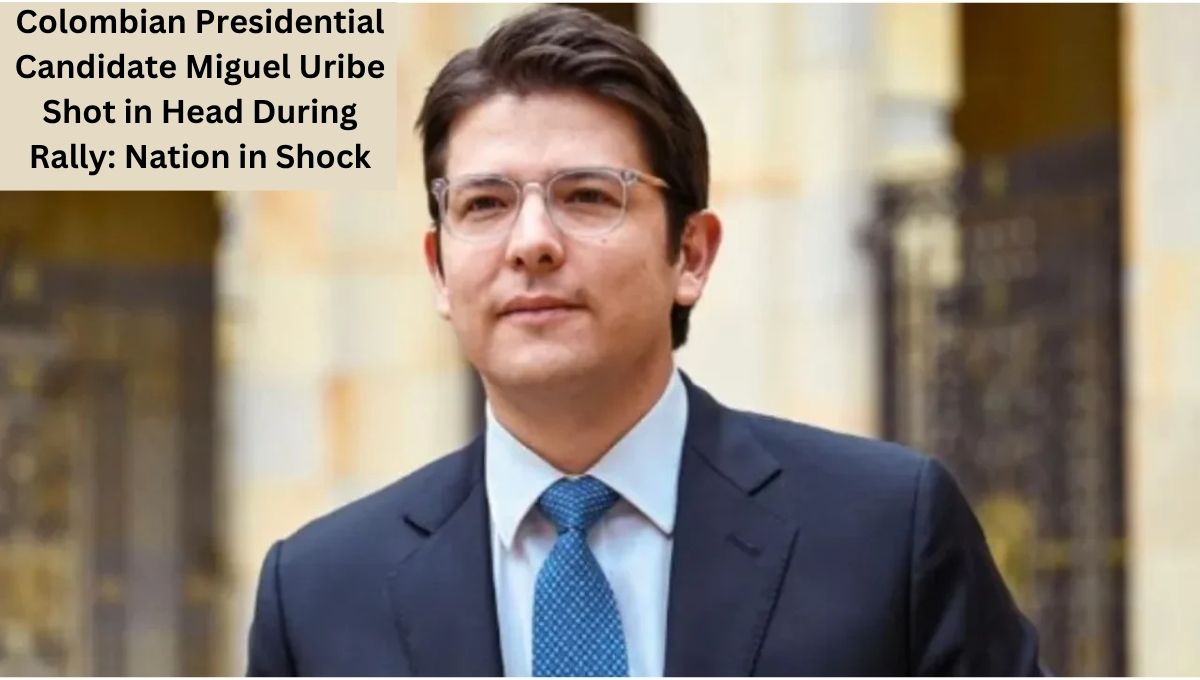
In a most shocking incident, during a rally in Bogotá, Colombian Presidential Candidate Miguel Uribe Shot in Head During Rally: Nation in Shock. A wave of shock and concern swept across Colombia on Saturday as Senator Miguel Uribe Turbay, a leading presidential hopeful, was shot during a public campaign event in Bogotá’s Fontibón district.
The 39-year-old opposition politician was reportedly shot three times twice in the head and once in the knee and is currently fighting for his life in intensive care at the Fundación Santa Fe de Bogotá Clinic. The violent attack has not only reignited painful memories of Colombia’s dark past of political assassinations but also stirred fears of growing instability ahead of the 2026 presidential elections.
Colombian Presidential Candidate Miguel Uribe Shot in Head During Rally: Nation in Shock
The Attack: Caught on Camera
The shocking incident occurred while Uribe was speaking to a small crowd in a local park. Phone footage circulating online captured the horrifying moment gunshots rang out, causing the crowd to scatter as Uribe collapsed, blood covering his head and back.
Emergency responders were seen rushing the senator to an ambulance as panic unfolded at the scene. Authorities confirmed the arrest of a 15-year-old suspect armed with a Glock pistol.
Colombian Defense Minister Pedro Sánchez stated that officials are actively investigating possible accomplices and “intellectual authors” behind the assassination attempt. A $730,000 reward has been announced for any information leading to additional suspects.
Miguel Uribe: A Rising Star in Colombian Politics
Miguel Uribe Turbay is not just any politician. He is a Harvard-educated senator, widely seen as a leading figure in Colombia’s conservative opposition.
Uribe represents the Centro Democrático party, founded by former President Álvaro Uribe (to whom he is not related), and has been vocal in his criticism of leftist President Gustavo Petro.
He is known for promoting law and order, economic stability, and foreign investment stances that have resonated with Colombia’s business community and conservative voters.
Uribe garnered the highest Senate vote count in the 2022 elections, cementing his position as a formidable contender in the upcoming 2026 presidential race.
A Legacy of Tragedy and Resilience
Uribe’s personal history is steeped in Colombia’s turbulent past. His mother, Diana Turbay, was a respected journalist and daughter of former President Julio César Turbay Ayala. In 1990, she was kidnapped by operatives of Pablo Escobar’s Medellín Cartel while on assignment.
After nearly five months in captivity, she died in a botched rescue operation in 1991 a tragedy that deeply marked her son’s life.
In a poignant moment last year, Uribe launched his presidential bid at the very location where his mother was killed. “I could have grown up seeking revenge,” he said at the time. “But I decided to do the right thing: forgive, but never forget.”
Political Reactions and National Outcry
Reactions to the attack were swift and widespread. President Gustavo Petro condemned the shooting, stating that it was “not just an attack on a man, but on democracy itself.”
In a televised address, Petro vowed to “hunt down the masterminds, whether they are in Colombia or abroad,” and criticized criminal organizations for exploiting minors to carry out violence.
Petro also extended solidarity to the Uribe and Turbay families: “Respect for life is the red line in our democracy.”
However, U.S. Secretary of State Marco Rubio took a more pointed stance, suggesting that Petro’s “inflammatory rhetoric” contributed to a political climate that enabled such violence. Rubio condemned the attempted assassination as a “direct threat to democracy.”
International Condemnation and Solidarity
The attack has drawn condemnation from leaders across Latin America. Chilean President Gabriel Boric stated that “there is no room or justification for violence in a democracy,” while Ecuadorian President Daniel Noboa expressed “solidarity with the Uribe family” and called for unity against intolerance.
Former Colombian presidents Álvaro Uribe Vélez, Juan Manuel Santos, Ernesto Samper, and Iván Duque also released statements decrying the violence. The Centro Democrático party labeled the attack as “an unacceptable act of violence that endangers democracy and freedom in Colombia.”
A Nation Haunted by Its Past
Colombia is no stranger to political violence. The late 1980s and early 1990s saw the assassinations of multiple presidential candidates, including Luis Carlos Galán and Carlos Pizarro, during the height of narco-terrorism.
Miguel Uribe belongs to a new generation of Colombian politicians whose lives were shaped by those tragedies. His rival, Bogotá Mayor Carlos Fernando Galán, is the son of the slain Liberal leader.
María José Pizarro, another Senate colleague, is the daughter of M-19 leader Carlos Pizarro, also assassinated while campaigning.
Uribe’s own journey marked by tragedy, elite education, and a political platform rooted in stability has made him both a symbol of resilience and a target in Colombia’s fractured political landscape.
Hope and Uncertainty
As of Sunday morning, Miguel Uribe remained in critical condition but was said to be stable after undergoing neurosurgical and vascular procedures. His wife, Maria Claudia Tarazona, issued an emotional plea on social media:
“Miguel is fighting for his life right now. Let us ask God to guide the hands of the doctors who are treating him.”
Supporters continue to hold vigil outside the hospital, lighting candles and waving Colombian flags. The attack has sparked a new national conversation about the safety of political candidates, youth involvement in crime, and the future of Colombia’s fragile democracy.
Conclusion: A Test for Colombian Democracy
The shooting of Miguel Uribe Turbay is not just a personal tragedy it is a national alarm bell. As Colombia heads toward the 2026 presidential elections, the country must reckon with the resurgence of political violence that threatens to undermine democratic values. Whether Uribe recovers to resume his campaign or not, his story will leave an indelible mark on Colombia’s modern political history a story of pain, courage, and a battle for the soul of a nation.
Also Read: Teenage shooter of Colombian presidential hopeful sentenced to seven years
Related Posts:
- 11 Explosive Revelations From Ted Cruz’s Leaked…

- Afghanistan–Pakistan War 2025: Inside the 48-Hour Ceasefire

- 5 Shocking Facts About the Racially Aggravated Rape…

- In 8 Moves, EU Targets China-Linked Refineries and…

- Trump’s 20-Point Gaza Peace Plan Gains Urgent Global…

- 7 Powerful Insights into Zohran Mamdani’s Historic…